Houthi drone attacks Yemen defense minister’s convoy in Taiz

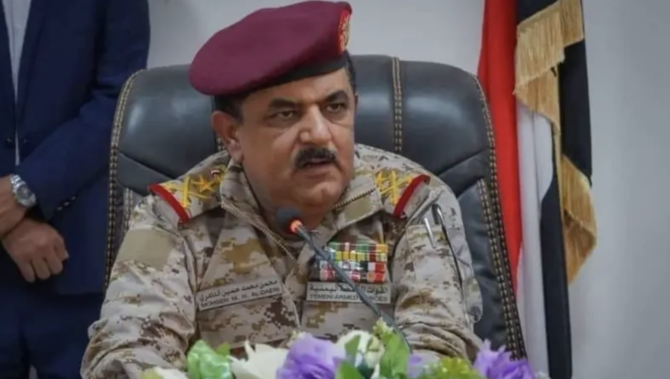
File photo of Yemeni Defense Minister Lt. Gen. Mohsen Al-Daeri. (Screenshot)
Short Url
Updated 26 March 2023
Follow

Houthi drone attacks Yemen defense minister’s convoy in Taiz

  • Muammar Al-Eryani, Yemen’s information minister, accused the Houthis of attempting to derail peace attempts

AL-MUKALLA: A Yemeni government soldier was killed and two others wounded on Saturday when an explosives-laden drone fired by Iran-backed Houthis attacked a convoy conveying senior military leaders, including Defense Minister Lt. Gen. Mohsen Al-Daeri, in the besieged city of Taiz, Yemeni officials and local media said.

A Yemeni government official told Arab News that the Houthis launched a drone at a convoy carrying the defense minister, the army’s chief of staff, and the governor of Taiz as they traveled from the Red Sea town of Mocha to Taiz. Al-Daeri and all other government officials were unhurt.

Muammar Al-Eryani, Yemen’s information minister, accused the Houthis of attempting to derail peace attempts.  

“This sinful targeting, which comes in the wake of the terrorist Houthi militia’s continuous escalation on multiple fronts, confirms its insistence on sabotaging efforts to restore the ceasefire and calm the situation,” the minister said on Twitter. 

Al-Eryani had earlier warned that large-scale military operations would resume throughout the nation if the Houthis continued their assaults on government soldiers, particularly in the central province of Marib. 

Scores of fighters have been killed or injured since early last week, when the Houthis began a series of intense assaults on government troops in the district of Hareb, south of Marib province, capturing a few villages.

Those attacks, as well as other less intense shelling and ground attacks in Taiz, have dashed hopes of a peaceful solution to the war, which had arisen following the latest successful round of prisoner-swap talks between the Houthis and the Yemeni government, which resulted in an agreement to release more than 800 prisoners during Ramadan.

Al-Eryani said Houthi raids in Hareb had resulted in the displacement of a significant number of people and posed the prospect of all-out conflict, which would put an end to the country’s relative peace since the UN-brokered ceasefire came into force in April last year.

Speaking to a group of military personnel in Taiz’s Al-Bareh on Friday, the minister pledged to defeat the Houthis, retake Sanaa and other areas currently controlled by the Iran-backed militias, and urged soldiers to remain alert.

“To reclaim every square inch of our territory, retake our capital, and restore our legitimate leadership to its proper position, we must all share the same spirit and direct our firearms against these militias,” the minister said. 

Brig. Gen. Mohammed Al-Kumaim, a Yemeni military analyst, said the Houthis have used the UN-brokered truce to regroup, and to target military officials and government-controlled areas. He suggested that the Yemeni government should abandon any agreements with the Houthis and resume military operations.

“Following this attack on the convoy of the highest military authority in the Yemeni army, the government is expected to terminate all accords, including the Stockholm Agreement, and unleash the fronts,” Al-Kumaim said.

Since October, the Yemeni government has labeled the Houthis a terrorist organization. It threatened to withdraw from the Stockholm Agreement and other agreements with the Houthis and resume military offensives when the Houthis shelled oil facilities in Hadramout and Shabwa with drones and missiles, halting Yemen’s oil exports.

Anatomy of a disaster
Two decades later, Iraqis are still paying the price for Bush's ill-judged war

Enter


keywords

Abbas reiterates opposition to displacement of Palestinians

Russian President Vladimir Putin with Palestinian President Mahmoud Abbas at the Senate Palace of the Kremlin in Moscow. (AP)
Updated 23 January 2026
Follow

Abbas reiterates opposition to displacement of Palestinians

  • During Moscow talks, president calls for immediate halt to Israeli acts of terror
  • Historically, Russia has supported and stood by the Palestinian people at political and diplomatic levels

MOSCOW: The Palestinian National Authority’s President Mahmoud Abbas has reiterated his opposition to all attempts to displace Palestinian people from their land.

Speaking with Russian President Vladimir Putin at the presidential palace in Moscow, Abbas was reported by the Kremlin’s official website as saying that “the Palestinian people are holding on to their land, and we categorically oppose attempts by the Americans and Israelis to expatriate Palestinians beyond Palestinian territory.” 
He said the Palestinian people “will not abandon their land, whatever the cost.” Abbas stressed the need to fully implement US President Donald Trump’s peace plan, leading to the withdrawal of occupation forces and the launch of the reconstruction process.
He emphasized that the Palestinian Authority would assume a central role in administering the Gaza Strip, and that the enclave and the West Bank constituted two parts of a single territorial unit, with a unified and undifferentiated system of civilian institutions.
He stressed the need for an immediate halt to “Israeli settler colonialism and Israeli acts of terror in the West Bank, including Jerusalem, along with the release of withheld Palestinian funds and the cessation of all measures that undermined the Palestinian Authority and the two-state solution.”
He reaffirmed his commitment to continue the struggle for the realization of the Palestinian people’s right to self-determination and of their right to a fully sovereign, independent state based on the borders of June 4, 1967, with East Jerusalem as its capital, while living in security and peace with neighbors.
He told Putin: “What we need is peace, and we hope that with your help and support, we can achieve it — a peace built on the basis of international legal resolutions, decisions of the United Nations, and the principles established following the wars of 1967 and 1973.
“East Jerusalem remains the capital of Palestine, and we know that Russia has always supported — indeed, was the first to support — Palestine, maintaining a firm stance in support of our people.”
Abbas thanked his Russian counterpart for Moscow’s support and commended the bilateral “bonds of friendship” between both countries. He added: “We are friends of Russia and the Russian people. For over 50 years our nations have been bound by a strong friendship that has developed over the decades and continues on the correct path. Russia is a great friend and a nation upon which we rely in many spheres.
“Historically, Russia has supported and stood by the Palestinian people at political and diplomatic levels. Your economic and financial support is both significant in scale and crucial in importance.”
Abbas emphasized moving forward with the implementation of a comprehensive national reform program aimed at consolidating the rule of law, strengthening the principles of good governance, transparency, and accountability, and ensuring the separation of powers.
Putin affirmed Moscow’s “principled and consistent approach” to the Palestinian question.
He said: “We believe that only the establishment and full functioning of the Palestinian state can lead to a lasting settlement of the Middle East conflict.”