Pakistani professionals struggle with higher costs as economy teeters 

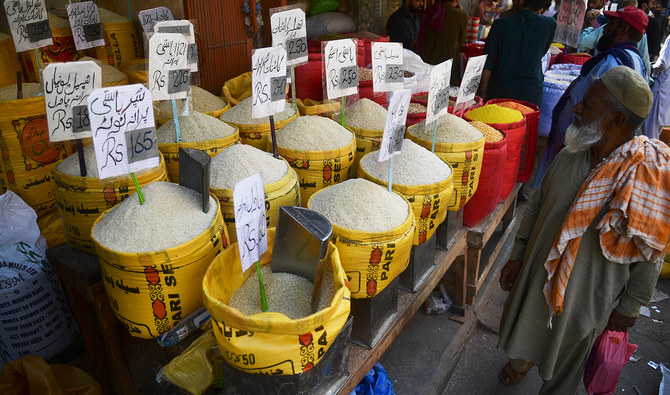
A man looks at rice prices at a market in Karachi on February 3, 2023. (AFP/FILE)
Short Url
Updated 24 March 2023
Follow

Pakistani professionals struggle with higher costs as economy teeters 

  • The minimum wage is about Rs25,000, but many who earn much more say their salaries do not last the month 
  • Economists say latest measures, which include higher taxes and fuel costs, are hurting educated professionals 

KARACHI: Naureen Ahsan earns more than twice the average wage in Pakistan, but the school administrator says she has no choice but to homeschool her daughters and delay their London-board certified final exams because she can’t afford their education. 

Like most people in the nation of 220 million, Ahsan and her husband, who owns a car servicing business, are struggling to cope with a surge in living costs triggered by the government’s devaluing the currency and removing subsidies to pave the way for the latest tranche of an International Monetary Fund (IMF) bailout needed to stave off economic collapse. 

Pakistan is no stranger to economic crises — this is its fifth IMF bailout since 1997 — but economists say the latest measures, which include higher taxes and fuel costs, are hurting educated professionals. Many say they are cutting down on necessities to make ends meet. 

“We don’t eat out any more,” Ahsan told Reuters. “We no longer buy meat, fish. I’ve cut down on tissue paper and detergent. We don’t see friends, we don’t give gifts. Occasionally, we scream at each other.” 

The government-mandated minimum wage is about 25,000 rupees, but with inflation at a record 31.5 percent in February, its highest rate in nearly 50 years, many people who earn much more than that say their salaries do not last the month. 

Abhi Salary, one of Pakistan’s biggest fintech firms, which allows its 200,000 or so subscribers to withdraw wages in advance, says transactions have increased by more than a fifth every month for the last three months. Most people spend two-thirds of the money on groceries as they rush to stock up before prices rise again, Abhi CEO Omair Ansari said. 

“Unfortunately the poor in Pakistan are left with nothing to lose,” said Abid Suleri, the Sustainable Development Policy Institute of Pakistan, an economic think tank. “Educated professionals... find their purchasing power and savings eroded, and daily consumption either unaffordable or out of reach.” 

Ramadan, which began this week, is likely to add to price pressures in Muslim-majority Pakistan. Analysts predict inflation to rise to at least 35 percent a month in March and April. 


People show their national identity cards to receive free bags of flour from a delivery truck at a distribution point ahead of the Muslim holy fasting month of Ramadan, in Lahore on March 20, 2023, following an announcement from Pakistan’s Prime Minister Shehbaz Sharif to provide free flour to the needy people during the Ramadan in the wake of country's soaring inflation. (AFP/FILE)

During the holy month, Muslims traditionally break their daylong fast with special foods and at large family gatherings, culminating in the Eid Al-Fitr festivities. This year, for many people, Ramadan means more belt tightening. 

“We’re cutting down on the number of meals and the food,” said Ahmed, a senior manager at a multinational company who declined to give his family name because he was worried about possible backlash from his employer. “It will be more difficult to buy sweets and gifts for Eid, which is a break from our family tradition.” 

The economic turmoil is driving some professionals out of the country. Khaliq, a doctor who also didn’t want to be give his full name because he was embarrassed by his financial situation, said he and his wife, who is also a doctor, work as much as they can to save up for exams to qualify them to work in Britain. 

“We think twice about eating out or using the car,” he said, adding that the weakening rupee was making the cost of their exam, which is in British pounds, higher by the day. “We plan to pass the exams and move out ASAP.” 


Multi-party summit pushes for talks between Pakistan government, opposition to ease tensions

Updated 5 sec ago
Follow

Multi-party summit pushes for talks between Pakistan government, opposition to ease tensions

  • National Dialogue Committee group organizes summit attended by prominent lawyers, politicians and journalists in Islamabad
  • Participants urge government to lift alleged ban on political activities, end politically motivated cases and release women prisoners

ISLAMABAD: Participants of a meeting featuring prominent politicians, lawyers and civil society members on Wednesday urged the government to initiate talks with former prime minister Imran Khan’s Pakistan Tehreek-e-Insaf (PTI) party, lift alleged bans on political activities and release jailed leaders of the PTI to foster reconciliation and pave the way for economic prosperity.

The summit was organized by the National Dialogue Committee (NDC), a political group formed last month by former PTI members Chaudhry Fawad Husain, ex-Sindh governor Imran Ismail and Mehmood Moulvi. The NDC has called for efforts to ease political tensions in the country and facilitate dialogue between the government and Khan’s party. 

The development takes place amid rising tensions between the PTI and Pakistan’s military and government. Khan, who remains in jail on a slew of charges he says are politically motivated, blames the military and the government for colluding to keep him away from power by rigging the 2024 general election and implicating him in false cases. Both deny his allegations. 

Since Khan was ousted in a parliamentary vote in April 2022, the PTI has complained of a widespread state crackdown, while Khan and his senior party colleagues have been embroiled in dozens of legal cases. Prime Minister Shehbaz Sharif last month reiterated his openness to talks with the PTI.

“The prime objective of the dialogue is that we want to bring the political temperatures down,” Ismail told Arab News after the conference concluded. 

“At the moment, the heat is so much that people— especially in politics— they do not want to sit across the table and discuss the pertaining issues of Pakistan which is blocking the way for investment.”

Former prime minister Shahid Khaqan Abbasi, who heads the Awaam Pakistan political party, attended the summit along with Jamaat-e-Islami senior leader Liaquat Baloch, Muttahida Quami Movement-Pakistan’s Waseem Akhtar and Haroon

Rasheed, president of the Supreme Court Bar Association. Journalists Asma Shirazi and Fahd Husain also attended the meeting. 

Members of the Pakistan Peoples Party, the ruling Pakistan Muslim League-Nawaz (PML-N) and the PTI did not attend the gathering. 

Muhammad Ali Saif, a former adviser to the Khyber Pakhtunkhwa chief minister, told participants of the meeting that Pakistan was currently in a “dysfunctional state” due to extreme political polarization.

“The tension between the PTI and the institutions, particularly the army, at the moment is the most fundamental, the most prominent and the most crucial issue,” Saif noted. 

‘CHANGED FACES’

The summit issued a joint communiqué after the meeting, proposing six specific confidence-building measures. These included lifting an alleged ban on political activities and the appointment of the leaders of opposition in Pakistan’s Senate and National Assembly. 

It also called for the immediate release of women political prisoners, such as Khan’s wife Bushra Bibi and PTI leader Yasmin Rashid, and the withdrawal of cases against supporters of political parties.

The communiqué also called for an end to media censorship and proposed that the government and opposition should “neither use the Pakistan Armed Forces for their politics nor engage in negative propaganda against them.”

Amir Khan, an overseas Pakistani businessperson, complained that frequent political changes in the country had undermined investors’ confidence.

“I came here with investment ideas, I came to know that faces have changed after a year,” Amir Khan said, referring to the frequent change in government personnel. 

The NDC plans to consult senior opposition leaders currently in prison to finalize a representative committee for talks once the government announces its own team.

“Let us create some environment. Let us bring some temperatures down and then we will do it,” Ismail said regarding a potential meeting with the jailed Khan. 

Khan’s party, on the other hand, has been calling for a “meaningful” political dialogue with the government. 

However, it has accused the government of denying PTI members meetings with Khan in the Rawalpindi prison where he remains incarcerated. 

“For dialogue to be meaningful, it is essential that these authorized representatives are allowed regular and unhindered access to Imran Khan so that any engagement accurately reflects his views and PTI’s collective position,” PTI leader Azhar Leghari told Arab News last week.