
LONDON: British and Egyptian universities have concluded a joint three-year research project on the conservation of historical and archaeological buildings and sites in Cairo.
The study conducted by Imperial College London and Cairo University looked at the management and conservation of UNESCO heritage sites in Historic Old Cairo and threats including population growth, urbanization, pollution and natural hazards.
Dr. Sharif Mourad, professor at Cairo University’s structural engineering department, and one of the principal researchers, said some of the challenges include dealing with structures that were built over 600 years ago because of the material used in construction, and the type of architectural style.

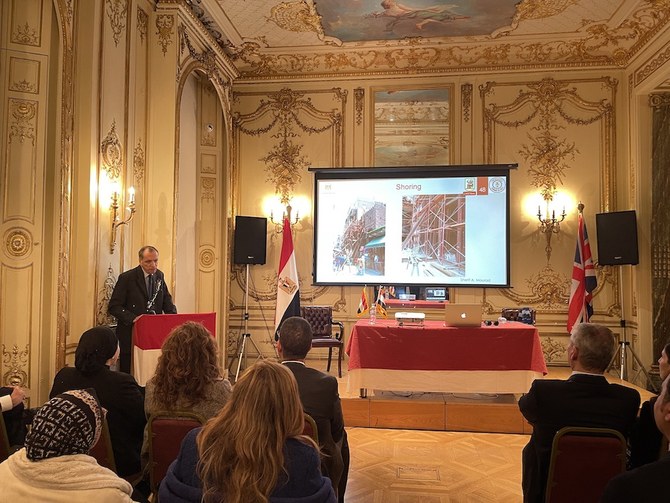
Dr. Ahmed Elghazouli, professor of structural engineering and head of structures section at Imperial College London, speaks during an event at the Egyptian Cultural Office in London. (AN Photo/Sarah Glubb)
Another challenge, he told Arab News, was “time duration,” which leads to deterioration of these ancient structures. There was also the constant threat of earthquakes, humidity and acid rain, all of which result in economic losses for the country.
“In Cairo also there is a problem with the rising of the water table — the water which is underground,” he said. He said urbanization means that people require access to water and proper sewage systems, which if not done correctly can see a rise in the water table.
Mourad, who was visiting the UK to share the results of the project, was speaking on the sidelines of an event organized by the Egyptian Cultural Office in London, under the auspices of Egypt’s ambassador to the UK Sherif Kamel. Among those in attendance were several high-level officials, diplomats, specialists, academics and archaeologists from Egypt and Britain.

The Egyptian Cultural Office in London organized the event under the auspices of Egypt’s ambassador to the UK Sherif Kamel. (Supplied)
Mourad said evaluating these structures requires a multidisciplinary team that would understand the original construction, research records for alterations, and have knowledge of their use.
He said “collaborating with an entire team is important,” including engineers, historians, architects, surveyors, materials scientists and geotechnical engineers. The aim is to “come up with some sort of compromise that everybody would accept,” particularly if a structure is badly damaged and needs urgent intervention.
Mourad stressed the need to consider several aspects before taking any measures to preserve these structures such as historical value, societal conditions, ability to intervene, and the use of new technologies versus traditional methods.

Dr. Rasha Kamal, the Egyptian cultural attache and director of the educational mission in the UK, and Dr. Ahmed Elghazouli, professor of structural engineering and head of structures section at Imperial College London. (Supplied)
During the event, he also presented case studies of assessments he carried out on several ancient buildings with a team of experts at Cairo University’s engineering faculty, including Al-Ashraf street which has many structures registered as monuments.
“There’s a lot of experimental work being done at Imperial College and there’s a lot of field work and assessments carried out on the site in Cairo,” said Dr. Ahmed Elghazouli, Imperial College London’s professor of structural engineering and head of structures, and also a principal researcher on the project.
“It is important from a scientific research point of view how we deal with these structures, and of course, they have very different materials to what we use at the moment,” said Elghazouli of the project funded by the UK’s Arts and Humanities Research Council and the Science and Technology Development Fund of the Egyptian Ministry of Higher Education and Scientific Research.

The event was attended by a number of high-level officials, diplomats, specialists and academics and archaeologists from Egypt and Britain. (AN Photo/Sarah Glubb)
He said there was a lot of work to be done on developing new ways of upgrading and assessing structures. “We want to serve the local communities in Egypt, but an important outcome of the project is to also increase the interaction and collaboration between institutions in Egypt and in the UK.
“And part of what we’re doing in this visit and also in my visit to Cairo is to try to raise awareness of the issues and the challenges and the importance of international collaboration in these areas,” Elghazouli said.

The Egyptian Cultural Office in London organized the event under the auspices of Egypt’s ambassador to the UK Sherif Kamel. (Supplied)