Brent plunge fails to displace Russian crude for Asian buyers

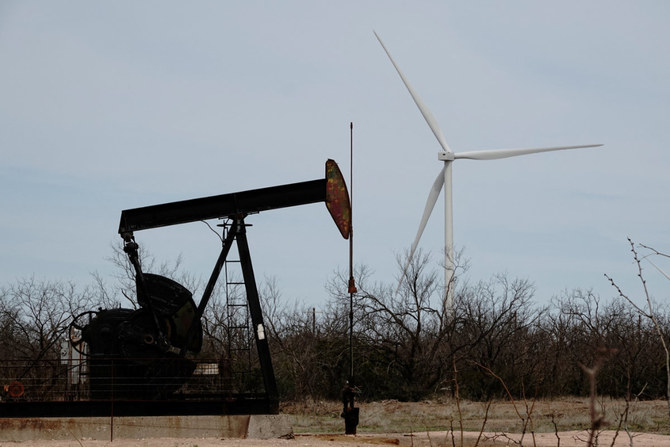
A pump jack drills oil crude from the Yates Oilfield in West Texas' Permian Basin near Iraan, Texas, on March 17, 2023. (REUTERS/Bing Guan)
Short Url
Updated 23 March 2023
Follow

Brent plunge fails to displace Russian crude for Asian buyers

  • Middle East crude prices in Asia appear to be resilient as the market bets on robust demand from China
  • With Russian crude so cheap, a move of a few dollars on Brent-Dubai EFS or even freight would not make a difference

SINGAPORE/LONDON: A plunge in Brent crude prices has narrowed the spread between Atlantic Basin and Middle East benchmarks but has failed to spur interest from Asian refiners, which are instead buying up discounted Russian oil, leaving an overhang in African supply.
Global oil benchmark Brent tumbled more than 10 percent over the past two weeks, touching a 15-month-low of $70.12 a barrel on Monday, as investors have fretted over banking sector turmoil in the US and Europe and as strikes in France have dented oil demand.
Middle East crude prices in Asia appear to be resilient as the market bets on robust demand from China, which is rebounding from zero-COVID restrictions that formerly squeezed its economy.
The Brent-Dubai Exchange for Swaps (EFS), representing the premium of light sweet Brent over Middle East sour crude Dubai, shrank to $1.40 a barrel this week, its narrowest in more than two years.
A tighter EFS typically means Brent-linked crude produced in the Atlantic Basin, including from West African countries, becomes more economical for Asian buyers.

But traders have not seen a significant uptick in Asian demand for West African crude, because the cargoes remain much more expensive than Russian oil, even though they have gained competitiveness over Middle Eastern crude.
With Russian crude so cheap, a move of a few dollars on Brent-Dubai EFS or even freight would not make a difference, other than providing Chinese buyers with a tool to drive prices lower, said a West African crude trader.
Russia’s light sweet ESPO crude for May delivery is traded at a discount of about $6.80 a barrel against the ICE Brent on the deliver-ex-ship (DES) basis to northern China, trading sources said. Meanwhile, Congo’s Djeno, a medium sweet crude favored by Chinese refiners, is assessed at a premium of $1.50 a barrel above ICE Brent for May delivery on DES basis.
The pattern is similar in India, where Russian crude is delivered at discounts to Dubai quotes while West African oil is loaded at parity or a slight discount to dated Brent, an Indian trader said.
Russia became the top crude supplier to China and India in recent months, eroding the market share of other suppliers such as West African countries.
Just over 30 million barrels of West African crude have been loaded for Asia in March, the smallest volume since 2014 or earlier, shipping data from Refinitiv and Kpler showed.
The slowing exports of West African crude are exacerbating a supply overhang in the West of Suez market and weighing down the Brent prices that the West African grades are pegged to.
On Tuesday, about 20 million barrels of Nigerian crude for April loading were still unsold, just as the trade cycle for May cargoes was about to kick off. About four April-loading Angolan crude cargoes were also awaiting buyers.
In the past three months, Nigeria has exported around 42 million barrels of crude on average each month while Angola’s average monthly exports have been around 33 million barrels.


Saudi Arabia approves over 1k chemical permits, awards 172 mining licenses 

Updated 4 sec ago
Follow

Saudi Arabia approves over 1k chemical permits, awards 172 mining licenses 

RIYADH: Saudi Arabia processed more than 1,000 chemical permit requests in November and awarded exploration rights for 172 mining sites in what the government described as its largest licensing round on record. 

The Ministry of Industry and Mineral Resources said it handled 1,095 chemical clearance requests during the month, including 1,041 approvals for non-restricted chemicals and 54 for restricted substances, covering 2,081 product classifications, the Saudi Press Agency reported. 

It forms part of ongoing efforts to accelerate the discovery and development of mineral resources valued at over SR9.4 trillion ($2.51 trillion), aligning with Vision 2030’s objective to position mining as the third pillar of the national industrial sector.   

Ministry spokesperson Jarrah Al-Jarrah explained that the chemical clearance service enables industrial investors to obtain import or export permits for chemicals used in manufacturing through the “Sanaei” digital platform.  

“He clarified that the service aims to ensure that chemical clearances for industrial facilities are granted through streamlined procedures and in a timely manner, thus serving investors and facilitating the entry of their materials through ports of entry,” the SPA report stated. 

Al-Jarrah explained that the service plays a critical role in enhancing industrial output by developing and automating permit procedures for production-related chemicals as part of the ministry’s digital services.  

In a separate development, the ministry announced that 24 domestic and international companies and consortiums won exploration licenses across 172 mining sites in Saudi Arabia, with 76 of those sites awarded through a multi-round public auction.   

These sites span three mineral belts in the Riyadh, Madinah, and Qassim regions, with committed exploration spending exceeding SR671 million during the first two years of project implementation.  

The ministry described this licensing round as the largest mining tender in the Kingdom’s history.   

The competition covered more than 24,000 sq. km across regions known for strategic minerals including gold, copper, silver, zinc, and nickel.   

Additionally, the ministry noted that 26 qualified companies participated through the electronic bidding platform, progressing through a transparent process that began with prequalification and culminated in competitive multi-round auctions.  

The ministry confirmed that these investments aim to develop untapped exploration zones and enhance the utilization of Saudi Arabia’s mineral wealth, strengthening global supply chains.   

It also announced plans to launch further exploration license tenders covering 13,000 sq. km across Madinah, Makkah, Riyadh, Qassim, and Hail, with additional opportunities to be revealed at the 5th Future Minerals Forum in Riyadh from Jan. 13 to 15.  

These efforts, the ministry stated, reflect a broader mining strategy focused on maximizing resource potential, attracting foreign investment, creating employment opportunities, and integrating value chains to establish Saudi Arabia as a global mining hub.