

Arrest of suspected suicide bomber in southwest Pakistan spotlights growing trend of women recruits

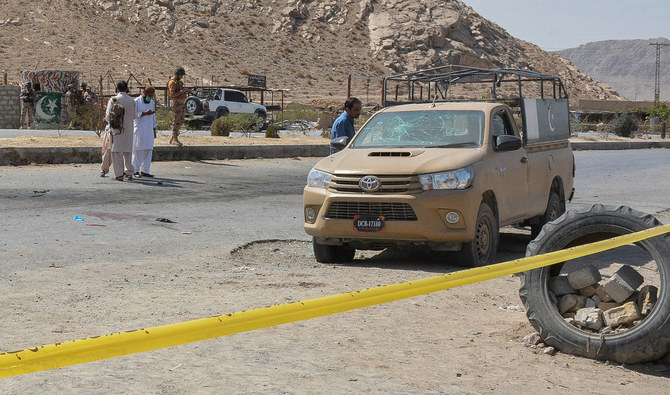
This representational photo shows security personnel examining the site of a blast after a suicide bomber on a motorbike blew himself up near a checkpoint in Pakistan's southwestern city of Quetta on September 5, 2021. (AFP/File)
Short Url
Updated 22 March 2023
Follow

Arrest of suspected suicide bomber in southwest Pakistan spotlights growing trend of women recruits

  • Mahil Baloch, suspected of links to the Balochistan Liberation Front, arrested from outside Quetta, officials say
  • Last year a highly educated female suicide bomber linked to a separatist group killed three Chinese teachers in Karachi

QUETTA: The Counter Terrorism Department (CTD) in Pakistan’s southwestern province of Balochistan said on Wednesday it had arrested a suspected female suicide bomber who was affiliated with the Baloch Liberation Front (BLF) separatist group and was planning attacks in the provincial capital of Quetta.

Mahil Baloch, who hails from the remote town of Mand in Balochistan near the Iran border, was arrested from an area on the outskirts of Quetta, bringing into the spotlight the increasing number of women who are joining the separatist insurgency in the impoverished province.

Pakistan has been hunting women recruits in militant groups since a highly educated female suicide bomber last year killed three Chinese teachers in Karachi along with their local driver, targeting nationals from Pakistan's most important partner and seeking to undermine a relationship on which Islamabad's financial survival largely depends. The Baloch National Army (BLA) claimed the attack.

The BLF and BLA are among a number of separatist groups operating against the Pakistani state in Balochistan. The groups' stated aim is complete independence for Balochistan, Pakistan's largest province by territory but the smallest in terms of population given its arid mountainous terrain and poor development indicators. The southwestern province borders Iran and Afghanistan and has seen a decades-long insurgency against what separatists call the unfair exploitation of resources in the mineral rich-region.

“The Counter Terrorism Department Balochistan along with other law enforcement agencies were tracing the terrorist groups involved in using females and children for terrorist activities in Pakistan. After a solid lead, the LEAs arrested a suspected female suicide bomber with a suicide vest,” Babar Yousafzai, a spokesman for the Balochistan chief minister, told reporters at a press conference with Aitzaz Goraya, the Deputy Inspector General (DIG) Counter Terrorism Department Balochistan.

Yousafzai said some relatives of Baloch who were working for the BLF had fled to Iran and were handling the group’s financial and other activities from there. Baloch had been living with her in-laws in Quetta since 2028 and her husband was a BLF commander.

The spokesperson said Baloch had confessed that she joined the BLF in 2022 after her husband was killed in a security operation. She had received an initial invitation on Facebook by a BLF group member. After that, a man called Sharbat Khan reached out to Baloch on the messaging app “Telegram,” and told her to receive a suicide jacket and keep it “until further directions.”

Baloch had told investigators that her family was being financially supported by the BLF separatist group.

DIG Goraya said Baloch was arrested “red-handed with an active suicide vest.” The hunt for her accomplices was ongoing.

“We have clues of the suspects in contact with Mahil Baloch through a Facebook ID and Telegram account and we are in contact with Meta [Facebook parent company] and Telegram authorities. We would proceed for further actions after getting their details,” Goraya told journalists.

Yousafzai urged militants to stop using innocent females and children for their “vicious objectives.”

“The terrorist group lured Mahil Baloch with the fake slogan of independence,” he said, “but when she was caught by security forces, the group disowned her.”


At ECO meeting, Pakistan proposes ‘Regional Innovation Hub’ to curb natural disasters

Updated 21 January 2026
Follow

At ECO meeting, Pakistan proposes ‘Regional Innovation Hub’ to curb natural disasters

  • Pakistan hosts high-level 10th ECO Ministerial Meeting on Disaster Risk Reduction in Islamabad
  • Innovation hub to focus on early warning technologies, risk informed infrastructure planning

ISLAMABAD: Pakistan has proposed to set up a “Regional Innovation Hub on Disaster Risk Reduction” that focuses on early warning technologies and risk informed infrastructure planning, the Press Information Department (PID) said on Wednesday, as Islamabad hosts a high-level meeting of the Economic Cooperation Organization (ECO).

The ECO’s 10th Ministerial Meeting on Disaster Risk Reduction (DRR) is being held from Jan. 21-22 at the headquarters of the National Disaster Management Authority (NDMA) in Pakistan’s capital. 

The high-level regional forum brings together ministers, and senior officials from ECO member states, representatives of the ECO Secretariat and regional and international partner organizations. The event is aimed to strengthen collective efforts toward enhancing disaster resilience across the ECO region, the PID said. 

“Key agenda items include regional cooperation on early warning systems, disaster risk information management, landslide hazard zoning, inclusive disaster preparedness initiatives, and Pakistan’s proposal to establish a Regional Innovation Hub on Disaster Risk Reduction, focusing on early warning technologies, satellite data utilization, and risk-informed infrastructure planning,” the statement said. 

The meeting was attended by delegations from ECO member states including Pakistan, Türkiye, Azerbaijan, Iran, Kyrgyzstan, Tajikistan, Turkmenistan and Uzbekistan. Representatives of regional and international organizations and development partners were also in attendance.

Discussions focused on enhancing regional coordination, harmonizing disaster risk reduction frameworks, and strengthening collective preparedness against transboundary and climate-induced hazards impacting the ECO region, the PID said. 

ECO members states such as Pakistan, Türkiye, Afghanistan and others have faced natural calamities such as floods and earthquakes in recent years that have killed tens of thousands of people. 

Heavy rains triggered catastrophic floods in Pakistan in 2022 and 2025 that killed thousands of people and caused damages to critical infrastructure, inflicting losses worth billions of dollars. 

Islamabad has since then called on regional countries to join hands to cooperate to avert future climate disasters and promote early warning systems to avoid calamities in future.