Afghanistan school year starts but no classes held

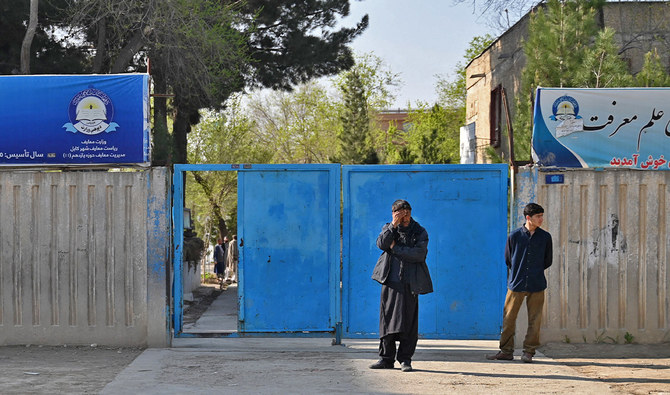
Afghan men stand at the entrance gate of a school in Kabul, Afghanistan, on March 21, 2023. (AFP)
Short Url
Updated 21 March 2023
Follow

Afghanistan school year starts but no classes held

  • Students were unaware of the start, hundreds of thousands of girls remain barred from attending class
  • Afghanistan is the only country in the world where girls are prohibited from going to secondary school

KABUL: Afghanistan’s schools reopened Tuesday for the new academic year, but no classes were held as students were unaware of the start and hundreds of thousands of teenage girls remain barred from attending class.

Afghanistan is the only country in the world where girls are prohibited from going to secondary school.

Taliban authorities have imposed an austere interpretation of Islam since storming to power in August 2021 after the withdrawal of the US-led foreign forces that backed the previous governments.

The education ministry made no public announcement of the reopening of schools, several teachers and officials told AFP.

“A letter issued by the minister of education was given to us by our principal to reopen the school today, but since no public announcement was made, no students came,” said Mohammad Osman Atayi, a teacher at the Saidal Naseri Boys High School in Kabul.

AFP journalists toured seven schools in Kabul and saw only a few teachers and primary students arriving — but no classes were held.

Schools also reopened in provinces including Herat, Kunduz, Ghazni and Badakhshan but no lessons were held there either, AFP correspondents reported.

Tuesday’s start of the new academic year coincided with Nowruz, the Persian New Year, celebrated widely in Afghanistan before the Taliban returned to power but now unacknowledged by the country’s new rulers.

Hundreds of thousands of teenage girls meanwhile remain barred from secondary school.

“The Taliban have snatched everything away from us,” said 15-year-old Sadaf Haidari, a resident of Kabul who should have started grade 11 this year.

“I am depressed and broken.”

The ban on girls’ secondary education came into effect in March last year, just hours after the education ministry reopened schools for both girls and boys.

Taliban leaders –- who have also banned women from university education –- have repeatedly claimed they will reopen secondary schools for girls once “conditions” have been met, from obtaining funding to remodelling the syllabus along Islamic lines.

The international community has made the right to education for women a key condition in negotiations over aid and recognition of the Taliban government.

No country has officially recognized the Taliban as Afghanistan’s legitimate rulers.

Afghanistan under the Taliban government is the “most repressive country in the world” for women’s rights, the United Nations has said.

Women have been effectively squeezed out of public life -– removed from most government jobs or are paid a fraction of their former salary to stay at home.

They are also barred from going to parks, fairs, gyms and public baths, and must cover up in public.


Top US defense official hails ‘model ally’ in South Korea talks

Updated 5 sec ago
Follow

Top US defense official hails ‘model ally’ in South Korea talks

SِEOUL: The Pentagon’s number three official hailed South Korea as a “model ally” as he met with local counterparts in Seoul on Monday, days after Washington’s new defense strategy called for reduced support for partners overseas.
Under Secretary of Defense for Policy Elbridge Colby arrived in South Korea on Monday and is seen as a key proponent of President Donald Trump’s “America First” foreign policy.
That policy — detailed in Washington’s 2026 National Defense Strategy (NDS) released last week — calls for the United States to prioritize deterring China and for long-standing US allies to take “primary responsibility” for their own defense.
Arriving in Seoul on his first overseas trip as the Pentagon’s number three official, Colby in a post on X called South Korea a “model ally.”
And he praised President Lee Jae Myung’s pledge to spend 3.5 percent of the country’s GDP on the military.
That decision, he told a forum, “reflects a clear-eyed and sage understanding of how to address the security environment that we all face and how to put our storied and historic alliance on sound footing for the long haul,” according to South Korea’s Yonhap News Agency.
“Such adaptation, such clear-eyed realism about the situation that we face and the need for greater balance in the sharing of burdens, will ensure that deterrence remains credible, sustainable and resilient in this changing world,” he added, according to the agency.
Colby also met Monday with South Korea’s defense and foreign ministers, who touted Seoul’s development of nuclear-powered attack submarines as proof the country was taking more responsibility for its defense.
Details remain murky on where the nuclear submarines will be built, however.
South Korea’s leader said last month it would be “extremely difficult” for them to be built outside the country.
But Trump has insisted they will be built in the United States.
Longstanding treaty allies, ties between the United States and South Korea were forged in the bloodshed of the Korean War.
Washington still stations 28,500 troops in South Korea as a deterrent against the nuclear-armed North.