IMF says was not consulted on Pakistan’s petrol subsidy plan — media

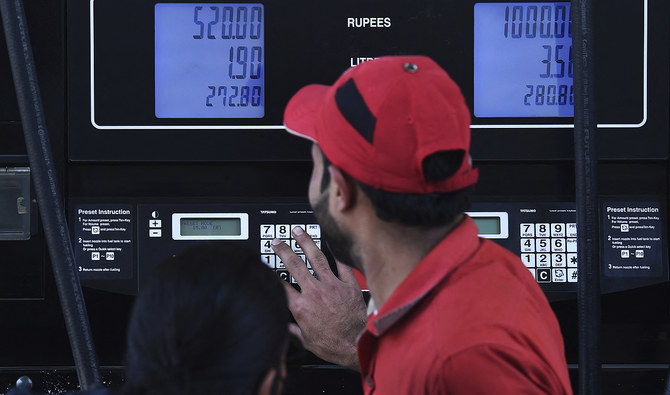
An employee of a petrol station fills the tank of a customer in Karachi on February 16, 2023. (Photo courtesy: AFP/File)
Short Url
Updated 21 March 2023
Follow

IMF says was not consulted on Pakistan’s petrol subsidy plan — media

  • Pakistan’s PM last week announced a petrol subsidy of Rs50 per liter for low-income people
  • Staff agreement to follow once “few remaining points” are closed, says IMF’s resident representative

ISLAMABAD: The International Monetary Fund’s (IMF) resident representative for Pakistan said on Monday that the Fund was not consulted on the government’s recent move to announce a fuel subsidy of Rs.50 per liter, adding that it is seeking “greater details” on the scheme, Bloomberg reported.

Pakistan has hiked taxes, shifted to a market-based exchange rate, and increased fuel prices to revive a stalled $6.5 billion IMF loan program as the prospect of default looms large over the South Asian country. As Pakistan’s currency weakened and its reserves dipped to historic lows over the past couple of months, inflation more than doubled to 31.5 percent in February this year, making it difficult for low-income Pakistanis to make ends meet.

Despite Pakistan’s efforts to seek a bailout program from the international lender, Prime Minister Shehbaz Sharif on Sunday announced a “petroleum relief package” for low-income people. The announcement of the relief package came days after the government increased the petrol price by Rs5 per liter, taking it to Rs272 per liter.

“Ruiz said the lender wasn’t consulted on the government’s plan to raise fuel prices for wealthier motorist to finance a subsidy for lower-income people,” Bloomberg said in a report.

“Fund staff are seeking greater details on the scheme in terms of its operation, cost, targeting, protections against fraud and abuse, and offsetting measures, and will carefully discuss these elements with the authorities,” Bloomberg quoted her as saying.

On the staff-level agreement, Ruiz said Islamabad had made “substantial progress” toward meeting policy commitments.

“A staff-level agreement will follow once the few remaining points are closed,” she told Bloomberg. “Ensuring there is sufficient financing to support the authorities in the implementation of their policy agenda is the paramount priority.”

Finance Minister Ishaq Dar said the IMF agreement has been delayed as the Fund wanted to see “friendly countries” finalize commitments they made to help Pakistan shore up its reserves before signing off on the bailout package.



Pakistan transporters call off five-day strike after successful talks with Punjab government

Updated 5 sec ago
Follow

Pakistan transporters call off five-day strike after successful talks with Punjab government

  • Transporters went on strike against heavy fines, penalties imposed by Punjab over traffic violations
  • Punjab government sets up committee to resolve transporters issues, confirms provincial minister

ISLAMABAD: Pakistani goods transporters called off their five-day-long nationwide strike on Friday after successful talks with the Punjab government, officials and transporters confirmed, as the business community warned of an impending economic crisis if the dispute stayed unresolved. 

Transporters went on a nationwide strike on Dec. 8 against stringent traffic rules and heavy fines imposed by the Punjab government over traffic violations. These penalties were included in the Motor Vehicle Ordinance 2025 last month. 

The ordinance details hefty fines ranging from Rs2000 [$7] to Rs50,000 [$178] and mentions prison sentences going up to six months for various offenses committed by drivers, such as driving on the wrong side of the road or driving in vehicles with tinted windows. 

“Yes, the strike has been called off after our meeting with Senior Minister of Punjab Marriyum Aurangzeb,” Nabeel Tariq, president of the All Pakistan Goods Transport Association (APGTA), told Arab News. 

Tariq said fines ranging from Rs1000 ($3.6) to Rs1500 ($5.4) for traffic violations have been increased to around Rs20,000 ($71.3) as per the new rules. 

He said the APGTA has agreed to accept a 100 percent or even 200 percent hike in fines. However, he said an increase of 2000 percent was not “logical.”

“Our urgent demands have been accepted and a committee has been formed to review the ordinance and come up with recommendations,” Tariq said. 

Speaking to Arab News, Aurangzeb confirmed the strike had been called off after talks with the Punjab government and that a committee has been formed to resolve the transporters’ issues. 

The committee will be headed by Aurangzeb and will include representatives of goods transporters, a statement issued by her office said. 

“The government wants to protect human lives and make things better for all citizens,” the statement said. “We will resolve the issues (with transporters) amicably.” 

‘UNPRECEDENTED CRISIS’

Pakistan’s business and industrial community, meanwhile, warned of an impending crisis if the disputed was not resolved. 

The All Pakistan Textile Mills Association (APTMA) and the Karachi Chamber of Commerce and Industry (KCCI) have both appealed for immediate government intervention.

Imdad Hussain Naqvi, president of the Grand Transport Alliance Pakistan (GTAP), told Arab News that over 400,000 goods carriers had been stranded across Pakistan due to the strike, affecting supplies to millions of consumers.

Earlier, in a letter to Punjab Chief Minister Maryam Nawaz, APTMA Chairman Kamran Arshad said the strike has “critically impacted import and export operations which are backbone of the country’s economy.”

He said hundreds of cargo vehicles remain stranded across Punjab, creating “abnormal delays” in goods movement and triggering heavy demurrage, detention charges, missed vessels and production shutdowns due to the non-availability of raw materials.

Arshad warned the disruption poses “a serious risk of order cancelation of export orders by international buyers, which would have far-reaching consequences for Pakistan’s foreign exchange earnings.”

Meanwhile in Pakistan’s commercial hub Karachi, KCCI President Rehan Hanif issued an even stronger warning, saying the nationwide strike threatens to paralyze Pakistan’s economic lifeline. 

“The complete suspension of cargo movement is pushing Pakistan toward an unprecedented trade and industrial crisis,” Hanif said in a statement. 

He added that import and export consignments are now stranded at the city’s ports, highways and industrial zones.