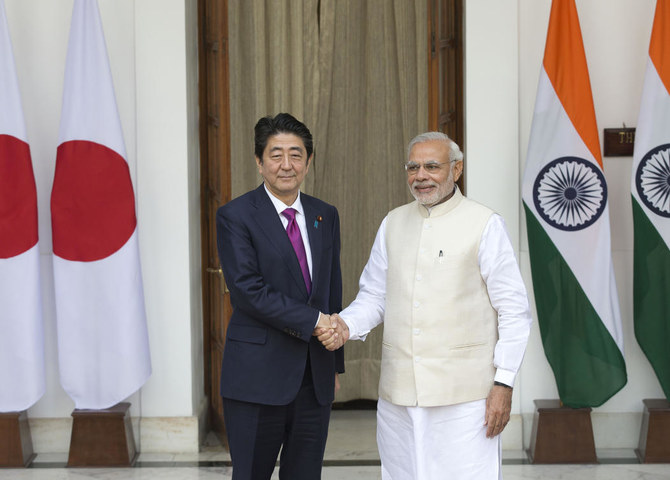
NEW DELHI: Outgoing Japanese Prime Minister Shinzo Abe and his Indian counterpart agreed on Thursday that a strong partnership between their nations will be critical in charting the course for the global community in the post-coronavirus world, an Indian official said.
Abe, who is stepping down because of a chronic health problem, and Prime Minister Narendra Modi welcomed an agreement between the armies of the two countries that will give them access to each other’s bases for supplies and services.
“They concurred that the agreement will further enhance the depth of defense cooperation between the two countries and contribute to peace and security in the Indo-Pacific region,” Indian External Affairs Ministry spokesman Anurag Srivastava said in a statement.
In a telephone call, the two leaders also reviewed the status of an India-Japan Special Strategic and Global Partnership program, including a high-speed rail project that is to link the Indian cities of Mumbai and Ahmedabad.
In December, Abe canceled a meeting with Modi in the northeastern state of Assam, where street protests erupted over a new Indian law that grants citizenship based on religion and excludes Muslims.
Abe was scheduled to travel to Assam and Manipur states to discuss security and economic ties with Modi as part of annual exchange of visits by the two leaders.

India, Japan call for strong partnership in post-COVID world
https://arab.news/8j95k
India, Japan call for strong partnership in post-COVID world
- Abe and Modi welcomed an agreement between the armies of the two countries
- The agreement will give them access to each other’s bases for supplies and services
Bangladesh says at least 287 killed during Hasina-era abductions
DHAKA: A Bangladesh commission investigating disappearances during the rule of ousted prime minister Sheikh Hasina said Monday at least 287 people were assumed to have been killed.
The commission said some corpses were believed to have been dumped in rivers, including the Buriganga in the capital, Dhaka, or buried in mass graves.
The government-appointed commission, formed after Hasina was toppled by a mass uprising in August 2024, said it had investigated 1,569 cases of abductions, with 287 of the victims presumed dead.
“We have identified a number of unmarked graves in several places where the bodies were presumably buried,” Nur Khan Liton, a commission member, told AFP.
“The commission has recommended that Bangladesh seek cooperation from forensic experts to identify the bodies and collect and preserve DNA samples from family members.”
In its final report, submitted to the government on Sunday, the commission said that security forces had acted under the command of Hasina and her top officials.
The report said many of those abducted had belonged to the country’s largest Islamist party, Jamaat-e-Islami, or the Bangladesh Nationalist Party (BNP), both in opposition to Hasina.
In a separate investigation, police in December began exhuming a mass grave in Dhaka.
The grave included at least eight victims of the uprising against Hasina, bodies all found with bullet wounds, according to Criminal Investigation Department (CID) chief Md Sibgat Ullah.
The United Nations says up to 1,400 people were killed in crackdowns as Hasina attempted to cling to power.
She was sentenced to death in absentia in November for crimes against humanity.
“We are grateful for finally being able to know where our brother is buried,” said Mohamed Nabil, whose 28-year-old sibling Sohel Rana was identified as one of the dead in the grave in Dhaka.
“But we demand a swift trial for the police officials who shot at the people during the uprising.”


