SINIYAH ISLAND, United Arab Emirates: Archaeologists said Monday they have found the oldest pearling town in the Arabian Gulf on an island off one of the northern sheikhdoms of the United Arab Emirates.
Artifacts found in this town on Siniyah Island in Umm Al-Quwain, likely once home to thousands of people and hundreds of homes, date as far back as the region’s pre-Islamic history in the late 6th century. While older pearling towns have been mentioned in historical texts, this represents the first time archaeologists say they have physically found one from this ancient era across the nations of the Arabian Gulf.
“This is the oldest example of that kind of very specifically Khaleeji pearling town,” said Timothy Power, an associate professor of archaeology at the UAE University, using a word that means “Gulf” in Arabic. “It’s the spiritual ancestor of towns like Dubai.”
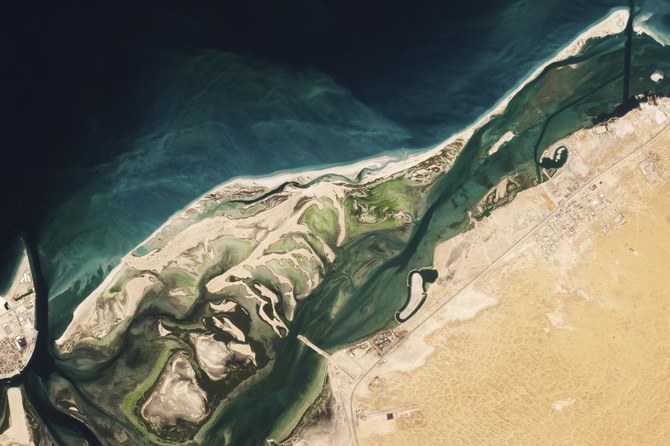
The pearling town sits on Siniyah Island, which shields the Khor Al-Beida marshlands in Umm Al-Quwain, an emirate some 50 kilometers (30 miles) northeast of Dubai along the coast of the Arabian Gulf. The island, whose name means “flashing lights” likely due to the effect of the white-hot sun overhead, already has seen archaeologists discover an ancient Christian monastery dating back as many as 1,400 years.
The town sits directly south of that monastery on one of the curling fingers of the island and stretches across some 12 hectares (143,500 square yards). There, archaeologists found a variety of homes made of beach rock and lime mortar, ranging from cramped quarters to more sprawling homes with courtyards, suggesting a social stratification, Power said. The site also bears signs of year-round habitation, unlike other pearling operations run in seasonal spots in the region.
“The houses are crammed in there, cheek by jowl,” he added. “The key thing there is permanence. People are living there all year around.”
In the homes, archaeologists have discovered loose pearls and diving weights, which the free divers used to quickly drop down to the seabed while relying only on their held breath.
The town predates the rise of Islam across the Arabian Peninsula, making its residents likely Christians.
Umm Al-Quwain’s Department of Tourism and Archaeology, UAE University, the Italian Archaeological Mission in the emirate and the Institute for the Study of the Ancient World at New York University all took part in the excavation. Umm Al-Quwain, the least-populated emirate in the UAE, plans to build a visitor’s center at the site.
Today, the area near the marshland is more known for the low-cost liquor store at the emirate’s Barracuda Beach Resort. In recent months, authorities have demolished a hulking, Soviet-era cargo plane linked to a Russian gunrunner known as the “Merchant of Death” as it builds a bridge to Siniyah Island for a $675 million real estate development. Authorities hope that development, as well as other building, will grow the emirate’s economy.
However, even this ancient site bears lessons for the Emirates.
The story of pearling, which rapidly collapsed after World War I with the introduction of artificial pearls and the Great Depression, holds particular importance in the history of the UAE — particularly as it faces a looming reckoning with another extractive industry. While crude oil sales built the country after its formation in 1971, the Emirates will have to confront its fossil fuel legacy and potentially plan for a carbon-neutral future as it hosts the United Nations COP28 climate talks later this year.
Those searching the site found a dumpsite nearby filled with the detritus of discarded oyster shells. People walking across the island can feel those remains crunching under their feet in areas as well.
“You only find one pearl in every 10,000 oyster shells. You have to find and discard thousands and thousands of oyster shells to find one,” Power said. ”The waste, the industrial waste of the pearling industry, was colossal. You’re dealing with millions, millions of oyster shells discarded.”


![]()

Their world was the oyster: Oldest pearl town found in UAE
Short Url
https://arab.news/93wnm
Their world was the oyster: Oldest pearl town found in UAE
- The town was likely once home to thousands of people and hundreds of homes


Latest updates





© 2026 SAUDI RESEARCH & PUBLISHING COMPANY, All Rights Reserved And subject to Terms of Use Agreement.