

Time for Syria to return to Arab fold, UAE president tells Assad

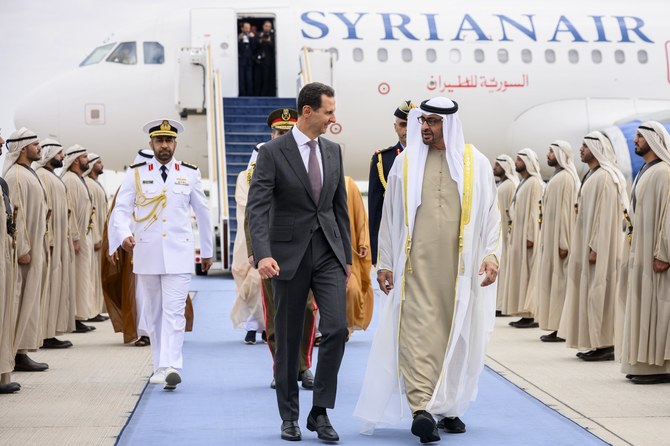
Syrian President Bashar Al-Assad meets UAE President Sheikh Mohamed bin Zayed during an official visit to the UAE. (WAM)
Short Url
Updated 19 March 2023
Follow

Time for Syria to return to Arab fold, UAE president tells Assad

  • Assad, accompanied by his wife Asma Al-Assad, arrived in Abu Dhabi on Sunday
  • The Syrian president’s visit to Abu Dhabi comes after a visit to Oman last month

DUBAI: The UAE’s president on Sunday told his Syrian counterpart it was time for diplomatically isolated Damascus to be reintegrated into the wider Arab region during a meeting in Abu Dhabi.

The trip by Syrian President Bashar Assad — his second to the UAE in as many years — comes after a visit to Oman last month, his only official engagements in Arab countries since the start of Syria’s war in 2011.

The visit coincides with amplified engagement by Arab states toward the Damascus government, which has been politically isolated in the region since the start of Syria’s war and was expelled from the Cairo-based Arab League in 2011 over its violent crackdown on pro-democracy demonstrations.

“Syria has been absent from its brothers for too long, and the time has come for it to return to them and to its Arab surroundings,” Sheikh Mohamed bin Zayed Al-Nahyan told Assad during a meeting at the presidential palace.

The Emirati president called for efforts to facilitate the repatriation of Syrian refugees and endorsed engagement between Damascus and Ankara, which is now working toward a rapprochement with Assad after years of supporting rebels fighting his government.

“We held constructive talks aimed at developing relations between our two countries. Our discussions also explored ways of enhancing cooperation to accelerate stability and progress in Syria and the region,”
Sheikh Mohammed said on Twitter.

Abu Dhabi, which normalized relations with Assad’s government in 2018, has led aid efforts in the aftermath of the Feb. 6 earthquake that struck southeastern Turkiye and northern Syria, killing tens of thousands.

Analysts say the diplomatic momentum generated in the quake’s aftermath could bolster Damascus’s relations with Middle Eastern countries that have so far resisted normalization after more than a decade of war.
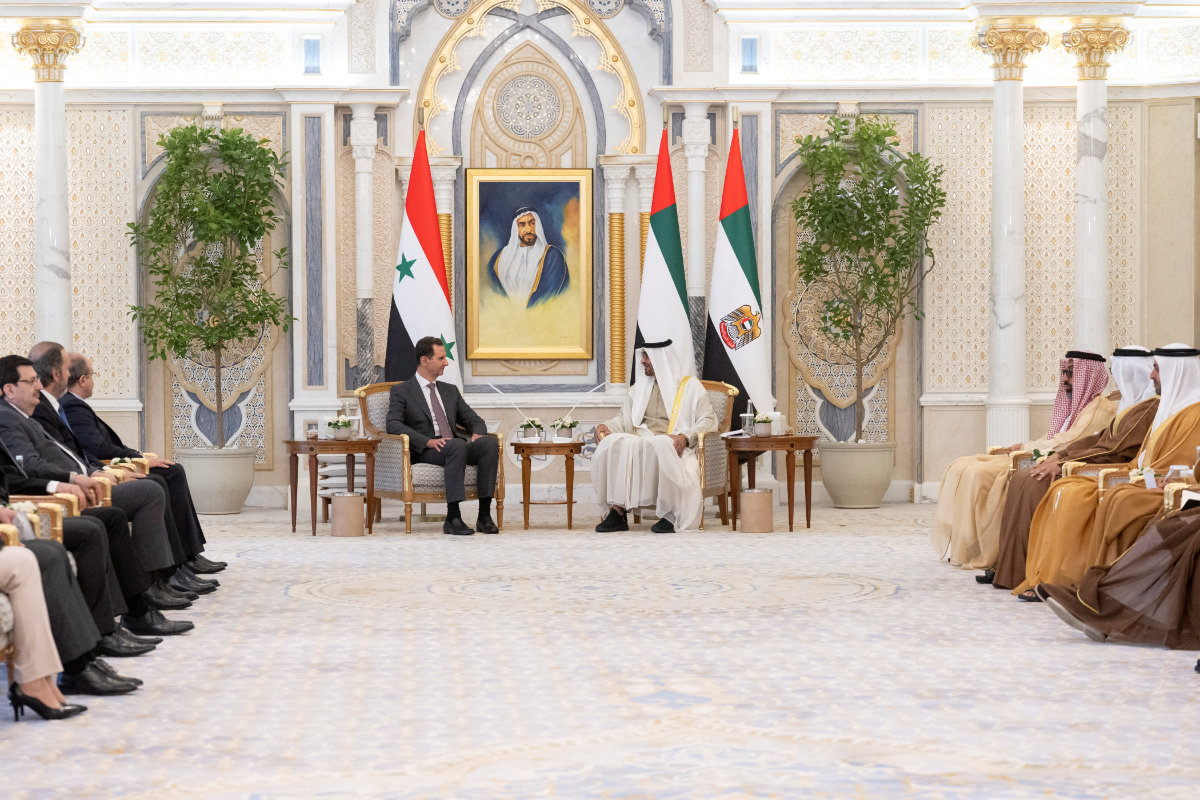


Sheikh Mohamed bin Zayed Al Nahyan, UAE president, meets with Syrian President Bashar Al Assad during a reception at Qasr Al Watan in Abu Dhabi on March 19, 2023. (UAE Presidential Court/Handout via REUTERS)

“The UAE’s approach and efforts toward Syria are part of a deeper vi- sion and a broader approach aimed at strengthening Arab and regional stability,” said Emirati senior presidential adviser Anwar Gargash.

“The UAE’s position is clear regarding the need for Syria to return to” its place in the Arab world and regain legitimacy in the region, Gargash said on Twitter.

“This was confirmed by His Highness Sheikh Mohammed bin Zayed during his meeting today” with Assad, the adviser added.

Assad praised the UAE’s role in strengthening relations between Arab countries. He criticized the policy of severing ties between Arab states as an “incorrect principle in politics,” arguing that relations should be “fraternal.”

Assad, accompanied by his wife Asma Al-Assad, arrived in the UAE on Sunday and was received by the UAE president at the presidential airport in Abu Dhabi.

Assad’s visit was marked with more ceremony than his trip to the UAE last year. He received a canon salute as his convoy entered the royal palace. Assad’s plane was greeted by Emirati fighter jets.


Anatomy of a disaster
Two decades later, Iraqis are still paying the price for Bush's ill-judged war

Enter


keywords

Death toll in Iran protests rises to more than 500, rights group says

In this frame grab from footage circulating on social media shows protesters dancing and cheering around a bonfire.
Updated 41 min 38 sec ago
Follow

Death toll in Iran protests rises to more than 500, rights group says

  • Protests began on December 28 in response to soaring prices, before turning against the clerical rulers who have governed since the 1979 Islamic Revolution

DUBAI/JERUSALEM: Unrest in Iran has killed more than 500 people, a rights group said on Sunday, as Tehran threatened to target US military bases if President Donald Trump carries ​out threats to intervene on behalf of protesters.
With the Islamic Republic’s clerical establishment facing the biggest demonstrations since 2022, Trump has repeatedly threatened to intervene if force is used on protesters.
According to its latest spreadsheet — based on activists inside and outside Iran, US-based rights group HRANA said it had verified the deaths of 490 protesters and 48 security personnel, with more than 10,600 people arrested.
Reuters was unable to independently verify the tolls.
Iranian Parliament Speaker Mohammad Baqer Qalibaf, speaking in parliament on Sunday, warned the United States against “a miscalculation.”
“Let us be clear: in the case of an attack on Iran, the occupied territories (Israel) as well as all US bases and ships will be our legitimate target,” said Qalibaf, a former commander in Iran’s elite Revolutionary Guards.
Authorities intensify crackdown
The protests began on December 28 in response to soaring prices, before turning against the clerical rulers who have governed since the 1979 Islamic Revolution.
Authorities accuse the US and Israel of fomenting unrest. Iran’s police ‌chief Ahmad-Reza Radan said ‌security forces had stepped up efforts to confront “rioters.”
The flow of information from Iran has been hampered ‌by ⁠an Internet blackout ​since Thursday.
Footage ‌posted on social media on Saturday from Tehran showed large crowds marching along a street at night, clapping and chanting. The crowd “has no end nor beginning,” a man is heard saying.
In footage from the northeastern city of Mashhad, smoke can be seen billowing into the night sky from fires in the street, masked protesters, and a road strewn with debris, another video posted on Saturday showed. Explosions could be heard.
Reuters verified the locations.
State TV aired footage of dozens of body bags on the ground at the Tehran coroner’s office on Sunday, saying the dead were victims of events caused by “armed terrorists.”
Three Israeli sources, who were present for Israeli security consultations over the weekend, said Israel was on a high-alert footing for the possibility of any US intervention.
An Israeli military official said the protests were an internal Iranian matter, but Israel’s military was ⁠monitoring developments and was ready to respond “with power if need be.” An Israeli government spokesperson declined to comment.
Israel and Iran fought a 12-day war in June last year, which the United States briefly joined by ‌attacking key nuclear installations. Iran retaliated by firing missiles at Israel and an American air base in ‍Qatar.
US ready to help, says Trump
Trump, posting on social media on Saturday, said: “Iran is looking at FREEDOM, perhaps like never before. The USA stands ready to help!!!“
In a phone call on Saturday, Israeli Prime Minister Benjamin Netanyahu and US Secretary of State Marco Rubio discussed the possibility of US intervention in Iran, according to an Israeli source present for the conversation.
Reza Pahlavi, the exiled son of Iran’s last shah and a prominent voice in the fragmented opposition, said Trump had observed Iranians’ “indescribable bravery.” “Do not abandon the streets,” Pahlavi, who is based in the US, wrote on X.
Maryam Rajavi, president-elect of the National Council of Resistance of Iran, a Paris-based Iranian opposition group, wrote on X that people in Iran had “asserted control of public spaces and reshaped Iran’s political landscape.”
Her group, also known as Mujahideen-e-Khalq (MEK), joined the 1979 revolution but later broke from the ruling clerics and fought them during the Iran-Iraq war in ‌the 1980s.
Netanyahu, speaking during a cabinet meeting, said Israel was closely monitoring developments. “We all hope that the Persian nation will soon be freed from the yoke of tyranny,” he said.