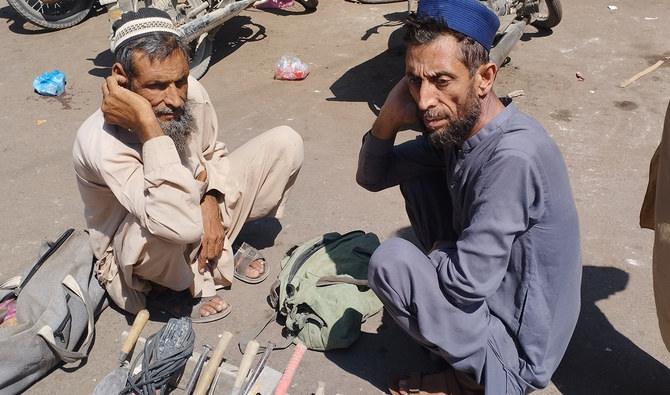

KARACHI: Every morning, construction worker Jamal Shah goes to Karachi’s busy Burns Road where he and dozens of laborers sit by the roadside, waiting to get a gig for the day working on one of the commercial capital’s mega building projects.
For months now, the 35-year-old said he sits at his usual spot from 8am. Night falls but no one comes to offer work.
Shah is among perhaps hundreds of thousands of Pakistani daily wage workers who have lost their livelihoods as the rising cost of doing business has led many industries in Pakistan, including construction, to scale down operations.
Pakistan’s consumer price index (CPI) jumped 31.5 percent in February year-on-year, according to the statistics bureau, the highest annual rate in nearly 50 years, as food, beverage and transportation prices surged more than 45 percent. The government is currently in talks to secure an IMF bailout deal, which will offer a critical lifeline to avert an economic meltdown.
“We come here at 8 and sit here till 5pm in this scorching sun, but we get no work. The reason? The reason is only inflation,” Shah, who has to send money to his family in Pakistan’s northwestern Bajaur region, said. “How will we earn?”
Noor Hussain, 30, said the Rs200-300 that daily wage laborers earned a day, which is a little over a dollar, was hardly enough for himself, and left him with nothing to send back to his family in Sindh’s Larkana district.
“I have three kids, my mother, because of inflation we are very worried,” he said. “Sometimes there is work, sometimes there isn’t.”
According to the Pakistan Credit Rating Agency (PACRA) and the Association of Builders and Developers (ABAD), the construction sector employs around 7.61 percent of Pakistan’s total labor force and provides a stimulus to more than 72 allied industries.
ABAD recently sent out a distress signal to the government, asking for relief amid the economic crisis, particularly that the government allow opening letters of credit for the import of steel and other raw materials to keep the industrial wheel in motion.
With foreign exchange reserves with the central bank currently standing at barely enough to cover a month’s imports, the government has restricted the import of goods, including industrial raw materials, to stop dollar outflows.
“At the moment, 50 percent of construction projects carried out by the industry have stopped, and the rest are likely to face the same fate due to the steel and cement prices,” Nadeem Yousuf Jeewa, ABAD vice chairman, told Arab News.
“Steel, which was available for Rs160,000 per ton about a year ago, is now available for Rs300,000,” he added. “This means that the per square foot cost that was Rs3,000 nearly a year ago has gone up to Rs6,000 and beyond the planned cost of projects.”
Jeewa said about 25 million workers were associated with the industry and nearly 10 million were now facing the spectre of unemployment.
“This means that those who were getting a job daily are now able to get it only two or three times a week,” he said. “This is how much they are affected.”
The ABAD vice chairman said the association had urged the government to allow steel imports from neighboring countries like Iran and India, where prices were much lower:
“In Iran, the price is about $600 per ton, and in India, it is somewhere near $700. In Pakistan, the price is as high as about $1,100.”
Shamoon Baker Ali, the chairman of the Karachi Iron and Steel Merchants Association (KISMA), told Arab News the price of rebar, or steel, used in construction had increased by about 50 percent since last year.
“If the government allows the import of rebar from China, the prices will go down, and cheap rebar will also be available in Pakistan,” he said.
The decline in the number of building projects in the country has also impacted the production and sale of cement in Pakistan, dealers, and manufacturers said.
The average price of cement had increased to about Rs1,155 per bag in Pakistan from Rs749, recorded in March 2022.
Data released by the All Pakistan Cement Manufacturers Association earlier this month showed overall cement dispatches had dropped by 16.65 percent during the first eight months of the ongoing fiscal year, compared to the corresponding period last year.
“Earlier, every shopkeeper would sell 200 to 300 bags per day,” cement dealer Muhammad Arif said, “but the sales today have dropped to 20 to 25 bags only, and the reason for that is inflation.”