

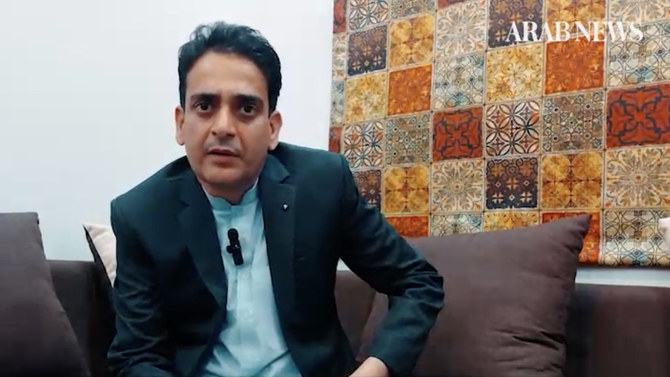

ISLAMABAD: A Pakistani man who worked for years as a laborer in Saudi Arabia and is now the owner of a chain of fast-food restaurants sees the Kingdom as a “land of opportunities” and urges more people to seek business possibilities there.
More than 2.5 million Pakistani expatriates live in Saudi Arabia, working mostly as laborers and low-skilled workers who send home the largest share of the South Asian nation’s remittances. But some, like Abdul Kabeer Shah, are now also striking it big.
Shah, 44, went to Saudi Arabia as a 21-year-old in 2000 and for four years worked as an assistant for electricians and plumbers in Riyadh and Jeddah.
In 2004, he joined a food chain in Jeddah, quickly learning to make fast food items like burgers and shawarmas. After four years of working there, one of Shah’s longtime Saudi customers, Dr. Abdullah Eid Saleh Al-Balawi, whom he had befriended at the job and who was impressed with the Pakistani man’s cooking skills and work ethic, offered him the opportunity of a lifetime: to go into the food business with him as a partner in Jeddah.
Thus was born the food startup The Taste, or Al-Ta’am in Arabic.
Al-Balawi contributed the initial capital investment in the restaurant and brought Shah on board on a profit-sharing basis. Today, they are both co-owners of the food chain, which has eight branches.
“This was a turning point in my life. I became a food entrepreneur from a laborer, and suddenly my monthly income greatly increased,” Shah told Arab News in a recent interview at his palatial home in Islamabad, where he was visiting his family.
Before his fortunes turned in the Kingdom, Shah, one of eight siblings, used to live in a small three-room house in Landhi, Karachi, and dropped out of school in the eighth grade to assist his father, who worked at a retail shop.
But even as a teenager, Shah had an eye and a passion for business.
“I developed a liking for business while working with my father at the retail shop,” he said. “So, I always wanted to set up my own business to support my family.”
Shah and his Saudi business partner employ over 100 workers at their eight restaurant branches in Jeddah, where the main items on the menu are burgers, shawarmas, roasted chicken and pomegranate juice. And while the market is saturated with such food items, Shah said what made their restaurants different was the use of Asian spices, giving the ubiquitous products a unique taste.
“The use of at least 16 different Asian spices like chili, cinnamon, ginger, cumin and turmeric in our food products make them unique and tasty,” he said. “Our burgers and shawarmas are not only spicy but also have intense aromas and bold flavors, which our customers like the most.”
Shah’s partner Al-Balawi said the duo was planning to expand and open at least two more branches, one each in the cities of Tabuk and Jeddah, by the end of the year.
“We are also working on adding more food items in our menu to increase our sales and create additional job opportunities for skilled workers from Pakistan and other nationalities,” he told Arab News in a phone interview.
The company has also recently hired a dedicated social media team to digitally market its business.
“We have been using all modern marketing tools and techniques to boost our sales and profits while equally focusing on the quality of our products,” Al-Balawi added.
Excited about expanding his business, Shah urged more Pakistanis to come to Saudi Arabia and work in businesses and increase remittances to their home country. In 2022, Pakistani expatriates in Saudi Arabia remitted $6.67 billion to Pakistan through official channels, according to central bank data, the largest source of remittances to the South Asian nation.
“Do your jobs legally and remit money to your country through legitimate channels,” Shah advised foreigners in the Kingdom. “It will be beneficial for both the country and the individuals.”
Indeed, Shah’s own story and his rise from poverty to wealth and success is no small miracle. Today, he lives in a posh flat in the Al-Adel area of Jeddah and visits his parents in Pakistan at least three times a year.
“First, I used to live with other laborers in a shared room, and now I have rented my own luxury apartment,” he said.
In Pakistan, he has purchased a palatial house in an elite neighborhood, where his parents live with his wife and five children.
“I could not study due to poverty, but I would like my children to receive quality education to achieve their dreams in life,” he said.
Commenting on Shah’s success, Pakistan-Saudi Arabia Business Council Chairman Junaid Esmail Makda said it was impressive, calling on governments in both nations to facilitate entrepreneurs in exploring and setting up joint-investment opportunities.
“Saudi Arabia is offering huge investment opportunities for Pakistani businessmen in the food, industry and agriculture sectors,” Makda told Arab News, adding that the Kingdom provides raw materials and energy at competitive rates to facilitate such opportunities.
“Pakistani businessmen can remit the precious foreign exchange back home from the Kingdom to help boost the economy besides creating job opportunities for the nationals there.”
Standing on the greens outside his massive Islamabad home, Shah added:
“Saudi Arabia is a peaceful country and a land of opportunities for businessmen and investors from across the world.”


