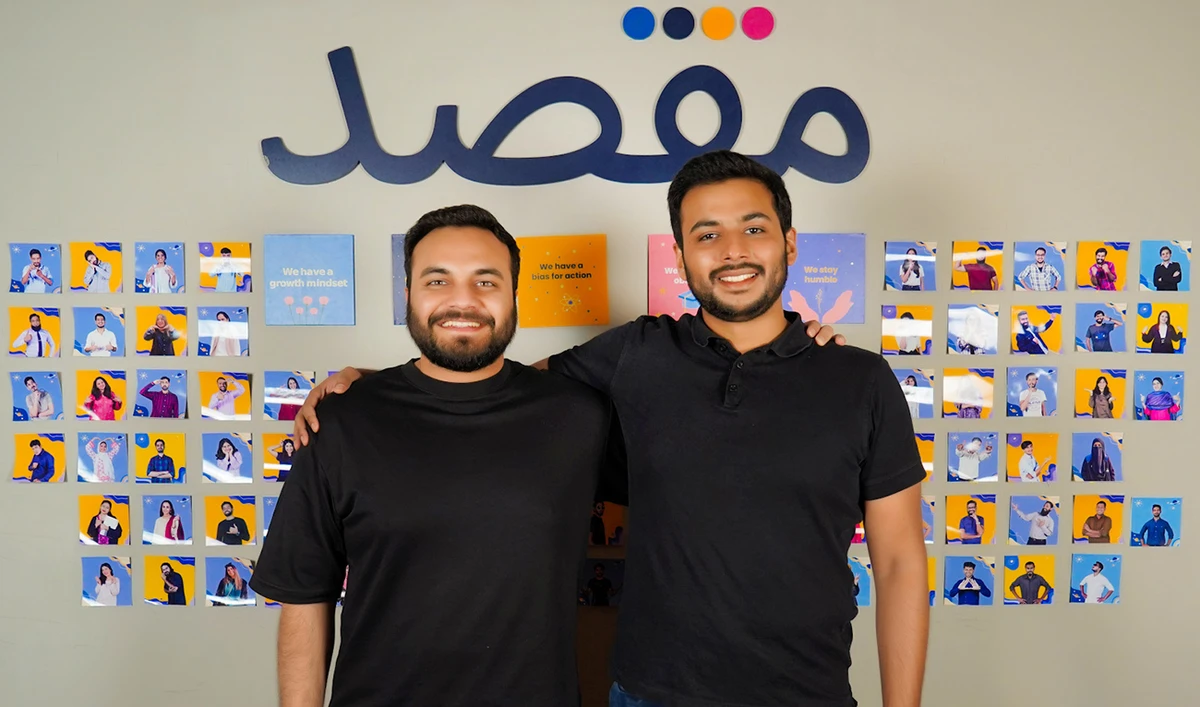
- Maqsad aims to make education accessible for 100 million Pakistani students via an end-to-end learning mobile platform
- Maqsad’s new funds will be used primarily to expand the subject offering and supercharge the tech behind the platform
KARACHI: A Pakistani edtech company has raised $2.8 million in a seed funding round led by Speedinvest, one of the largest European venture capital funds, and Indus Valley Capital, the startup announced on Thursday.
Founded by childhood friends Taha Ahmed and Rooshan Aziz in 2021, the edtech company Maqsad, which translates to ‘purpose’ in the Urdu language, aims to make education accessible for 100 million Pakistani students via an end-to-end learning mobile platform that provides teaching, testing, and query resolution for grades 9 to 12.
The capital from this funding round, which brings Maqsad’s all-time capital raised to $4.9 million and positions the company as Pakistan’s best-funded ed-tech firm, will be used primarily to expand the subject offering and supercharge the tech behind the platform.
With the latest funding round, Pakistani startups have raised $11.5 million in 2023.
“We are going to work on Artificial Intelligence (AI) based initiatives that will be launched soon by utilizing the funding,” Rooshan Aziz, the co-founder of the startup, told Arab News. “It is good news coming out of Pakistan in the current situation.”

The oversubscribed round also had participation from Stellar Capital, Alter Global, Johann Jenson (SVP Product at GoStudent), and other strategic angels, the startup said.
While currently a purely business-to-customer (B2C) platform, Maqsad’s long-term vision is to embed itself across the education ecosystem. The company has already received interest from private and public sector institutions for potential partnerships, the founder said.
“In the last six months, the Maqsad app has been downloaded over a million times, answered 4 million student queries, and has consistently ranked as the #1 education app in Pakistan on the Google Play Store,” Aziz said.
Pakistan also has one of the highest student-teacher ratios in the world, with only one teacher for every 44 students. Maqsad’s query-solving technology (“DoubtSolve”) and interactive testing resolve a key problem for students who lack ready access to quality instructors.
“We recently enhanced our assessment feature, which allows students to confidently self-evaluate, and witnessed consistent 150 percent+ month-on-month growth in questions attempted,” Aziz said.
Education presents a substantial opportunity in Pakistan, with a forecasted annual spend of $37 billion by 2032. A quarter of this goes toward after-school academic support that is often expensive and difficult to access, according to the startup.
“Maqsad offers an exceptional learning experience for students at a fraction of the cost,” said Taha Ahmed. “Our focus on student problems is at the core of our mission, and we’ve collected feedback from over 20,000 students and teachers across Pakistan to ensure learning outcomes are being achieved.”
The lead fund, Speedinvest, with more than €1 billion to invest in pre-seed, seed, and early-stage tech startups globally, has six unicorns including an ed-tech in their portfolio. The investor said they see huge potential in Pakistani startups.
“We invested in Maqsad because we see potential for it to touch the lives of millions of students and disrupt the education ecosystem,” Philip Specht, partner at Speedinvest, said in a statement.
“We are incredibly impressed by Rooshan and Taha as team builders and believe Maqsad is on track to be one of the most successful businesses in Pakistan.”
Indus Valley Capital’s founder Aatif Awan said his firm first invested in Maqsad 18 months ago before the startup had a product or a team.
“We were compelled by the vision Rooshan and Taha had for education in Pakistan, Awan said.
“Investing again in Maqsad is a no-brainer as we have seen them bring together one of the best startup teams in Pakistan to build a category-leading product that has helped over a million students..
The other major startup funding deals in 2023 included $7.5 million raised by AdalFi, a Lahore-based digital lending infrastructure provider, and $1.2 million raised Swag Kicks, a Karachi-based second-hand clothing online marketplace.