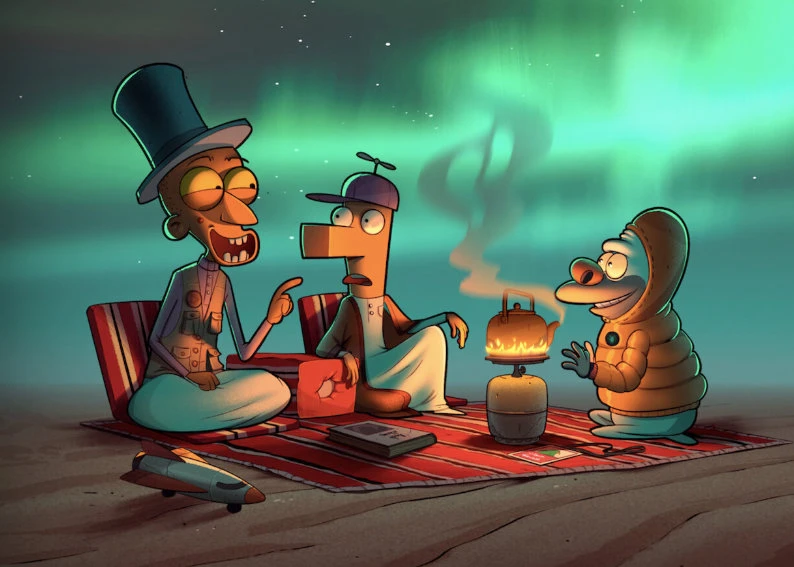
- The new six-episode season of ‘Masameer County’ follows the adventures of the county’s mischievous citizens while shedding light on the evolving social and cultural scene in the Kingdom in a light-hearted manner
JEDDAH: Netflix has released season two of the hit Saudi animation miniseries “Masameer County” following the success of its debut season in 2021.
The show is ranking No.3 in the Kingdom following its release early in March.
The six-episode season, created by Abdulaziz Almuzaini and Malik Nejer, follows the adventures of the mischievous citizens of Masameer County, while shedding light on the evolving social and cultural scene in the Kingdom in a light-hearted manner.
Almuzaini, founder and CEO of Saudi animation studio Myrkott, told Arab News that “we are no longer discussing any issues here; we are making stories.”
He said: “Netflix allowed us to broaden our content. The platform has given us more freedom. The script was bold and people loved it, and we made sure we reflect the same in the second season.”
The new season follows the escapades of Saad, Saltooh and Trad the dog, which include a daring 24-hour mission, an unexpected ride in an elevator, and a rocket launch.
Nejer directed the second season and also lent his voice to the characters in the show.
In an exclusive interview with Arab News, Nejer revealed that he has been developing his voice since childhood, and enjoys performing a range of characters.
The voice artist believes that necessity is the mother of invention. Initially, 140 episodes of the series were streamed on YouTube after 2011 to highlight the Kingdom’s culture.
“(When) the series was only displayed on YouTube, at first there was not enough budget to hire a voice actor and that led me to perform almost all the voices. Using my talent, it worked out. I loved it and I continued afterward, even after we became a Netflix series,” said Nejer, who has performed for many other TV shows and cartoon series.
“I continued doing that for the next 10 years because I loved it and felt that am good at it; and, most importantly, it helps us to save the budget.”
Speaking of his experience as a director, he said: “Masameer cannot be compared to any other Arabic or foreign content; it is different.”
The second season of the series is available on Netflix in 190 countries, with audio translation into Arabic, English, Portuguese and Spanish, and subtitles in over 30 languages.
In 2020, the platform streamed “Masameer: The Movie,” co-created by Faisal Al-Amer and Nejer, in more than 190 countries and 30 languages.
“We, as Saudis, tell a story, our story, and as filmmakers or creators don’t need to sugar-coat or create a flowery image of our society,” Al-Amer told Arab News in a previous interview.
“This is us; we don’t create movies for the approval of the West, we make them express ourselves.”
Season one of “Masameer County,” released in 2021, saw the Masameer team engaging in a long-standing tribal feud, media war and a health craze gone too far.
Almuzaini said that the opening season gained more views than the movie and was No.1 on Netflix’s top 10 content in the region for one month, beating international works including “Stranger Things” and “Lupin.”
The series is part of Netflix’s five-year exclusive partnership with Saudi animation studio Myrkott, signed in 2020, to bring viewers Saudi-focused shows and films.