

Lebanese designer Dima Ayad gets colorful at Dubai Fashion Week

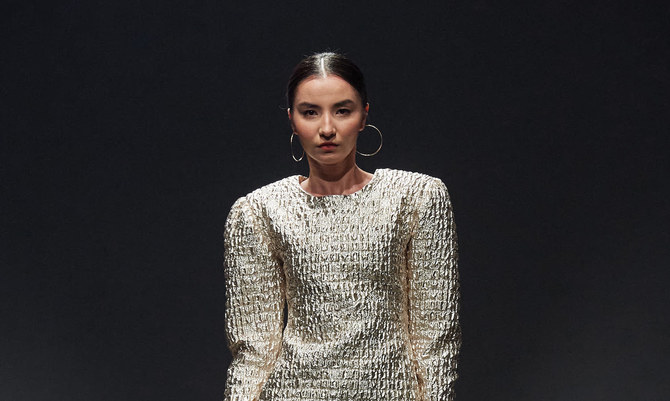
Dima Ayad presented her Fall/Winter 2023 collection at Dubai Fashion Week. (Supplied)
Short Url
Updated 15 March 2023
Follow

Lebanese designer Dima Ayad gets colorful at Dubai Fashion Week

DUBAI: After teaming up with US celebrity model Ashley Graham to showcase her Summer 2023 collection, Lebanese designer Dima Ayad showed off looks from her Fall/Winter 2023 line at Dubai Fashion Week on Tuesday.  

Metallics shone through in the new collection from the designer who is known for championing size inclusivity. A textured gold dress stood out on the runway, while metallic collars on thobe-like dresses and electrifying pops of blue in varying shades caught the eye of many a fashion industry insider on the front row of the show at Dubai Design District.  


Titled “Freedom in Color,” rouching, patternwork, fringing and marbled textiles were all on show as Ayad offered up a textured collection that mixed and matched with abandon — plisse fabric in magenta was paired with a sequined underskirt in the same color in one example of the designer’s marriage of materials.  

The designer highlighted regional talent by sending Tunisian plus-size model Ameni Esseibi down the runway in a glittering gold coordinating set.  

Ayad is fresh off a campaign featuring US plus-size model Graham — a celebrity catch for the Dubai-based brand.  


The label released the promotional video on Instagram late last week, sharing a glimpse of its Summer 2023 collection.   

In the video, Graham shared motivational words with her and Ayad’s fans as she shows off a colorful, sequined and patterned dresses.  


“Your words have power so make sure you are speaking well over yourself,” Graham said in the short campaign clip. “Don’t talk bad to yourself. It’s not nice. Don’t follow people that are going to make you feel bad about yourself. I’m talking, like, push the unfollow button on Instagram. It is kind of empowering. 

“You are never going to be ready enough for the thing you are constantly preparing for, so stop constantly preparing and just do it,” Graham added in the video. 


Review: ‘Sorry, Baby’ by Eva Victor

Eva Victor appears in Sorry, Baby by Eva Victor, an official selection of the 2025 Sundance Film Festival. (Supplied)
Updated 27 December 2025
Follow

Review: ‘Sorry, Baby’ by Eva Victor

  • Victor makes a deliberate narrative choice; we never witness the violence of what happens to her character

There is a bravery in “Sorry, Baby” that comes not from what the film shows, but from what it withholds. 

Written, directed by, and starring Eva Victor, it is one of the most talked-about indie films of the year, winning the Waldo Salt Screenwriting Award at Sundance and gathering momentum with nominations, including nods at the Golden Globes and Gotham Awards. 

The film is both incisive and tender in its exploration of trauma, friendship, and the long, winding road toward healing. It follows Agnes, a young professor of literature trying to pick up the pieces after a disturbing incident in grad school. 

Victor makes a deliberate narrative choice; we never witness the violence of what happens to her character. The story centers on Agnes’ perspective in her own words, even as she struggles to name it at various points in the film. 

There is a generosity to Victor’s storytelling and a refusal to reduce the narrative to trauma alone. Instead we witness the breadth of human experience, from heartbreak and loneliness to joy and the sustaining power of friendship. These themes are supported by dialogue and camerawork that incorporates silences and stillness as much as the power of words and movement. 

The film captures the messy, beautiful ways people care for one another. Supporting performances — particularly by “Mickey 17” actor Naomi Ackie who plays the best friend Lydia — and encounters with strangers and a kitten, reinforce the story’s celebration of solidarity and community. 

“Sorry, Baby” reminds us that human resilience is rarely entirely solitary; it is nurtured through acts of care, intimacy and tenderness.

A pivotal scene between Agnes and her friend’s newborn inspires the film’s title. A single, reassuring line gently speaks a pure and simple truth: “I know you’re scared … but you’re OK.” 

It is a reminder that in the end, no matter how dark life gets, it goes on, and so does the human capacity to love.