NGOs urge the release of Burundi rights campaigners

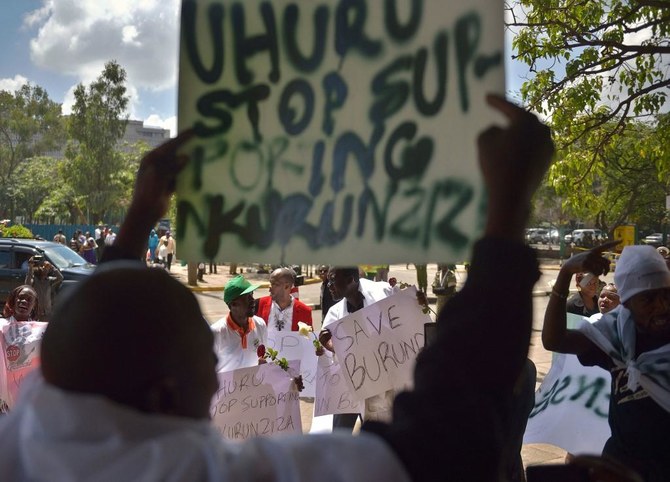
Activists protest in the Kenyan capital of Nairobi on December 18, 2015, against recent killings in neighbouring Burundi by government forces in a crackdown against public dissent. (File/AFP)
Short Url
Updated 14 March 2023
Follow

NGOs urge the release of Burundi rights campaigners

NAIROBI: Three human rights groups called Tuesday for the immediate unconditional release of five Burundian activists charged with rebellion and undermining state security.
Burundian intelligence agents arrested the five, four of whom were about to fly to Uganda from the economic capital Bujumbura, last month.
They were later charged with rebellion and undermining the domestic security of the state as well as the functioning of public finances, before being detained in Bujumbura’s central prison.
Under Burundian law, they face up to 30 years in prison.
Amnesty International, Human Rights Watch (HRW) and the Burundi Human Rights Initiative said the charges were “baseless” and demanded they be dropped.
“Burundian authorities should immediately and unconditionally release five human rights defenders arbitrarily arrested,” they said in a joint statement.
“The arrests... and the serious charges brought against them signal a worsening climate for independent civil society in Burundi,” said Clementine de Montjoye, Africa researcher at HRW.
The jailed activists include Sonia Ndikumasabo, president of the Association of Women Lawyers of Burundi, who was arrested at the airport.
Another was Prosper Runyange, a member of the Association for Peace and the Promotion of Human Rights (APDH), arrested the same day in the northern town of Ngozi.
“If working in partnership with or receiving funding from international groups is treated as a criminal offense and a threat to state security, what little space was left for civil society to operate in Burundi will be closed,” HRW’s Montjoye warned.
Despite ongoing concerns about the rights situation, both the European Union and the United States last year resumed aid flows to the deeply impoverished landlocked nation, citing political progress under President Evariste Ndayishimiye.
Ndayishimiye has been praised for slowly ending years of Burundi’s isolationism under former leader Pierre Nkurunziza’s chaotic and bloody rule.
But he has failed to improve its wretched record on human rights and the African Great Lakes nation of 12 million people remains one of the poorest on the planet.
Burundi had been under US and EU sanctions over a bloody crisis that erupted in 2015 when Nkurunziza made a controversial bid for a third term in office.
The turmoil claimed the lives of 1,200 Burundians and led to 400,000 fleeing the country.


House Republicans barely defeat Venezuela war powers resolution to check Trump’s military actions

Updated 23 January 2026
Follow

House Republicans barely defeat Venezuela war powers resolution to check Trump’s military actions

WASHINGTON: The House rejected a Democratic-backed resolution Thursday that would have prevented President Donald Trump from sending US military forces to Venezuela after a tied vote on the legislation fell just short of the majority needed for passage.
The tied vote was the latest sign of Republican House Speaker Mike Johnson’s tenuous hold on the majority, as well as some of the growing pushback in the GOP-controlled Congress to Trump’s aggressions in the Western Hemisphere. A Senate vote on a similar resolution was also tied last week until Vice President JD Vance broke the deadlock.
To defeat the resolution Thursday, Republican leaders had to hold the vote open for more than 20 minutes while Republican Rep. Wesley Hunt, who had been out of Washington all week campaigning for a Senate seat in Texas, rushed back to Capitol Hill to cast the decisive vote.
On the House floor, Democrats responded with shouts that Republican leaders were violating the chamber’s procedural rules. Two Republicans — Reps. Don Bacon of Nebraska and Thomas Massie of Kentucky — voted with all Democrats for the legislation.
The war powers resolution would have directed Trump to remove US troops from Venezuela. The Trump administration told senators last week that there are no US troops on the ground in the South American nation and committed to getting congressional approval before launching major military operations there.
But Democrats argued that the resolution is necessary after the US raid to capture Venezuelan leader Nicolás Maduro and since Trump has stated plans to control the country’s oil industry for years to come.
The response to Trump’s foreign policy
Thursday’s vote was the latest test in Congress of how much leeway Republicans will give a president who campaigned on removing the US from foreign entanglements but has increasingly reached for military options to impose his will in the Western Hemisphere. So far, almost all Republicans have declined to put checks on Trump through the war powers votes.
Rep. Brian Mast, the Republican chair of the House Armed Services Committee, accused Democrats of bringing the war powers resolution to a vote out of “spite” for Trump.
“It’s about the fact that you don’t want President Trump to arrest Maduro, and you will condemn him no matter what he does, even though he brought Maduro to justice with possibly the most successful law enforcement operation in history,” Mast added.
Still, Democrats stridently argued that Congress needs to assert its role in determining when the president can use wartime powers. They have been able to force a series of votes in both the House and Senate as Trump, in recent months, ramped up his campaign against Maduro and set his sights on other conflicts overseas.
“Donald Trump is reducing the United States to a regional bully with fewer allies and more enemies,” Rep. Gregory Meeks, the top Democrat on the House Foreign Affairs Committee, said during a floor debate. “This isn’t making America great again. It’s making us isolated and weak.”
Last week, Senate Republicans were only able to narrowly dismiss the Venezuela war powers resolution after the Trump administration persuaded two Republicans to back away from their earlier support. As part of that effort, Secretary of State Marco Rubio committed to a briefing next week before the Senate Foreign Relations Committee.
Yet Trump’s insistence that the US will possess Greenland over the objections of Denmark, a NATO ally, has alarmed some Republicans on Capitol Hill. They have mounted some of the most outspoken objections to almost anything the president has done since taking office.
Trump this week backed away from military and tariff threats against European allies as he announced that his administration was working with NATO on a “framework of a future deal” on Arctic security.
But Bacon still expressed frustration with Trump’s aggressive foreign policy and voted for the war powers resolution even though it only applies to Venezuela.
“I’m tired of all the threats,” he said.
Trump’s recent military actions — and threats to do more — have reignited a decades-old debate in Congress over the War Powers Act, a law passed in the early 1970s by lawmakers looking to claw back their authority over military actions.
The war powers debate
The War Powers Resolution was passed in the Vietnam War era as the US sent troops to conflicts throughout Asia. It attempted to force presidents to work with Congress to deploy troops if there hasn’t already been a formal declaration of war.
Under the legislation, lawmakers can also force votes on legislation that directs the president to remove US forces from hostilities.
Presidents have long tested the limits of those parameters, and Democrats argue that Trump in his second term has pushed those limits farther than ever.
The Trump administration left Congress in the dark ahead of the surprise raid to capture Maduro. It has also used an evolving set of legal justifications to blow up alleged drug boats and seize sanctioned oil tankers near Venezuela.
Democrats question who gets to benefit from Venezuelan oil licenses
As the Trump administration oversees the sale of Venezuela’s petroleum worldwide, Senate Democrats are also questioning who is benefiting from the contracts.
In one of the first transactions, the US granted Vitol, the world’s largest independent oil broker, a license worth roughly $250 million. A senior partner at Vitol, John Addison, gave roughly $6 million to Trump-aligned political action committees during the presidential election, according to donation records compiled by OpenSecrets.
“Congress and the American people deserve full transparency regarding any financial commitments, promises, deals, or other arrangements related to Venezuela that could favor donors to the President’s campaign and political operation,” 13 Democratic senators wrote to White House Chief of Staff Susie Wiles Thursday in a letter led by Democratic Sen. Adam Schiff of California.
The White House has said it is safeguarding the South American country’s oil for the benefit of both the people of Venezuela and the US