

UN Commission of Inquiry on Syria documents failure to protect country’s civilians

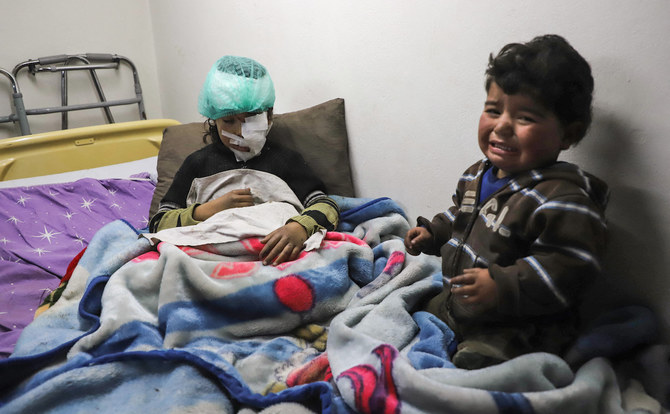
Ten-year-old Syrian child Mariam Othman, after being rescued from the rubble of a building hit by reported regime bombardment. (File/AFP)
Short Url
Updated 13 March 2023
Follow

UN Commission of Inquiry on Syria documents failure to protect country’s civilians

  • Syrian government, international community failed to deliver aid through available route within the first week following recent earthquakes, report reveals
  • Commission chairman cited Israeli attack on Aleppo International Airport, which serves as a conduit for humanitarian aid

LONDON: The UN Independent International Commission of Inquiry on Syria released its latest report documenting ongoing human rights violations throughout the country over the last six months of 2022.

The commission also said that the response to the recent massive earthquakes that struck the country was characterized by the failures of the Syrian government and international community to secure the delivery of urgent and life-saving aid to the northwest part of the country.

The commission highlighted that parties to the Syrian conflict, including the UN, failed to reach an agreement on an immediate cessation of hostilities and the facilitation of humanitarian aid through any available route in the critical first week following the earthquake.

“Syrians now need a comprehensive ceasefire that is fully respected, for civilians — including aid workers — to be safe. Incomprehensibly, due to the cruelty and cynicism of parties to the conflict, we are now investigating fresh attacks even in the very areas devastated by the earthquakes,” Paulo Pinheiro, chair of the commission, said.

Pinheiro cited last week’s reported Israeli attack on Aleppo International Airport, which serves as a conduit for humanitarian aid.

“We are currently investigating several allegations of parties to the conflict deliberately obstructing humanitarian aid to the affected communities,” said Commissioner Hanny Megally.

“As aid is now finally increasing, it is more important than ever that they consent to impartial humanitarian relief being delivered unimpeded to those in need, whether through cross-border or cross-line modalities,” he added.

Entire communities have been destroyed, with the UN estimating that some five million people require basic shelter and non-food assistance in the Syrian part of the earthquake zone. Already before the Feb. 6 earthquakes, over 15 million Syrians — more than at any point since the start of the conflict — needed humanitarian assistance.

In government-controlled areas, the report documented rising insecurity in Dara’a, Suwayda and Hama, as well as continued arbitrary detention, torture, ill-treatment, and enforced disappearances. Seizures, auctions, and restrictions on access to property were examples of property rights violations.

Civilians in the earthquake-affected northwest have been particularly vulnerable to deadly attacks in recent months.

Government forces used cluster munitions to strike densely populated displacement camps in Idlib governorate inside the opposition-held area in November, killing seven civilians and injuring at least 60 more.

Furthermore, the commission discovered that conditions for safe and dignified return are still lacking. During the reporting period, some Syrians were denied return outright, while others were arbitrarily arrested or barred from returning to government-controlled areas.


Israel aims to ensure more Palestinians are let out of Gaza than back in

Updated 4 sec ago
Follow

Israel aims to ensure more Palestinians are let out of Gaza than back in

  • It was still not clear how Israel planned to enforce limits on the number of Palestinians entering Gaza from Egypt
  • Sources said Israeli officials had insisted on setting up a military checkpoint in Gaza to screen Palestinians moving in and out

TEL AVIV: Israel wants to restrict the number of Palestinians entering Gaza through the border crossing with Egypt to ensure that more are allowed out than in, three sources briefed on the matter said ahead of the border’s expected opening next week.
The head of a transitional Palestinian committee backed by the US to temporarily administer Gaza, Ali Shaath, announced on Thursday that the Rafah Border Crossing — effectively the sole route in or out of Gaza for nearly all of the more than 2 million people who live there — would open next week.
The border was supposed to have opened during the initial phase of President Donald Trump’s plan to end the war, under a ceasefire reached in October between Israel and Hamas.
Earlier this month, Washington announced that the plan had now moved into the second phase, under which Israel is expected to withdraw troops further from Gaza ⁠and Hamas is due to yield control of the territory’s administration. The Gaza side of the crossing has been under Israeli military control since 2024.
The three sources, who spoke on condition of anonymity due to the sensitivity of the issue, said it was still not clear how Israel planned to enforce limits on the number of Palestinians entering Gaza from Egypt, or what ratio of exits to entries it aimed to achieve.
Israeli officials have spoken in the past about encouraging Palestinians to emigrate from Gaza, although they deny intending to transfer the population out by force. Palestinians ⁠are highly sensitive to any suggestion that Gazans could be expelled, or that those who leave temporarily could be barred from returning.
The Rafah Crossing is expected to be staffed by Palestinians affiliated with the Ramallah-based Palestinian Authority and monitored by EU personnel, as took place during an earlier, weeks-long ceasefire between Israel and Hamas early last year.
The Israeli prime minister’s office did not immediately respond to a request for comment for this story. The military referred questions to the government, declining to comment.
The three sources said that Israel also wants to establish a military checkpoint inside Gaza near the border, through which all Palestinians entering or leaving would be required to pass and be subjected to Israeli security checks.
Two other sources also said that Israeli officials had insisted on setting up a military checkpoint in Gaza to screen Palestinians moving in and out.
The US Embassy in ⁠Israel did not immediately respond to a request for comment on whether Washington supported Israel in limiting the number of Palestinians entering Gaza or setting up a checkpoint to screen those entering and leaving.
Under the initial phase of Trump’s plan, the Israeli military partially pulled back its forces within Gaza but retained control of 53 percent of the territory including the entire land border with Egypt. Nearly all of the territory’s population lives in the rest of Gaza, under Hamas control and mostly in makeshift tents or damaged buildings.
The sources said that it was not clear how individuals would be dealt with if they were blocked by Israel’s military from passing through its checkpoint, particularly those entering from Egypt.
The Israeli government has repeatedly objected to the opening of the border, with some officials saying Hamas must first return the body of an Israeli police officer held in Gaza, the final human remains of a hostage due to be transferred under the ceasefire’s first phase.
US officials in private say that Washington, not Israel, is driving the rollout of the president’s plan to end the war.