

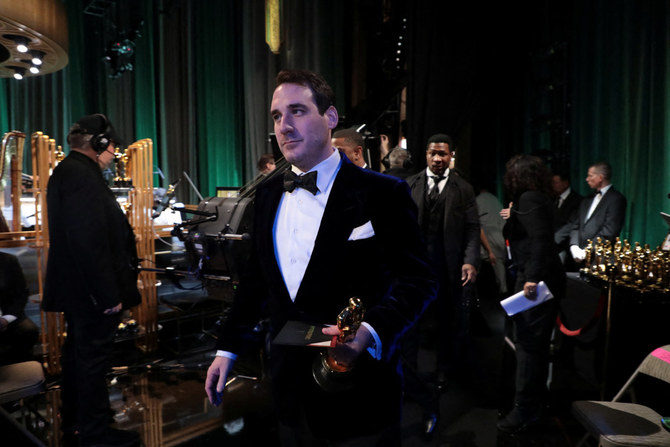
German anti-war epic ‘All Quiet on Western Front’ claims Oscars glory

James Friend, winner of the Oscar for Best Cinematography for "All Quiet on the Western Front," is seen backstage during the 95th Academy Awards in Hollywood, Los Angeles, on March 12, 2023. (Handout via Reuters)
Short Url
Updated 13 March 2023
Follow

German anti-war epic ‘All Quiet on Western Front’ claims Oscars glory

  • The film is based on the 1929 novel by Erich Maria Remarque, acclaimed as one of the most influential examples of pacifist literature ever written, translated into more than 60 languages

BERLIN: A wrenching German adaptation of the classic war novel “All Quiet on the Western Front” clinched the Academy Award for best international feature Sunday with its timely anti-militarist message.

Nearly a century after the book by Erich Maria Remarque was published, the Netflix production capped a triumphant march through awards season with the Oscar win.

It was the first German-language film in Academy history to be up for best picture, among a surprise nine nominations.


(L-R) Christian M. Goldbeck, winner of Best Production Design award, Edward Berger, winner of the Best International Feature Film award and James Friend, winner of the Best Cinematography award, each for "All Quiet On The Western Front" attend the Governors Ball. (AFP)

The last German winner of best international feature (a category then known as best foreign language film) was “The Lives of Others” in 2007.

Swiss director Edward Berger, 52, thanked his star Felix Kammerer, an Austrian stage actor making his cinematic debut, saying: “Without you, none of us would be here.”

In “All Quiet,” World War I is viewed through the eyes of teenage German soldier Paul Baeumer (Kammerer), a volunteer on the Western front.
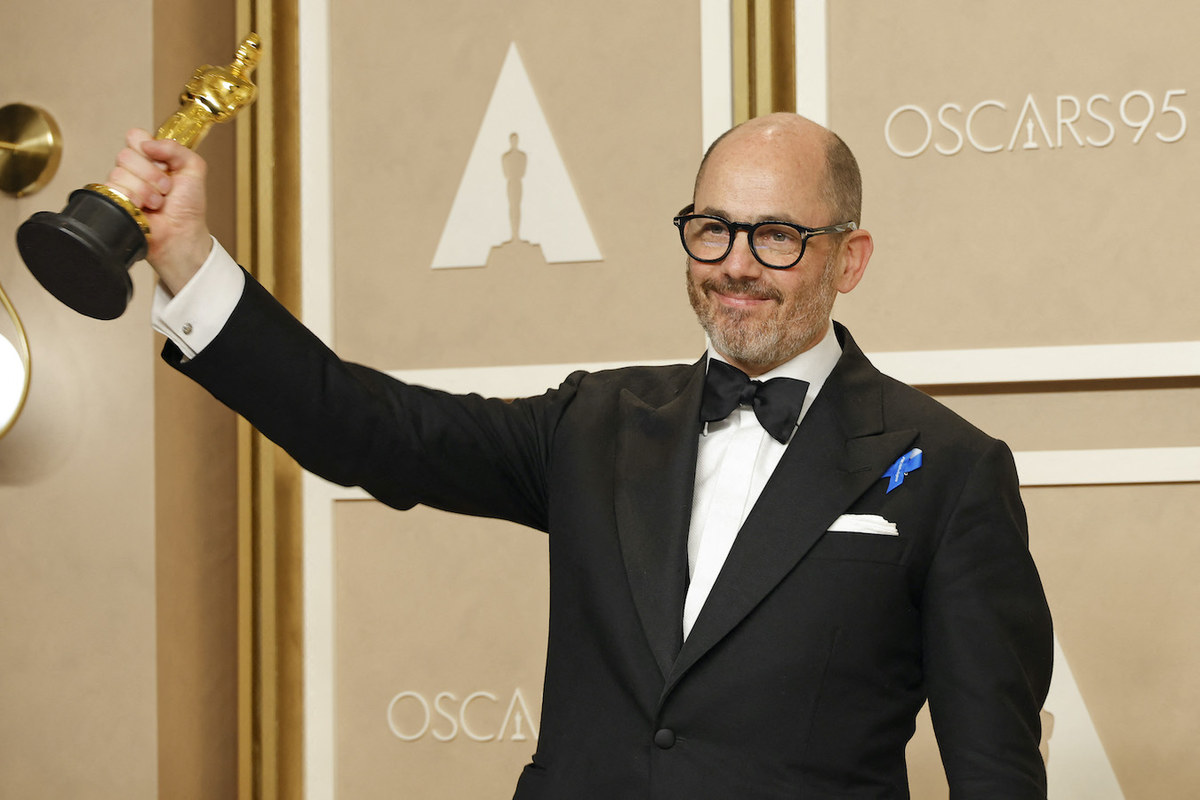


 Edward Berger, winner of the Academy Award for Best International Feature Film for "All Quiet on the Western Front", poses in the press room during the 95th Annual Academy Awards. (AFP)

Once in the trenches, he quickly becomes aware of the absurdity of war and the patriotic brain-washing that got him there.

In one of several graphic battle scenes which drew comparisons with Steven Spielberg’s “Saving Private Ryan,” Baeumer recognizes his enemy’s shared humanity.

A year into Russia’s invasion of Ukraine, German Culture Minister Claudia Roth hailed Berger’s epic when it scooped seven of Britain’s BAFTA prizes last month as “unfortunately the right film at the right time.”
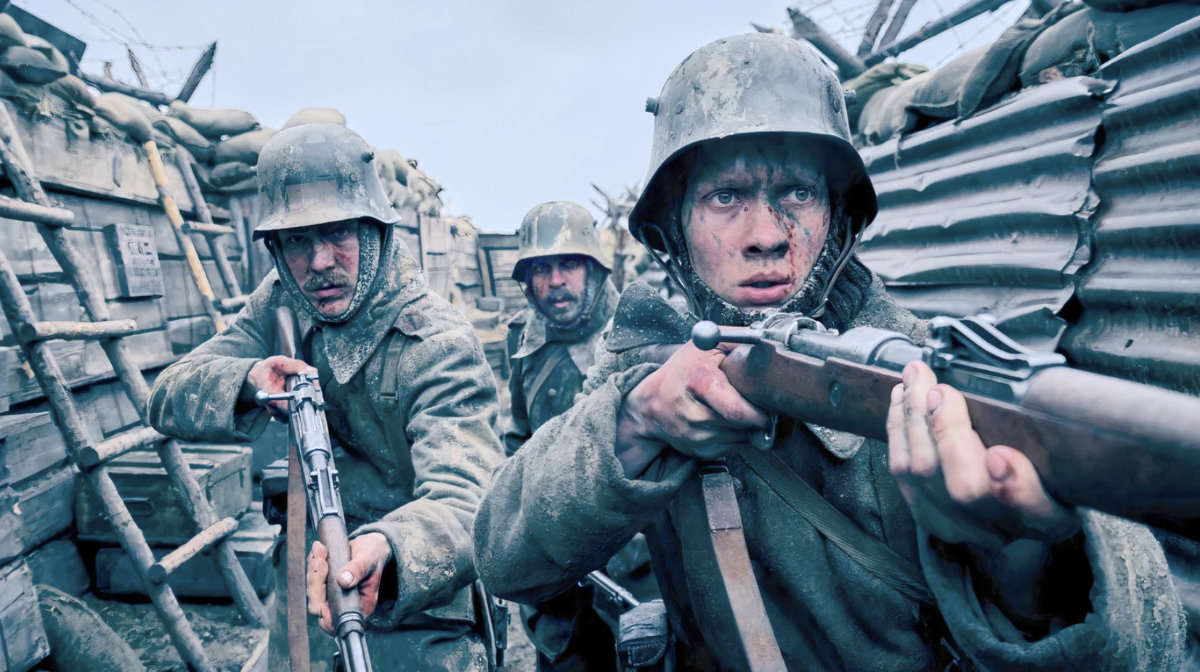


A scene from Netflix's film "All Quiet on the Western Front". (Screen grab from Netflix's official teaser video)

“It tackles the horrors of a war in the heart of Europe in a harrowing way... with unflinching images no one will easily forget,” she said.

Berger told AFP in Berlin last September as the picture premiered that the story was ripe for a fresh take.

“My film stands out from American or British (war) films made from the point of view of the victors,” he said.
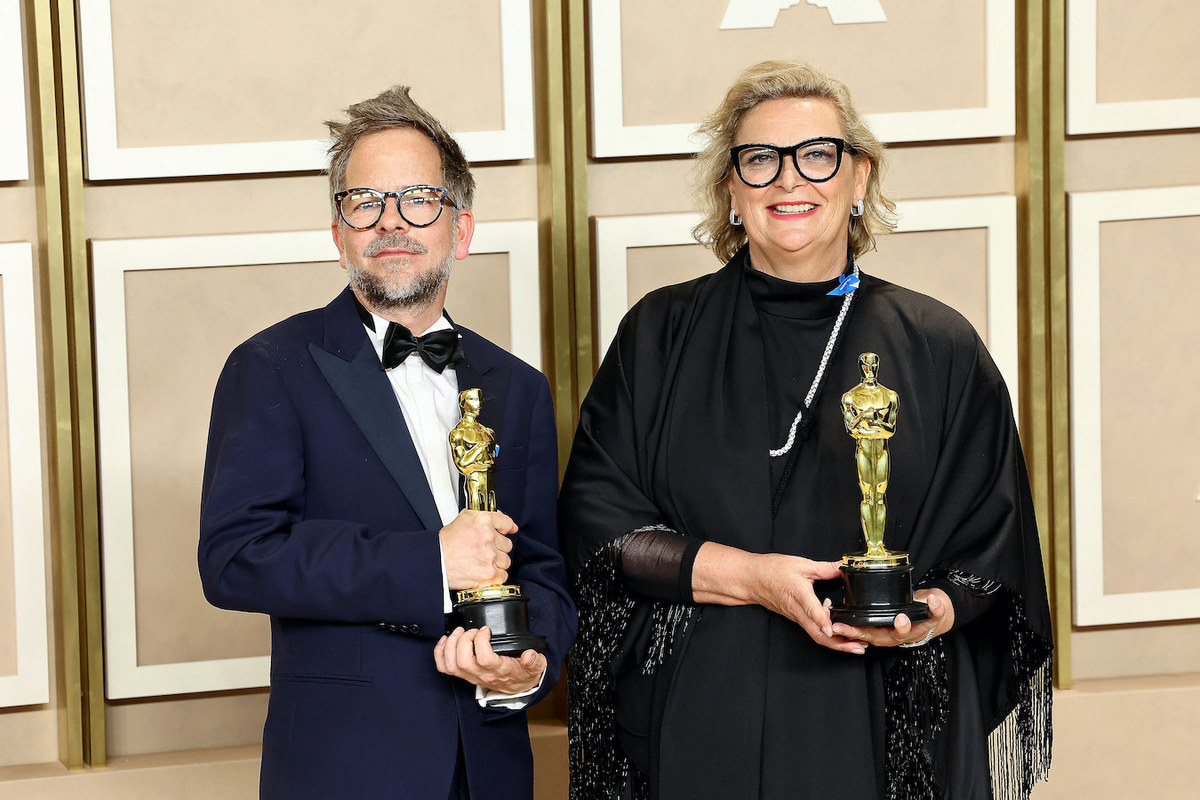


 (L-R) Ernestine Hipper and Christian M. Goldbeck, winners of the Best Production Design award for "All Quiet on the Western Front," pose in the press room during the 95th Annual Academy Awards. (AFP)

“In Germany, there is always this feeling of shame, mourning and guilt (surrounding war). It was important for me to present this perspective.”

Published in 1929, the novel is one of the most influential examples of pacifist literature ever written, translated into more than 60 languages.

Just one year after the book came out, a US film adaptation by Lewis Milestone was released which would win the Academy Awards for best picture and best director.

But its subversive message saw the work banned in Germany and targeted in the 1933 book burnings by the Nazis, who accused it of “betraying soldiers.”

Berger was previously best known for his 2018 Emmy-nominated minizeries “Patrick Melrose” starring Benedict Cumberbatch.


A cover of the book by Erich Maria Remarque, as advertised on Amazon.com.

He said he was pushed to accept “All Quiet” by his teenage daughter, who had just studied this book like several generations of high school students before her.
His adaptation of Remarque’s work aimed to show “the perspective of the vanquished,” he said.
This includes aspects not covered in the book: the signing of the armistice after World War I and the harsh conditions imposed on the Germans that later fed Nazi propaganda to justify nationalism and the outbreak of World War II.
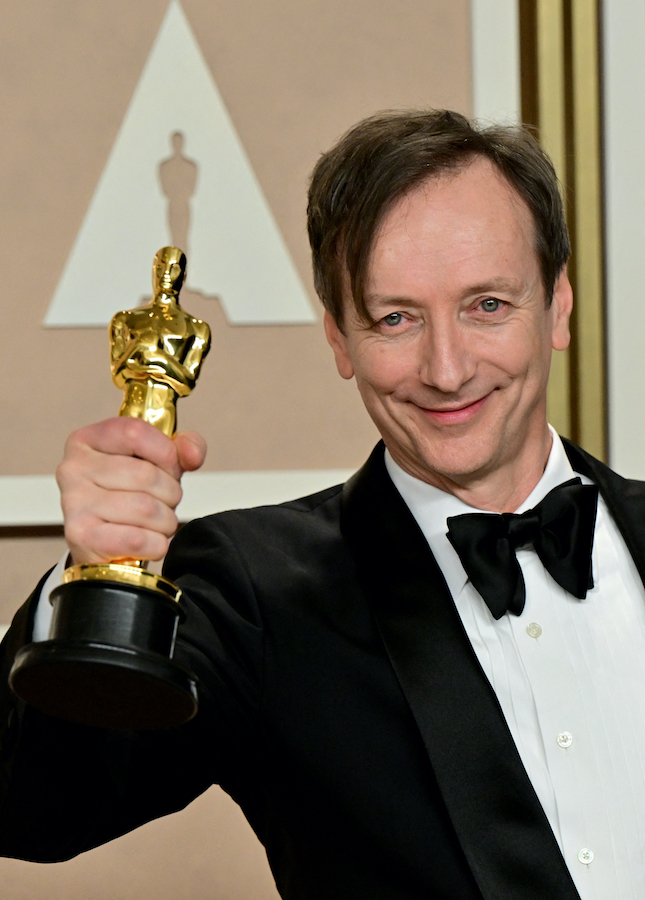


German pianist Volker Bertelmann poses with the Oscar for Best Music (Original Score) for "All Quiet on the Western Front" in the press room during the 95th Annual Academy Awards. (AFP)

German critics noted parallels with the current Russian onslaught in a story about a soldier fighting for a nationalist lie.
Martin Schwickert of the RND media group called the film “frighteningly current in light of the Ukraine war,” saying it “made plain what war means for those who have to fight it.”
The film proved popular in its home market, but reviews were mixed — and some were downright savage.
“In Germany, even after 100 years, one can’t see the difference between a good and a bad war film,” the daily Frankfurter Allgemeine Zeitung said.
The top-selling Bild however hailed the film as “brilliantly shot, wonderfully acted and packing a strong emotional punch.”
“A film everyone should see, especially in these times.”


List of 2023 Oscar winners

  • Best supporting actor: Ke Huy Quan, “Everything Everywhere All at Once”

  • Best supporting actress: Jamie Lee Curtis, “Everything Everywhere All at Once”

  • Best animated feature: “Guillermo del Toro’s Pinocchio”

  • Documentary feature: “Navalny”

  • Live action short: “An Irish Goodbye”

  • Cinematography: James Friend, “All Quiet on the Western Front”

  • Makeup and hairstyling: “The Whale”

  • Costume design: “Black Panther: Wakanda Forever”

  • International feature film: “All Quiet on the Western Front” (Germany)

  • Documentary short: “The Elephant Whisperers”

  • Animated short: “The Boy, the Mole, the Fox and the Horse”

  • Production design: “All Quiet on the Western Front”

  • Music (original score): Volker Bertelmann, “All Quiet on the Western Front” 


Riyadh takes shape at Tuwaiq Sculpture Symposium 2026

Updated 16 January 2026
Follow

Riyadh takes shape at Tuwaiq Sculpture Symposium 2026

RIYADH: This season, one of Riyadh’s busiest streets has taken on an unexpected role.

Under the theme “Traces of What Will Be,”sculptors are carving granite and shaping reclaimed metal at the seventh Tuwaiq Sculpture Symposium, running from Jan. 10 to Feb. 22.

The symposium is unfolding along Prince Mohammed bin Abdulaziz Road, known locally as Al‑Tahlia, a name that translates to desalination. The choice of location is deliberate.

The area is historically linked to Riyadh’s early desalination infrastructure, a turning point that helped to shift the city from water scarcity toward long‑term urban growth.

Twenty‑five artists from 18 countries are participating in this year’s event, producing large‑scale works in an open‑air setting embedded within the city.

The site serves as both workplace and eventual exhibition space, with sculptures remaining in progress throughout the symposium’s duration.

In her opening remarks, Sarah Al-Ruwayti, director of the Tuwaiq Sculpture Symposium, said that this year new materials had been introduced, including recycled iron, reflecting a focus on sustainability and renewal.

She added that the live-sculpting format allowed visitors to witness the transformation of raw stone and metal into finished artworks.

Working primarily with local stone and reclaimed metal, the participating artists are responding to both the material and the place.

For Saudi sculptor Wafaa Al‑Qunaibet, that relationship is central to her work, which draws on the physical and symbolic journey of water.

“My work … presents the connection from the salted water to sweet water,” Al‑Qunaibet told Arab News.

Using five pieces of granite and two bronze elements, she explained that the bronze components represented pipes, structures that carry saline water and allow it to be transformed into something usable.

The sculpture reflected movement through resistance, using stone to convey the difficulty of that transition, and water as a force that enables life to continue.

“I throw the stone through the difficult to show how life is easy with the water,” she said, pointing to water’s role in sustaining trees, environments and daily life.

Formally, the work relies on circular elements, a choice Al‑Qunaibet described as both technically demanding and socially resonant.

“The circle usually engages the people, engages the culture,” she said. Repeated circular forms extend through the work, linking together into a long, pipe‑like structure that reinforces the idea of connection.

Sculpting on site also shaped the scale of the piece. The space and materials provided during the symposium allowed Al‑Qunaibet to expand the work beyond her initial plans.

The openness of the site pushed the sculpture toward a six‑part configuration rather than a smaller arrangement.

Working across stone, steel, bronze and cement, American sculptor Carole Turner brings a public‑art perspective to the symposium, responding to the site’s historical and symbolic ties to desalination.

“My work is actually called New Future,” Turner told Arab News. “As the groundwater comes up, it meets at the top, where the desalination would take place, and fresh water comes down the other side.”

Her sculpture engages directly with the symposium’s theme by addressing systems that often go unseen. “Desalination does not leave a trace,” she said. “But it affects the future.”

Turner has been sculpting for more than two decades, though she describes making objects as something she has done since childhood. Over time, she transitioned into sculpture as a full‑time practice, drawn to its ability to communicate across age and background.

Public interaction remains central to her approach. “Curiosity is always something that makes you curious, and you want to explore it,” she said. Turner added that this sense of discovery is especially important for children encountering art in public spaces.

Saudi sculptor Mohammed Al‑Thagafi’s work for this year’s symposium reflects ideas of coexistence within Riyadh’s evolving urban landscape, focusing on the relationships between long‑standing traditions and a rapidly changing society.

The sculpture is composed of seven elements made from granite and stainless steel.

“Granite is a national material we are proud of. It represents authenticity, the foundation, and the roots of Saudi society,” Al‑Thagafi told Arab News.

“It talks about the openness happening in society, with other communities and other cultures.”

That dialogue between materials mirrors broader social shifts shaping the capital, particularly in how public space is shared and experienced.

Because the sculpture will be installed in parks and public squares, Al‑Thagafi emphasized the importance of creating multi‑part works that invite engagement.

Encountering art in everyday environments, he said, encouraged people to question meaning, placement, simplicity and abstraction, helping to build visual‑arts awareness across society.

For Al‑Thagafi, this year marked his fifth appearance at the symposium. “I have produced more than 2,600 sculptures, and here in Riyadh alone, I have more than 30 field works.”

Because the works are still underway, visitors can also view a small on‑site gallery displaying scaled models of the final sculptures.

These miniature models offer insight into each artist’s planning process, revealing how monumental forms are conceived before being executed at full scale.

As the symposium moves toward its conclusion, the completed sculptures will remain on site, allowing the public to encounter them in the environment that shaped their creation.