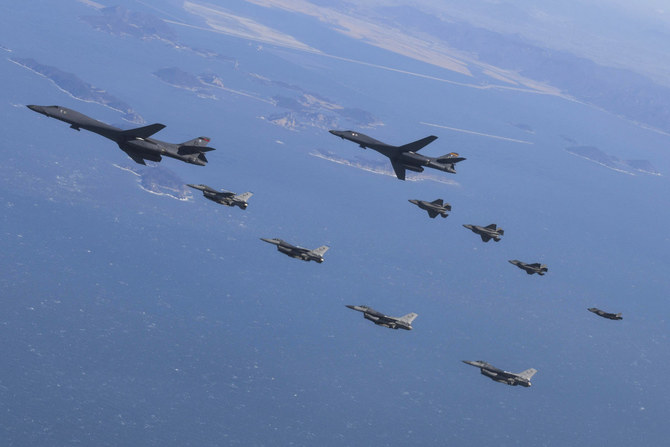

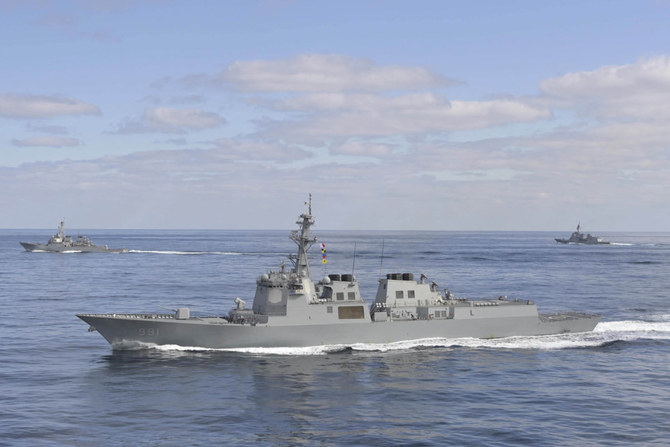

SEOUL: South Korea and the United States kicked off their largest joint military exercises in five years on Monday, after nuclear-armed Pyongyang warned such drills could be seen as a “declaration of war.”
Washington and Seoul have ramped up defense cooperation in the face of growing threats from the North, which has conducted a series of banned weapons tests in recent months.
The US-South Korea exercises, called Freedom Shield, are scheduled to run for at least 10 days from Monday and will focus on the “changing security environment” due to North Korea’s redoubled aggression, the allies said.
In a rare move, the Seoul military this month revealed that it and Washington special forces were staging “Teak Knife” military exercises — which involve simulating precision strikes on key facilities in North Korea — ahead of Freedom Shield.
All such exercises infuriate North Korea, which views them as rehearsals for an invasion.
It has said its nuclear weapons and missile programs are for self-defense.
Over the weekend, North Korea fired two “strategic cruise missiles” from a submarine in waters off its east coast, the official KCNA news agency reported Monday.
The agency cited the country’s “invariable stand” to confront a situation in which “the US imperialists and the South Korean puppet forces are getting ever more undisguised in their anti-DPRK military maneuvers.”
“Pyongyang has military capabilities under development it wants to test anyway and likes to use Washington and Seoul’s cooperation as an excuse,” said Leif-Eric Easley, a professor at Ewha University in Seoul.
DPRK is the initialism for North Korea’s official name, the Democratic People’s Republic of Korea.
In a separate statement, North Korea’s foreign ministry said the United States was “scheming” to call a UN Security Council meeting on human rights in the reclusive communist state, to coincide with the joint maneuvers.
“The DPRK bitterly denounces the US vicious ‘human rights’ racket as the most intensive expression of its hostile policy toward the DPRK and categorically rejects it,” the ministry said, according to KCNA.
Last year, the North declared itself an “irreversible” nuclear power and fired a record-breaking number of missiles, with leader Kim Jong Un last week ordering his military to intensify drills to prepare for a “real war.”
Washington has repeatedly restated its “ironclad” commitment to defending South Korea, including using the “full range of its military capabilities, including nuclear.”
South Korea, for its part, is eager to reassure its increasingly nervous public about the US commitment to so-called extended deterrence, in which US military assets, including nuclear weapons, serve to prevent attacks on allies.
Although the official policy of both countries toward the North — that Kim must give up his nukes and return to the table for talks — has not changed, experts said there had been a practical shift.
Washington has “effectively acknowledged that North Korea will never give up its nuclear program,” An Chan-il, a defector turned researcher who runs the World Institute for North Korea Studies, told AFP.
This Freedom Shield training is the first since that happened, meaning it “will be very different — both qualitatively and quantitatively — from previous joint exercises that took place in recent years,” he added.
North Korea, which recently called for an “exponential” increase in weapons production, including tactical nukes, had been widely expected to respond with missile launches and drills of its own — with experts saying more were likely over the course of the US-South Korean exercises.
“North Korea will use the Freedom Shield 2023 Exercise to unify its people and as an excuse to further invest in weapons of mass destruction,” said Chun In-bum, a retired South Korean army general.
“More missile launches with variations in style and scope should be expected with even a nuclear test. More acts of intimidation from North Korea should not come as a surprise.”
But Hong Min of the Korea Institute for National Unification said Pyongyang was not expected to “cross the red line.”
The North is likely to refrain from activities “at which the US and South Korea are forced to counter strike in response,” he said.