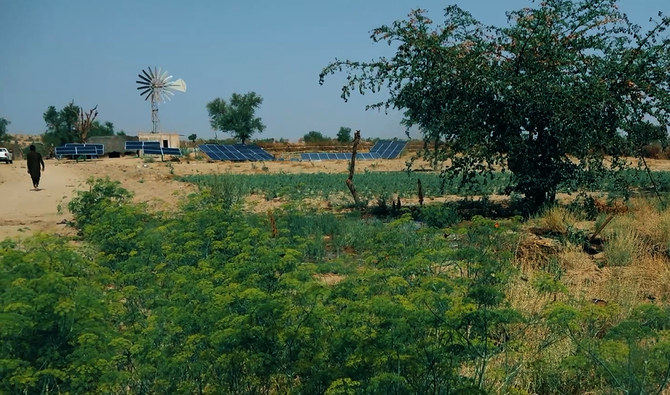

CHACHRO, Sindh: Farmers and experts say new cultivation initiatives using solar and wind irrigation systems have led to a significant increase in farm produce in Pakistan’s southern Thar Desert region, known for frequent droughts, malnutrition and food insecurity.
One beneficiary is 25-year-old farmer Ali Ahmed Rahimoon, who told Arab News he had grown enough wheat in his Tar Doas village to become a self-reliant farmer. The trick was installing solar and wind irrigation systems in an area that traditionally relies on rainwater for agriculture in the absence of rivers but where a low precipitation rate has been recorded in recent decades, proving a major obstacle to sustainable farming.
Food insecurity is such a grave problem in the region that the government regularly transports wheat and other grains to the area on subsidized rates from outside the desert to meet local demand. Now, however, Rahimoon said the new agricultural approach had the potential to change this equation for good.
“I was the first person [among local farmers] to experiment with agriculture using renewable energy in the Thar region,” he told Arab News. “After the initial experiments, I started relying on solar and wind-powered irrigation on a small level in 2020.”
“This year, by increasing the agricultural area, I cultivated wheat, cotton, pulses, and vegetables on seven acres out of a total of my 30 acres [of land],” he added.
“Much of what I have produced is wheat. That means I no longer need to purchase it from outside.”
Rahimoon said others in the desert were also experimenting with the new farming practices that used renewable energy. The Arid Zone Research Center (AZRC) in Tharparkar’s Umerkot district introduced the technique with a pilot project in 2018, which reaped successful results.
The AZRC also provided technical training and technology support to local farmers, helping them with various processes ranging from sowing to harvesting of the crops.
“The basic concept was to pump out underground water with solar and wind energy for cultivation,” Dr Attaullah Khan, Director Arid Zone Research Center Umerkot, said. “The initiative was aimed to make the Thar Desert self-reliant in food.”
He said Tharparkar had 200,000 hectares of cultivable land, while only one-third of groundwater in the region could be used for farming. The rest of the two-thirds, he added, was saline and could benefit alternate agriculture farming, such as shrub cultivation and other drought-resistant tree plantation, along with livestock management.
“So far, renewable energy-led cultivation has been applied to 156 acres [or 63 hectares] of land by about 20 farmers in Tharparkar district,” Khan added.
In the past, the paucity of food grains caused seasonal migrations from the region, as locals left their dwellings with animals and moved closer to rivers.
“The Thar Desert has remained a frequent victim of famine and food insecurity during the last three decades, leading to mass migrations,” Ali Akbar, executive director at the Association for Water, Applied Education and Renewable Energy, a non-governmental organization working on environmental issues in Sindh, told Arab News.
“However, this migration is likely to stop because of renewable-led agriculture.”
Akbar’s organization has distributed solar and wind energy panels to people in the desert to promote sustainable farming.
“Green farming in the Thar Desert is now a reality after successful experiments at the public level,” he said. “It is the need of the hour for the authorities to provide technical and financial assistance to the whole Thar Desert with new water conservation technologies so that the region’s potential can be translated into reality on a much bigger level.”
AZRC’s Khan concurred with Akbar, saying mass-level green farming in the desert could also significantly contribute to the country’s gross domestic product.
“Thar’s wasteland can feed the barren areas of the country,” he said, “and empower the farmers.”