Erdogan announces Turkiye elections will be held on May 14

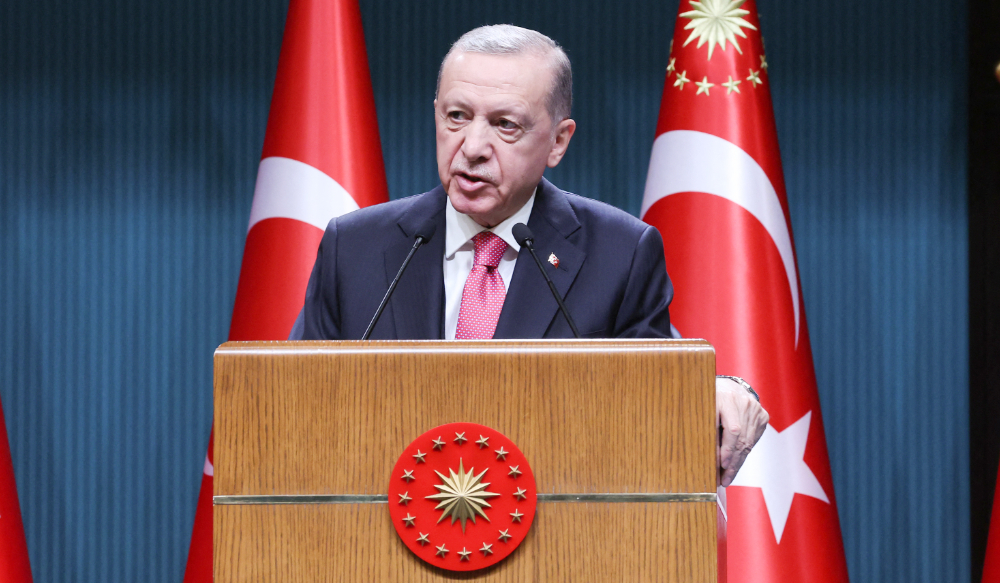
Turkish President Recep Tayyip Erdogan speaks after signing the decree announcing that national general elections will he held on May 14, at the Presidential Complex or Kulliye in Ankara on March 10, 2023. (AFP)
Short Url
Updated 10 March 2023
Follow

Erdogan announces Turkiye elections will be held on May 14

  • The polls are considered the country’s most significant in years, as the president faces an opposition bloc that is more strongly united in challenging his two-decade rule.

ANKARA: Presidential and parliamentary elections will be held in Turkiye on May 14, President Recep Tayyip Erdogan announced on Friday. A second presidential vote will take place on May 28 if a runoff is required.

These elections are considered the country’s most significant in many years, as the opposition bloc is united for the first time as it challenges Erdogan’s two-decade rule.

The opposition’s presidential candidate, Kemal Kilicdaroglu, is leader of the second-biggest party in the parliament, the center-left Republican People’s Party, or CHP. He has the backing of the six parties that form the opposition alliance.

The election campaigns are expected to evolve around the country’s ongoing economic crisis and allegations of mismanagement in the response to the devastating earthquakes that hit 11 provinces last month, killing more than 46,000 people and leaving hundreds of thousands homeless.

Ozgur Unluhisarcikli, the Ankara office director of think tank the German Marshall Fund of the United States, said that any move to postpone the elections would be contrary to Erdogan’s strategy and it is therefore expected the elections will go ahead on May 14, regardless of rumors to the contrary.

“Firstly, the Turkish economy is a ticking time bomb and unless the current monetary policy is abandoned, a currency crisis is a matter of time,” he told Arab News. “While such a crisis can probably be avoided until May, the risk will increase over time.

“Secondly, while Erdogan has significantly raised the minimum wage and civil servants’ salaries, these raises are eroding over time. Thirdly, the recent earthquake will cause additional problems for the economy in the long run.”

Therefore, Unluhisarcikli said, time is not on the ruling government’s side and it is in Erdogan’s best interest to hold the election before these negative factors kick in.

The pro-Kurdish Peoples’ Democratic Party, also known as the HDP, remains the potential kingmaker in the election, as it has not joined either of the two main alliances. It has declared its willingness to negotiate with Kilicdaroglu.

Recent research by Yoneylem, a Turkish polling firm, suggested that the chance of an opposition victory in the presidential election in the first ballot would increase if the HDP supports Kilicdaroglu.

Ilke Toygur, a professor at University Carlos III of Madrid and a senior associate at the Center for Strategic and International Studies’ Europe, Russia and Eurasia Program, believes Erdogan’s calculations about the election are based on two main factors: Preventing the opposition from consolidating, and assuming the economy will deteriorate further.

“The voters are already deeply impacted by high inflation and a cost-of-living crisis — and things just get worse,” she told Arab News.

The election race will not be easy for the opposition, either, according to Toygur.

“They have just announced their candidate after days of existential drama,” she said. “Both the media and the state resources are used against them. There are open law cases against some, which could be instrumentalized any minute.

“It is a very unfair competition. The situation after the earthquake opens up many questions about voter registration and participation.”


Lebanese PM urges swift approval of law aimed at paying back depositors

Updated 13 sec ago
Follow

Lebanese PM urges swift approval of law aimed at paying back depositors

BEIRUT: Lebanese Prime Minister Nawaf Salam urged the Cabinet to swiftly approve a draft law allowing depositors to gradually recover funds frozen in the banking system since a financial collapse in 2019, a move critical to reviving the economy.
The collapse — the result of decades of unsustainable financial policies, waste and corruption — led the state to default on its sovereign debt and sank the Lebanese pound.
The draft law marks the first time Beirut has put forward legislation aimed at addressing a vast funding shortfall — estimated at $70 billion in 2022 but now believed to be higher.

BACKGROUND

The draft law marks the first time Beirut has put forward legislation aimed at addressing a vast funding shortfall — estimated at $70 billion in 2022 but now believed to be higher.

The Cabinet approved several articles on Monday. Discussions would continue on Tuesday, Information Minister Paul Morcos said. Lebanon’s divided parliament must pass the law after cabinet approval.
Salam said the law is realistic and its goal is to do “justice to depositors,” also spurring recovery in the banking sector.
Finance Minister Yassine Jaber said implementation of the law would boost the economy, pumping deposits of $3-$4 billion annually into the system.
The draft, published on Friday, foresees repayments to small depositors – those with deposits valued at less than $100,000 – in monthly or quarterly instalments over four years.
Deposits larger than $100,000 will be repaid via tradable, asset-backed securities to be issued by the central bank or Banque du Liban, with no less than 2 percent of the value paid annually.
The maturity period will be set at 10 years for deposits valued at up to $1 million, at 15 years for deposits valued from $1 million to $5 million, and at 20 years for deposits valued at more than $5 million.
The securities will be backed by the income, revenues and returns of BdL-owned assets and any proceeds from the sale of assets, if any occur. The draft mentions precious metals, which have soared in value this year, as one possible source of income.
It says commercial banks will bear 20 percent of the responsibility for payments for the asset-backed securities. It says BdL and commercial banks will jointly finance the payments of the small deposits, with BdL’s share not exceeding 60 percent.
Debt owed by the state to BdL will be converted into a bond whose maturity and interest rate would be agreed between the Finance Ministry and BdL.
The Association of Banks in Lebanon has objected to the draft, saying on Sunday that the proposals do not reflect banks’ ability to meet “their obligations towards depositors” and that the state was not “fulfilling its outstanding debts to BdL.” 
Mike Azar, an expert on the financial system, said the law appeared to be intentionally vague on politically sensitive but critical questions.
“For example, what happens if the BdL or the banks can’t pay what they owe to depositors?” he said.

Swapping deposits for asset-backed securities issued by BdL could imply a big “contingent state debt,” he said. The government has yet to provide quantitative analysis underpinning the plan, including deposit repayment amounts, sources of funding, and bank recapitalization needs, he added.

Jaber noted that the value of BdL’s gold assets had risen with the price of gold since 2020, which would help provide confidence in the asset-backed securities.
The law requires an international auditing firm to evaluate BdL’s assets within one month to determine the size of the funding shortfall. Banks must also conduct an asset quality review and recapitalize.
The law would write off some dollar deposits.
These would include deposits that resulted from funds being converted into dollars from pounds at the official exchange rate long after it had collapsed as well as deposits containing illicit funds, in accordance with a law to counter money-laundering and financing for terrorism.