

Pakistani rupee depreciates further on continued uncertainty over IMF bailout

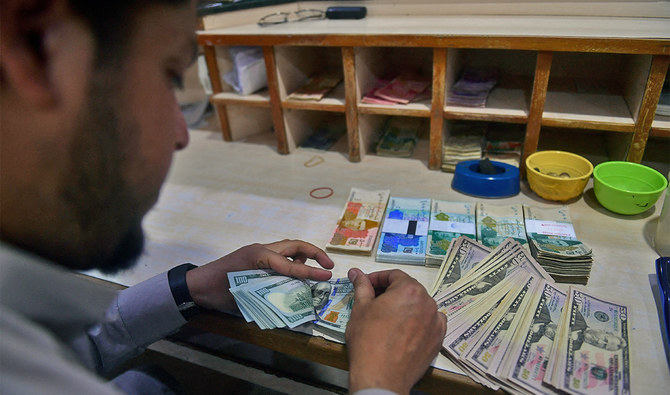
A dealer counts US dollars at a money exchange market in Karachi on January 26, 2023. (AFP/File)
Short Url
Updated 09 March 2023
Follow

Pakistani rupee depreciates further on continued uncertainty over IMF bailout

  • The rupee has been falling since January after foreign exchange companies removed a cap on the exchange rate
  • Market-based rate is key demand of IMF as part of programme of economic reforms it has agreed on with Pakistan

KARACHI: Pakistani currency dealers said on Thursday uncertainty continued to prevail in the market despite assurances from the government that it was close to finalizing a bailout deal with the International Monetary Fund, leading to the rupee depreciating further and trading at Rs282.30 against the United States dollar in the interbank market.

The rupee has been falling since January after foreign exchange companies removed a cap on the exchange rate, a key demand of the IMF as part of a program of economic reforms it has agreed on with the cash-strapped South Asian nation.

On Wednesday, the currency had closed at Rs279.12 against the USD in the interbank.

“Procrastination at IMF front is creating uncertainty in the market despite the assurance about signing a staff-level agreement with the IMF,” Zafar Sultan Paracha, general secretary of the Exchange Companies Association of Pakistan (ECAP), told Arab News. “The market wants to see some tangible actions at the IMF front.”

“The financial institutions are also involved in currency manipulation, while slow encashment by exporters and high demand from importers is also weakening the Pak rupee,” Paracha added.

Facing an acute balance of payments crisis, Pakistan is desperate to secure external financing, with less than three weeks’ worth of import cover in its foreign exchange reserves.

Pakistan secured a $6 billion IMF bailout in 2019. It was topped up with another $1 billion last year to help the country following devastating floods, but the IMF then suspended disbursements in November due to Pakistan’s failure to make more progress on fiscal consolidation.

While the move to remove the foreign exchange rate cap has increased the chances of a restart in IMF funding, Pakistan is also reeling from multi-decade high inflation, which economists fear will now get worse.

Most of Pakistan’s critical imports, including fuel, are paid for in dollars.


Pakistan denies reports army ordered ‘depopulation’ in Tirah Valley ahead of anti-militant operation

Updated 5 sec ago
Follow

Pakistan denies reports army ordered ‘depopulation’ in Tirah Valley ahead of anti-militant operation

  • Tirah Valley residents started fleeing homes this month ahead of a planned military operation against militants
  • Reports aimed at creating alarm among public, disinformation against security institutions, says information ministry

ISLAMABAD: Pakistan’s information ministry on Sunday denied reports the army has ordered depopulation in the northwestern Tirah Valley ahead of a planned anti-militant offensive, stating that any movement of residents from the area is voluntary. 

The denial from the government comes as residents of Tirah Valley in Pakistan’s northwestern Khyber Pakhtunkhwa (KP) province bordering Afghanistan flee their homes ahead of a planned military operation by the army against militants, particularly the Tehreek-e-Taliban Pakistan (TTP) group. 

Despite major military operations in the mid-2010s, Tirah Valley has remained a stronghold for insurgents, prompting authorities to plan what they describe as a targeted clearance.

“The government has taken notice of misleading claims in circulation regarding alleged ‘depopulation’ from Tirah Valley on the orders of the Army,” the Ministry of Information and Broadcasting (MoIB) said in a statement on Sunday. 

“These assertions are baseless, malicious, and driven by ulterior motives aimed at creating alarm among the public, disinformation against security institutions and furthering vested political interest.”

The ministry said Pakistan’s federal government and the armed forces had not issued directives for any such depopulation of the territory. It clarified that law enforcement agencies are “routinely conducting targeted, intelligence-based operations strictly against terrorist elements” with care to avoid disruption to peaceful civilian life. 

It said locals are increasingly concerned over presence of the “khawarij,” a term the military and government frequently use for the TTP, in Tirah Valley and desire peace and stability in the area.

The information ministry mentioned that the Khyber Pakhtunkhwa Relief, Rehabilitation and Resettlement Department issued a notification on Dec. 26 last year for the release of funds, reportedly Rs4 billion [$14.24 million], for the “anticipated temporary and voluntary movement of population from certain localities of Tirah.”

Families load their belongings onto vehicles in Pakistan’s Tirah Valley on January 15, 2026. (AN photo)

It also said that the notification mentioned that the deputy commissioner of Khyber District, where Tirah Valley is located, said the voluntary movement of people reflects the views of the local population articulated through a jirga at the district level. 

“Hence any stated position of the Provincial Government or their officials being conveyed to media that the said migration has anything to do with the Armed Forces is false and fabricated,” the information ministry said. 

“Given with malafide intent to gain political capital and unfortunately malign security institutions and therefore highly regrettable.”

The evacuation has exposed tensions between the provincial government, run by former prime minister Imran Khan’s Pakistan Tehreek-e-Insaf (PTI) party, and the military establishment over the use of force in the region.

“We have neither allowed the operation nor will we ever allow the operation,” KP Law Minister Aftab Alam Afridi said earlier this month, arguing that past military campaigns had failed to deliver lasting stability.

Pakistan military spokesperson Lt. Gen. Ahmed Shareef Chaudhry has previously defended security operations as necessary as militant attacks surge in the country. 

In a recent briefing, Chaudhry said security forces carried out 75,175 intelligence-based operations nationwide last year, including more than 14,000 in Khyber Pakhtunkhwa, attributing the surge in violence to what he described as a “politically conducive environment” for militants.