

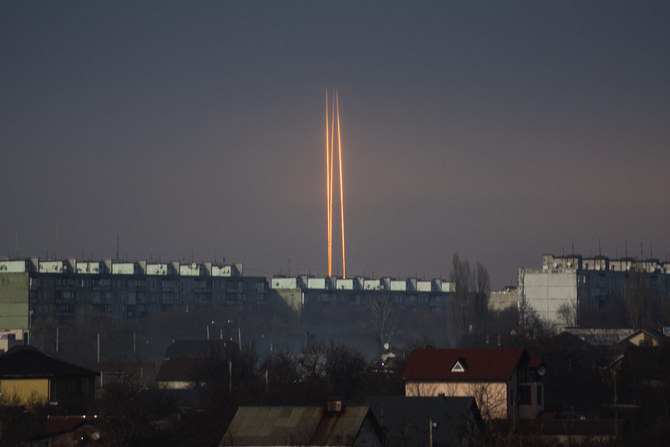
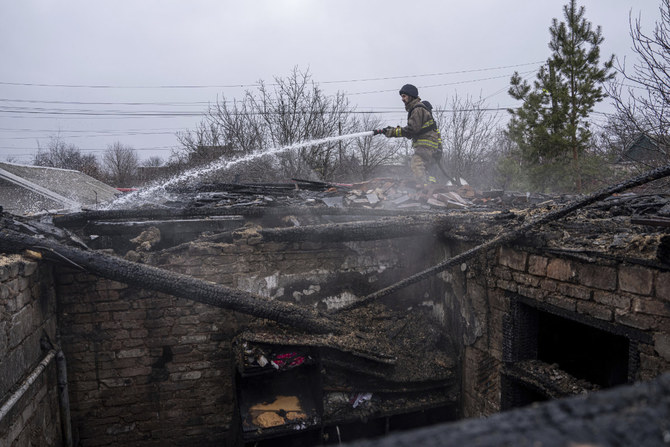

KYIV, Ukraine: Volleys of Russian missiles struck a series of Ukrainian regions early on Thursday, including the Black Sea port of Odesa and the second city of Kharkiv, knocking out power to several areas, regional officials said.
The governor of Odesa region, Maksym Marchenko, said on Telegram that a mass missile attack had hit an energy facility in the port city, cutting power. Residential areas had also been hit, but no casualties were reported.
Kharkiv region Governor Oleh Synehubov said the city and region had been hit by 15 strikes, with targets including infrastructure. Other strikes were reported in the central city of Dnipro and regions throughout the country.
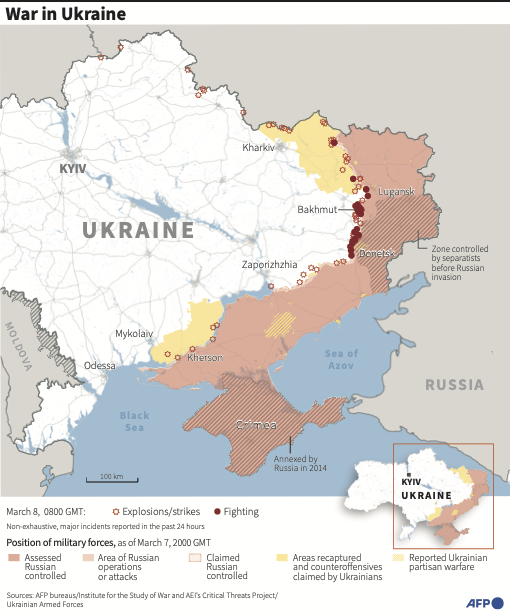
Late on Wednesday, Ukraine’s military said it had managed to push back intense Russian attacks on the city of Bakhmut despite a Russian claim of control over its eastern half.
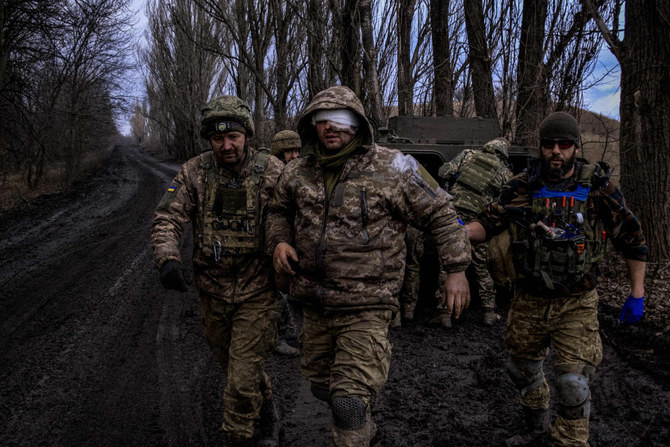
As one of the bloodiest battles of the year-long war ground on in the small city’s ruins, Ukrainian defenders — who last week appeared to be preparing for a tactical retreat — remained defiant.
“The enemy continued its attacks and has shown no sign of a letup in storming the city of Bakhmut,” the General Staff of the Ukrainian armed forces said on Facebook. “Our defenders repelled attacks on Bakhmut and on surrounding communities.”
Ukrainian military and political leaders now speak of hanging on to positions and inflicting as many casualties as possible on the Russians to grind down their fighting capability.
President Volodymyr Zelensky said in late Wednesday video address that the battle for Bakhmut and the surrounding Donbas region was “our first priority.”
In a separate interview with CNN, he said: “We think that in the Donbas direction Russia has started its offensive. This is the offensive. This is what it looks like: a slow aggression, because they don’t have enough strength and forces.”
Yevgeny Prigozhin, head of the Russian mercenary group Wagner, said his fighters had captured the eastern part of Bakhmut. If true, Russian forces would control nearly half the city in a costly pursuit of their first big victory in several months.
“Everything east of the Bakhmutka River is completely under the control of Wagner,” Prigozhin said on the Telegram messaging app.
The river bisects Bakhmut, on the edge of Ukraine’s Donetsk province that is already largely under Russian occupation. The city center is on the west side of the river.
Prigozhin has issued premature success claims before. Reuters was not able to verify the situation on the ground.
Ukrainian military analyst Oleh Zhdanov said that in addition to the Zabakhmutka district on the eastern outskirts of Bakhmut, the Russians had captured Ilyinivka district on the north side.
“The situation is critical,” he said in a video commentary, adding that Russian forces had also made gains near Avdiivka to the south of Bakhmut as well as to the north around Svatovo.
Arms buying push
Russia was throwing more troops into the battle, NATO Secretary-General Jens Stoltenberg said before a meeting of European Union defense ministers in Stockholm.
“They have suffered big losses, but at the same time we cannot rule out that Bakhmut may eventually fall in the coming days,” Stoltenberg said.
This would not necessarily be a turning point in the war but showed “we should not underestimate Russia,” he said.
EU defense ministers agreed to speed up the supply of artillery rounds and buy more shells to help Ukraine’s military, which is burning through shells faster than its allies can manufacture them.
Under the plan, EU states would get financial incentives worth 1 billion euros to send more of their artillery rounds to Kyiv, while another 1 billion euros would fund joint procurement of new shells.
Devastated cities
Russia has said it has annexed nearly 20 percent of Ukraine’s territory and says taking Bakhmut would be a step toward seizing the whole of the industrial Donbas region on its border.
Western analysts say Bakhmut has little strategic value, although its capture would be a boost to Russian President Vladimir Putin and his military after a series of setbacks in what they call their “special military operation.”
Kyiv says the losses suffered by Russia there could determine the course of the war, with Ukraine expected to launch a counteroffensive when the weather improves and it receives more Western military aid, including tanks.
The months of warfare in the east have been among the deadliest and most destructive since Russia invaded in February last year, adding Bakhmut’s name to a list of devastated cities that includes Mariupol, Sievierodonetsk and Lysychansk.
A Ukrainian military drone showed the scale of destruction in Bakhmut, filming apartment blocks on fire and smoke billowing from residential areas.
Iryna Vereshchuk, a deputy Ukrainian premier, said fewer than 4,000 civilians — including 38 children — out of a pre-war population of some 70,000 remain in Bakhmut.
US Director of National Intelligence Avril Haines told a Senate committee that Washington did not foresee the Russian military recovering enough this year to make major gains.
Russia casts its invasion of Ukraine as a response to threats to its security from its neighbor’s ties to the West.


