
BRUNECK: As land loss and soil erosion have threatened harvests across the globe for decades, Saudi Arabia is at the forefront of reshaping sustainable food culture for generations to come.
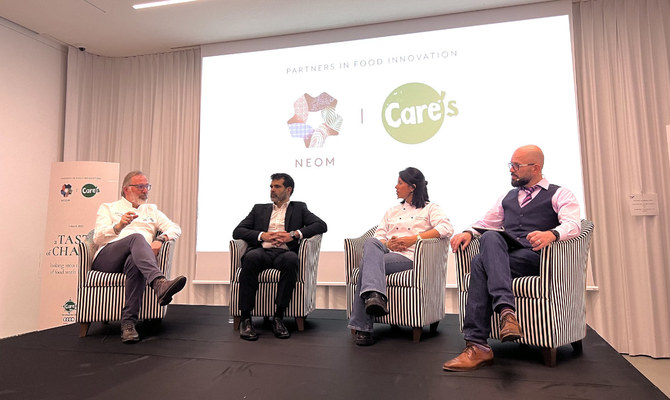
The NEOM smart city has announced a partnership with CARE’s, an organization committed to promoting ethical and sustainable food, during an event hosted in Bruneck’s AlpiNN Food Space & Restaurant in Italy.
The partnership will create a manifesto describing the principles of food security, innovative gastronomy, sustainable cooking and farming methods, and ethical supply.
The two key sustainability requirements relate to water use and soil conservation, and more will be determined as the partnership develops, the organizations said.
Juan Carlos Motamayor, executive director of NEOM’s food sector, told Arab News: “We have this focus on producing as much food as is economically efficient and pioneer in ways of becoming more self-sufficient when it comes to food.
“We (launched) the CARE’s partnerships to help us train chefs and professionals in the culinary industry, which will allow us to promote the consumption of locally-sourced food.”
The partnership aims to increase the percentage of locally-sourced food supplies, create awareness around food production methods in NEOM, establish quality training programs for Saudi chefs and achieve a Michelin star, or potentially a green star, restaurant in the upcoming years.
The training will also involve providing feedback to producers at NEOM city on how to elevate food production to align with the standards of the Kingdom’s advancing high-end cuisine industry.
Saudi Arabia is among the world’s biggest importers of fruits and vegetables. However, NEOM said that innovation and the use of local land to create a self-sufficient industry could revolutionize agriculture.
“NEOM is about diversifying the economy of the Kingdom through developing industries that tackle the greatest challenges that we’re facing,” Motamayor said.
“One of them is climate change, which impacts food production, and food production impacts climate change.
“To make food production and consumption more sustainable, we have to focus on demonstrating the value of technologies that are available at smaller scales, not necessarily at large commercial scales.”
He said that by demonstrating water efficiency and the ability to grow crops in high temperatures and drought, the model could potentially be implemented in countries across the globe, diminishing the effects of climate change as a potential result.
“Other regions in the world can use the technology and know-how we would like to support, not only from the NEOM region to the Kingdom, but beyond,” Motamayor said.
In partnership with CARE’s, NEOM will align the right expertise with the technologies needed to push the culinary industry forward.
Motamayor said: “There are multiple chef organizations with multiple stars, but CARE’s is the only organization in the world that has developed and promoted this 'Cook the Mountain' concept. It’s a concept where they tackle sustainability from multiple angles, but one of the key angles is the promotion of locally-sourced food.
“With the opportunity to have chefs like Norbert (Niederkofler) creating unique culinary offerings with Saudi chefs, we can bring attention to the benefits of having fresh food and having higher flavor and higher nutritional content.
The CARE’s program was originally conceived by chef Norbert Niederkofler of the St. Hubertus restaurant in San Cassiano and Paolo Ferretti, a business owner from Bolzano.
Cook the Mountain champions the restructuring of economic-social development by exploring the relationships between production, product, territory and consumption.
Norbert works with farmers, breeders, local producers, territory artisans, and chefs, taking on the role of an emotional educator promoting the idea of respecting nature and a region’s landscape.
“The next part of sustainability is the producers, farmers, growers, forages, to implement people like this in the whole process… With Cook the Mountain, we realized how important the local people are, especially because they know the soil, they know the land, they know what they can do with nature,” Niederkofler told Arab News.
The overall impact of the initiative also reduces food transportation carbon emissions, which creates around a third of the missions of the whole food industry.
While the initiative is able to be maintained for small restaurants such as AlpiNN, home to Cook the Mountain, it has yet to be implemented on a larger scale.
The partnership hopes to produce an actionable system in which millions of people can live a self-sufficient life, including NEOM’s The Line project which is projected to sustain nearly nine million residents by 2045.
“This is what we have to take responsibility: to put all the knowledge that we built up in the last years from our side, work together with scientists and see what kind of solutions we can find for the future,” Niederkofler said.
It is predicted that the worldwide arable lands only have 30 harvests remaining until complete depletion, Motamayor said, and the Global Soil Partnership reported that 75 billion tons of soil is eroded every year.
Through the right training on respectful food sourcing, ethical supply, and a focus on workers’ welfare, chef Norbert believes that Saudi talents have the potential to pave the way globally for an alternative urban living system.
He said: “When you respect nature around you, you can get three (Michelin) stars, even with a green star — because we showed it and it was done. This means that you maintain the culture of a country and imitate the traditions of a country.
“The most important thing for the future is the roots. When you maintain this and in this way, as a young chef from Saudi, they have the chance to go up to the top.”