Four dead in latest Egypt train crash

1 / 3
Policemen and first responders arrive at the scene of a train accident in the city of Qalyub in Qalyub province. (AFP)
2 / 3
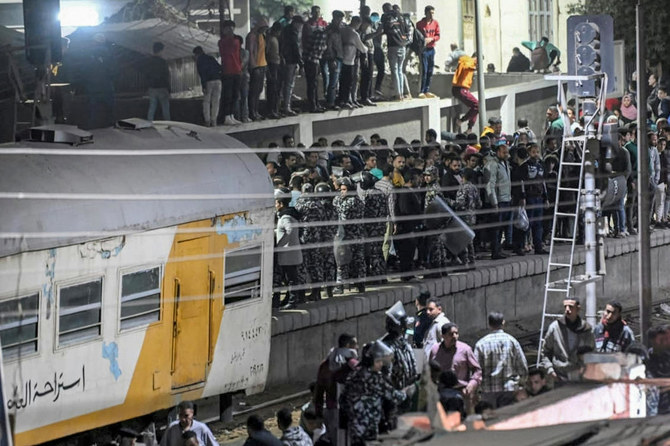
Policemen form a perimeter as people gather at the scene of a train accident in the city of Qalyub in Qalyub province (AFP)
3 / 3
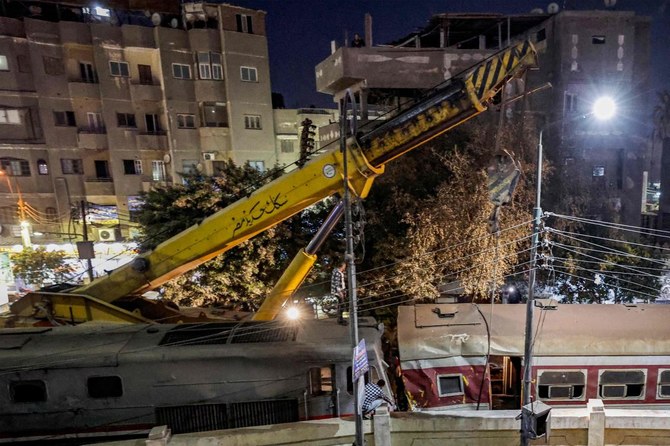
A crane is deployed to lift a derailed train at the scene of a railroad accident in the city of Qalyub in Qalyub province. (AFP)
Short Url
Updated 08 March 2023
Follow

Four dead in latest Egypt train crash

  • 20 people were also injured

CAIRO: A train crash in Egypt killed four people and injured more than 20, officials said Wednesday about the latest in a series of deadly accidents blamed on aging infrastructure and mismanagement.

The train overshot the station and ran into the buffers at the end of the track after passing through a stop signal, in the Nile Delta city of Qalyub north of Cairo, the National Railways Authority said.

“That led to the derailment of the locomotive and the first carriage,” it added in a statement.

Pictures from the scene showed emergency crews overnight using a crane to lift the derailed coach that appeared to be partially crumpled.

Egypt’s Health Ministry later gave the final toll of four killed and 23 injured, doubling the number of dead that had been announced overnight.

Families of those killed in the latest train tragedy will receive compensation worth 100,000 Egyptian pounds (around $3,000), said the Solidarity Ministry.

A similar amount will go to those seriously injured, a statement said.

President Abdel Fattah El-Sisi has vowed to hold to account those responsible for recurrent deadly rail accidents in Egypt, the Arab world’s most populous country.

In April 2021, Transport Minister Kamel El-Wazir fired the rail authority’s head following uproar over mismanagement of dilapidated train lines.

The sacking came after two train accidents within less than a month that killed more than 40 people.

Egypt’s worst railway tragedy occurred in 2002, when a fire ripped through a train killing more than 370 people just outside Cairo.

Egypt’s 105 million people depend largely on rail transport, but the network, although one of the largest on the African continent, is riddled with problems.

After the 2021 tragedies, the transport minister had acknowledged that “the human element” is often to blame for the deadly accidents.

Wazir vowed at the time that an automated network would be set up by 2024 — part of marquee projects promised by El-Sisi’s administration.

The projects also include the construction of a new high-speed network to replace existing lines for which contracts have been awarded.

Egypt’s roads also see frequent deadly accidents which are often blamed on poor maintenance and rules flouted by drivers.

In 2021, around 7,000 people were killed on Egyptian roads, according to official figures.


Sudan defense minister welcomes UN sanctions on RSF leaders as ‘long overdue’

Updated 7 sec ago
Follow

Sudan defense minister welcomes UN sanctions on RSF leaders as ‘long overdue’

  • Yassin Ibrahim said charges against commanders who perpetuated “atrocities of a kind rarely seen across broad stretches of history” were a “step in the right direction”
  • Among those targeted were RSF deputy commander Abdul Rahim Hamdan Dagalo, Brig. Gen. Al-Fateh Abdullah Idris, known as “the butcher of El-Fasher,” deputy commander Gedo Hamdan Ahmed and field commander Tijani Ibrahim

LONDON: Sudan’s Defense Minister Yassin Ibrahim on Wednesday called UN sanctions on Rapid Support Forces leaders “long overdue,” but a “step in the right direction.”

“Imposing sanctions on individuals or leaders of the Rapid Support Forces is long overdue. Nevertheless, it remains a step in the right direction,” he said.

“These crimes constitute war crimes, genocide and atrocities of a kind rarely seen across broad stretches of history. There should be far more charges brought forward, with arrest warrants issued not only against senior leadership but also against mid-level commanders operating on the ground — in addition to members of the ‘government of establishment,’ which serves as the political wing of the Rapid Support Forces.

“A new commander has recently joined their ranks within the ‘government of establishment,’ now operating in coordination with the Rapid Support Forces; the forces of Abdelaziz Al-Hilu and Joseph Tuka in Blue Nile.”

The UN Security Council imposed sanctions on four RSF leaders over atrocities in the western Sudanese city of El-Fasher. Among those targeted were RSF deputy commander Abdul Rahim Hamdan Dagalo and Brig. Gen. Al-Fateh Abdullah Idris, known as “the butcher of El-Fasher.” RSF deputy commander Gedo Hamdan Ahmed and field commander Tijani Ibrahim were also targeted.

The move, which followed recommendations by the US, UK and France, was submitted on Feb. 17 and aimed to include the leaders within the sanctions system established under Resolution 1591. The measures include travel bans and asset freezes to help curb the violence in Sudan.

The RSF’s capture of El-Fasher in October was one of the most brutal episodes of Sudan’s nearly three-year civil war. Last week, a UN fact-finding mission concluded that the takeover bore the hallmarks of genocide.

In a related move, the US Treasury’s Office of Foreign Assets Control last week sanctioned three RSF commanders for actions in El-Fasher, accusing them of “perpetrating a horrific campaign of ethnic killings, torture, starvation and sexual violence.” Those targeted were Idris, Gedo and Tijani Ibrahim.

The sanctions followed a UN Security Council statement on Tuesday that “strongly condemned” the RSF’s assault and destabilization in the Kordofan region and “all forms of violations and abuses committed against the civilian population.”

The UN council called on the warring parties to “immediately halt the fighting,” warning that deliberate attacks on humanitarian personnel “may constitute war crimes.”

Members also expressed “grave concern” over conflict-induced famine and extreme food insecurity in parts of Sudan, warning the crisis risks spreading.

The RSF has acknowledged “violations” in El-Fasher and said that it is investigating, but insists the scale of atrocities has been exaggerated by its enemies.