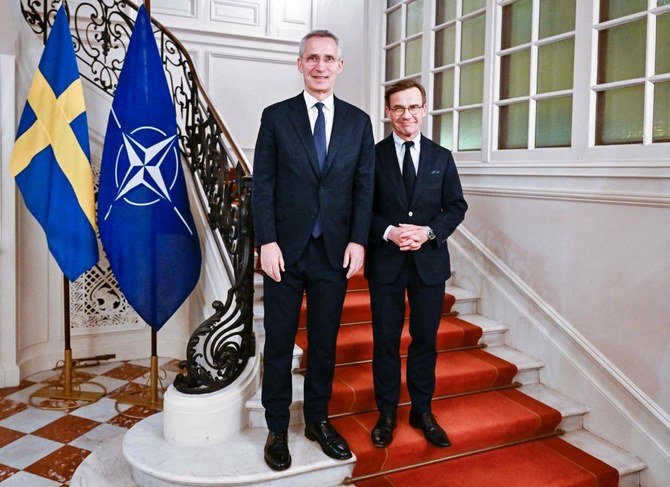
STOCKHOLM: NATO Security General Jens Stoltenberg said Tuesday that he saw some “progress” in Sweden and Finland’s stalled bids to join, ahead of talks with Turkiye set to restart this week.
Turkiye and Hungary are the only NATO members still to ratify the bids of the Nordic nations, which must be accepted by all 30 existing members of the military organization.
Ankara had suspended negotiations with Sweden and Finland in outrage after protests in January that included the burning of the Qur'an outside its embassy in Stockholm.
A new round of talks announced by Turkiye last month will take place at NATO headquarters in Brussels on Thursday.
Stoltenberg insisted on a visit to Sweden that getting the memberships finalized was “a top priority.”
“We are making progress,” he said at a press conference with the Swedish prime minister.
Stoltenberg said Stockholm “has delivered” on a deal with Turkiye inked last year that was meant to pave the way to NATO membership.
“The time has come to finalize the ratification process,” he said.
Two previous rounds of the tri-party NATO talks were attended by foreign ministry officials and focused on a specific list of Turkish demands, which include the expulsion of dozens of mostly Kurdish suspects.
Stoltenberg refused to speculate on the results of the fresh negotiations this week.
Turkiye has raised the prospect of accepting Finland without letting Sweden’s application through.
NATO officials are skeptical about splitting up the bids, but increasingly accept Helsinki may join first.
Turkish President Recep Tayyip Erdogan has dug in his heels on Sweden as he heads into a close presidential election in which he is trying to energise his nationalist electoral base.
Stoltenberg said that he also expected Hungary’s parliament to complete the process of ratifying the applications “shortly.”
That came as a visiting Hungarian parliamentary delegation said Swedish politicians need to stop spreading “lies” about Budapest and the rule of law.
Budapest is still expected to vote in favor of both countries joining the alliance “in the coming weeks,” the deputy speaker of the Hungarian parliament Csaba Hende told reporters in Stockholm.
Both Finland and Sweden dropped their decades-long policies of military non-alignment and applied to join the alliance last May in the wake of Moscow’s invasion of Ukraine.

NATO chief sees ‘progress’ on Sweden, Finland bids
Short Url
https://arab.news/9nb8z
NATO chief sees ‘progress’ on Sweden, Finland bids
- A new round of talks announced by Turkiye last month will take place at NATO headquarters in Brussels on Thursday
- Stoltenberg insisted on a visit to Sweden that getting the memberships finalised was "a top priority"
Russian pensioners turn to soup kitchen as war economy stutters
SAINT PETERSBURG: Dishes clatter, steam bursts from large cooking pots and music is seeping through the bustling chatter of Russian pensioners, hunched over bowls of free meals in a Saint Petersburg soup kitchen.
The general mood is upbeat but the place, at full capacity, is a testament to financial hardships plaguing an ever-increasing number of Russia’s elderly people, struggling to make ends meet as the country’s war economy stutters.
Nina, a 77-year-old retired engineer, said she could no longer go to the supermarket, getting her lunch and dinner from the soup kitchen instead, as she was not able to afford her own groceries.
“I haven’t been to a shop for three years because I don’t have the money. There’s simply no point in going,” she told AFP, her voice resolute but eyes glistening.
“Should I just go, look around and leave?,” she asked.
The cost of living in Russia — particularly in large cities — has skyrocketed in the four years since Moscow launched its full-scale offensive in Ukraine.
Huge spending on the military helped Russia buck predictions of economic collapse, but has pushed up inflation — a headache for the Kremlin which has aimed to shield citizens from the fallout of its war.
Prices have surged by a combined 45 percent since Russia launched its offensive, according to official data.
And though President Vladimir Putin recently hailed a cooling of inflation amid high interest rates, pensioners in the Saint Petersburg soup kitchen say their situation is still dire.
- ‘Poor boys’ -
On a bright winter day, AFP met former accountants, doctors and engineers turning to the free bowls of soup and pasta on offer.
Zinaida, a 77-year-old former paediatrician, told AFP her pension was 26,400 rubles ($345) a month.
“Over the last two to three years, we have seen food prices rise,” Zinaida said, attributing the surge to raising taxes.
In order to plug holes in Russia’s stretched public finances, the Kremlin has tapped the pockets of its citizens, raising the nationwide sales tax from 20 to 22 percent, starting this year.
For many pensioners like Zinaida, juggling monthly expenses has become increasingly tricky.
“By our age, everyone has a whole load of illnesses,” she said, and the medications were “very expensive.”
“You work just to pay for the utilities and the pharmacy. There is almost nothing left for anything else.”
That sentiment is shared by Anna, 66, who, despite a career as a surgeon, said she struggled to pay her bills in retirement.
“When you go to the pharmacy, you start to wonder if you’ll be able to buy anything for lunch.”
The Central Bank, which has hiked borrowing costs in a bid to tame price rises, expects annual inflation to ease to Moscow’s four-percent target only in 2027.
That is just one of the Russian economy’s worsening indicators as the war in Ukraine drags into its fifth year.
Growth slowed dramatically to one percent in 2025, Putin said earlier this week — down from 4.3 a year prior.
But for Tatyana, a former accountant, “it’s only fair that things should get more expensive.”
“We have this war going, with our poor boys there. May God grant them all good health.”
The general mood is upbeat but the place, at full capacity, is a testament to financial hardships plaguing an ever-increasing number of Russia’s elderly people, struggling to make ends meet as the country’s war economy stutters.
Nina, a 77-year-old retired engineer, said she could no longer go to the supermarket, getting her lunch and dinner from the soup kitchen instead, as she was not able to afford her own groceries.
“I haven’t been to a shop for three years because I don’t have the money. There’s simply no point in going,” she told AFP, her voice resolute but eyes glistening.
“Should I just go, look around and leave?,” she asked.
The cost of living in Russia — particularly in large cities — has skyrocketed in the four years since Moscow launched its full-scale offensive in Ukraine.
Huge spending on the military helped Russia buck predictions of economic collapse, but has pushed up inflation — a headache for the Kremlin which has aimed to shield citizens from the fallout of its war.
Prices have surged by a combined 45 percent since Russia launched its offensive, according to official data.
And though President Vladimir Putin recently hailed a cooling of inflation amid high interest rates, pensioners in the Saint Petersburg soup kitchen say their situation is still dire.
- ‘Poor boys’ -
On a bright winter day, AFP met former accountants, doctors and engineers turning to the free bowls of soup and pasta on offer.
Zinaida, a 77-year-old former paediatrician, told AFP her pension was 26,400 rubles ($345) a month.
“Over the last two to three years, we have seen food prices rise,” Zinaida said, attributing the surge to raising taxes.
In order to plug holes in Russia’s stretched public finances, the Kremlin has tapped the pockets of its citizens, raising the nationwide sales tax from 20 to 22 percent, starting this year.
For many pensioners like Zinaida, juggling monthly expenses has become increasingly tricky.
“By our age, everyone has a whole load of illnesses,” she said, and the medications were “very expensive.”
“You work just to pay for the utilities and the pharmacy. There is almost nothing left for anything else.”
That sentiment is shared by Anna, 66, who, despite a career as a surgeon, said she struggled to pay her bills in retirement.
“When you go to the pharmacy, you start to wonder if you’ll be able to buy anything for lunch.”
The Central Bank, which has hiked borrowing costs in a bid to tame price rises, expects annual inflation to ease to Moscow’s four-percent target only in 2027.
That is just one of the Russian economy’s worsening indicators as the war in Ukraine drags into its fifth year.
Growth slowed dramatically to one percent in 2025, Putin said earlier this week — down from 4.3 a year prior.
But for Tatyana, a former accountant, “it’s only fair that things should get more expensive.”
“We have this war going, with our poor boys there. May God grant them all good health.”
© 2026 SAUDI RESEARCH & PUBLISHING COMPANY, All Rights Reserved And subject to Terms of Use Agreement.


