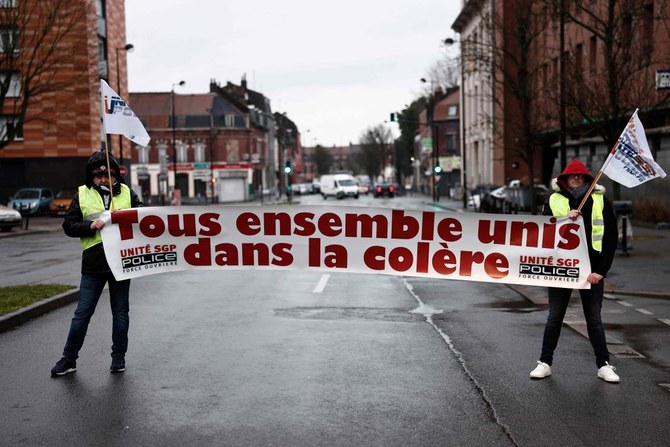
PARIS: France’s trade unions headed for a crucial face-off against President Emmanuel Macron on Tuesday, with fresh strikes and protests planned against a controversial pensions reform that would push back the retirement age for millions.
Unions have vowed to bring the country to a standstill over the proposed changes, which include raising the minimum retirement age to 64 from 62 and increasing the number of years people have to make contributions for a full pension.
“I call on all the country’s employees, citizens and retirees who are against the pensions reform to come out and protest en masse,” the head of the CFDT union Laurent Berger told the France Inter radio station Monday.
“The president cannot remain deaf” to the protests, he added.
Macron put the plan at the center of his re-election campaign last year, and his cabinet says the changes are essential to prevent the pensions system from falling into deficit in coming years.
But they face fierce resistance from both parliament and the street, with almost two in three people across the country supporting protests against it, according to a poll by the Elabe survey group published Monday.
“They’re right to be striking,” said Ali Toure, a 28-year-old construction worker, as he waited for a delayed RER suburban train at a station north of Paris.
“Manual labor is hard. It’s no big deal if I arrive late for a month, my boss will wait!” he said.
The hard-line CGT union said fuel deliveries from refineries across France had been blocked from Tuesday morning, which could see petrol stations running short if the protests continue as unions hope.
“The strike has begun everywhere... with deliveries blocked from all the refineries this morning,” said Eric Sellini, branch coordinator for the CGT.
Unions have warned of rolling strikes on public transport that could paralyze parts of the country for weeks on end.
Police expect 1.1 million to 1.4 million people to hit the streets Tuesday in more than 260 locations nationwide, a source has told AFP on condition of anonymity.
The upper limit of that range would mean stronger opposition than during the five previous days of rallies that have taken place since mid-January.
On the biggest day of demonstrations so far, 1.27 million people demonstrated on January 31, according to official figures.
Demonstrations were already forming early Tuesday morning, with the public road information service reporting that a national road in the city of Rennes had been blocked by around 100 protesters since 1 am.
In the lead-up to Tuesday, unions had promised to bring the country “to a standstill.”
Only one in five regional and high-speed trains are expected to run, while a leading trade unionist representing refinery workers has vowed to bring the French economy “to its knees.”
School teachers are also to stage walkouts.
Prime Minister Elisabeth Borne told French television Monday that while she respected the right to protest, a nationwide standstill would primarily penalize “the most fragile” among the population.
The government has argued that the changes are crucial to keep France’s pensions system from falling into deep deficts in the coming years.
“If we want to keep this system going, we need to work longer,” Macron said last month.
But unions contest that conclusion and say small increases in contributions could keep it solvent. They also argue that the proposed measures are unfair and would disproportionately affect low-skilled workers in tiring jobs who start their careers early.
According to an Elabe survey, 56 percent of respondents said they supported rolling strikes, and 59 percent backed the call to bring the country to a standstill.
The bill is now being debated in the upper house of parliament, after two weeks of heated debate in the lower house that ended without even reaching a vote on raising the retirement age.
Monday’s Senate debate dragged on until after 3 am Tuesday morning, with the body’s right-leaning majority shooting down alternative proposals for funding the pensions system fielded by the left. Debate is slated to resume at 2:30 pm.
The centrist government is hoping to push through the reform in parliament with help from the right, without resorting to a controversial mechanism that would bypass a parliamentary vote but risk fueling more protests.

France faces ‘standstill’ in protests against pensions overhaul
Short Url
https://arab.news/reurf
France faces ‘standstill’ in protests against pensions overhaul
- Unions vowed to bring France to a standstill over pension changes, which include raising the minimum retirement age to 64
- Cabinet says the changes are essential to prevent the pensions system from falling into deficit in coming years
Journalists in Bangladesh demand protection amid rising attacks
- Media industry in the South Asian country is being systematically targeted
- Interim government blamed for failing to adequately respond to the incidents
DHAKA: Journalists, editors and owners of media outlets in Bangladesh on Saturday demanded that authorities protect them following recent attacks on two leading national dailies by mobs.
They said the media industry in the South Asian country is being systematically targeted in the interim government headed by Nobel Peace Prize laureate Muhammad Yunus. They said the administration failed to prevent attacks on the Daily Star, the country’s leading English-language daily, and the Prothom Alo, the largest Bengali-language newspaper, both based in Dhaka, the capital.
In December, angry mobs stormed the offices of the two newspapers and set fire to the buildings, trapping journalists and other staff inside, shortly after the death of a prominent Islamist activist.
The newspaper authorities blamed the authorities under the interim government for failing to adequately respond to the incidents despite repeated requests for help to disperse the mobs. Hours later, the trapped journalists who took shelter on the roof of the Daily Star newspaper were rescued. The buildings were looted. A leader of the Editors Council, an independent body of newspaper editors, was manhandled by the attackers when he arrived at the scene.
On the same day, liberal cultural centers were also attacked in Dhaka.
It was not clear why the protesters attacked the newspapers, whose editors are known to be closely connected with Yunus. Protests had been organized in recent months outside the offices of the dailies by Islamists who accused the newspapers of links with India.
On Saturday, the Editors Council and the Newspapers Owners Association of Bangladesh jointly organized a conference where editors, journalist union leaders and journalists from across the country demanded that the authorities uphold the free press amid rising tensions ahead of elections in February.
Nurul Kabir, President of the Editors Council, said attempts to silence media and democratic institutions reflect a dangerous pattern.
Kabir, also the editor of the English-language New Age daily, said unity among journalists should be upheld to fight such a trend.
“Those who want to suppress institutions that act as vehicles of democratic aspirations are doing so through laws, force and intimidation,” he said.
After the attacks on the two dailies in December, an expert of the United Nations said that mob attacks on leading media outlets and cultural centers in Bangladesh were deeply alarming and must be investigated promptly and effectively.
“The weaponization of public anger against journalists and artists is dangerous at any time, and especially now as the country prepares for elections. It could have a chilling effect on media freedom, minority voices and dissenting views with serious consequences for democracy,” Irene Khan said in a statement.
Yunus came to power after former Prime Minister Sheikh Hasina fled the country amid a mass uprising in August, 2024. Yunus had promised stability in the country, but global human rights groups including Human Rights Watch and Amnesty International have blamed the government for its failure to uphold human and other civil rights. The Yunus-led regime has also been blamed for the rise of the radicals and Islamists.
Dozens of journalists are facing murder charges linked to the uprising on the grounds that they encouraged the government of Hasina to use lethal weapons against the protesters. Several journalists who are known to have close links with Hasina have been arrested and jailed under Yunus.
They said the media industry in the South Asian country is being systematically targeted in the interim government headed by Nobel Peace Prize laureate Muhammad Yunus. They said the administration failed to prevent attacks on the Daily Star, the country’s leading English-language daily, and the Prothom Alo, the largest Bengali-language newspaper, both based in Dhaka, the capital.
In December, angry mobs stormed the offices of the two newspapers and set fire to the buildings, trapping journalists and other staff inside, shortly after the death of a prominent Islamist activist.
The newspaper authorities blamed the authorities under the interim government for failing to adequately respond to the incidents despite repeated requests for help to disperse the mobs. Hours later, the trapped journalists who took shelter on the roof of the Daily Star newspaper were rescued. The buildings were looted. A leader of the Editors Council, an independent body of newspaper editors, was manhandled by the attackers when he arrived at the scene.
On the same day, liberal cultural centers were also attacked in Dhaka.
It was not clear why the protesters attacked the newspapers, whose editors are known to be closely connected with Yunus. Protests had been organized in recent months outside the offices of the dailies by Islamists who accused the newspapers of links with India.
On Saturday, the Editors Council and the Newspapers Owners Association of Bangladesh jointly organized a conference where editors, journalist union leaders and journalists from across the country demanded that the authorities uphold the free press amid rising tensions ahead of elections in February.
Nurul Kabir, President of the Editors Council, said attempts to silence media and democratic institutions reflect a dangerous pattern.
Kabir, also the editor of the English-language New Age daily, said unity among journalists should be upheld to fight such a trend.
“Those who want to suppress institutions that act as vehicles of democratic aspirations are doing so through laws, force and intimidation,” he said.
After the attacks on the two dailies in December, an expert of the United Nations said that mob attacks on leading media outlets and cultural centers in Bangladesh were deeply alarming and must be investigated promptly and effectively.
“The weaponization of public anger against journalists and artists is dangerous at any time, and especially now as the country prepares for elections. It could have a chilling effect on media freedom, minority voices and dissenting views with serious consequences for democracy,” Irene Khan said in a statement.
Yunus came to power after former Prime Minister Sheikh Hasina fled the country amid a mass uprising in August, 2024. Yunus had promised stability in the country, but global human rights groups including Human Rights Watch and Amnesty International have blamed the government for its failure to uphold human and other civil rights. The Yunus-led regime has also been blamed for the rise of the radicals and Islamists.
Dozens of journalists are facing murder charges linked to the uprising on the grounds that they encouraged the government of Hasina to use lethal weapons against the protesters. Several journalists who are known to have close links with Hasina have been arrested and jailed under Yunus.
© 2026 SAUDI RESEARCH & PUBLISHING COMPANY, All Rights Reserved And subject to Terms of Use Agreement.