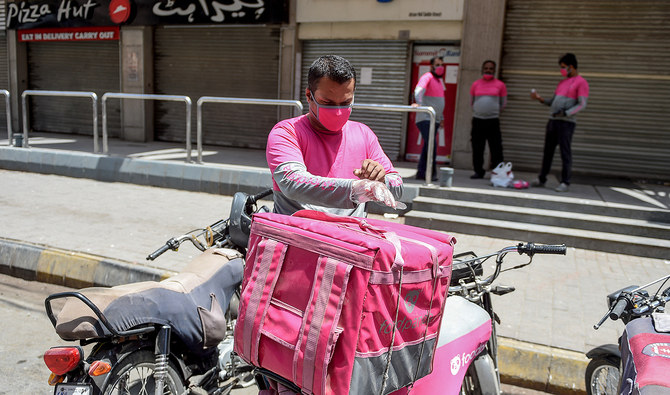

KARACHI: Prominent online food and grocery delivery platform, foodpanda Pakistan, said on Monday that supply glitches mean it would run out of stock sooner than anticipated, as Islamabad anxiously tries to revive a stalled loan program with the International Monetary Fund (IMF) amid the country’s rapidly declining reserves.
As Pakistan’s foreign exchange reserve dipped to a staggering $3.8 billion and as its currency depreciated to historic lows against the US dollar, prospects of the country defaulting on its international obligations loom large.
Many companies have shut down or scaled operations after Islamabad restricted imports in a bid to prevent the outflow of the US dollar from the country. The slow clearance of cargo has resulted in a shortage of raw materials, which in turn has caused a dearth of finished products in the market as well.
Muntaqa Peracha, CEO of foodpanda Pakistan, in an interview last week said the situation was becoming difficult for food delivery operators due to the import situation.
“We, for example as foodpanda, are facing issues in terms of stocks for our pandamart dark stores because suppliers are not able to import a few of their materials used to produce products,” Peracha told Arab News, adding that the import crisis applied to items such as tissue papers, tea, and oil.
“We are facing those issues where we are probably running out of stock sooner than what we had anticipated,” he added.
He, however, added that delivery operators cannot solve the problem alone as suppliers and the government need to play a bigger role to overcome the crisis.
foodpanda Pakistan, which has an estimated 20,000 on-demand delivery riders throughout the country, has been accused of being “unfair” when it comes to employee wages and imposing fines upon the cancelation of orders.
Peracha dismissed the criticism, saying that there has been some “noise” previously “but there is always noise.”
“I mean that [is], I think, a natural phenomenon of gig economy [a labor market characterized by short-term contracts or freelance work],” he said, adding that riders are now earning 35 percent more than the past.
“If you work six days a week on our platform as a rider and you run a full shift, you will be able to earn Rs42,000-45,000 ($153-164),” he said. “That is a lot more than what people offer at production facilities [and] manufacturing facilities.”
He argued that foodpanda was providing riders with facilities that included insurance, and the facility to buy assets, such as motorbikes, in installments at discounted rates.
Fahim Khan, a foodpanda rider and father of five children, said the benefits being provided by the platform were “unmatched”.
“I am associated with foodpanda for the last two years and have also worked with other companies but I think the incentives foodpanda is giving [to its riders], no other (company) is giving,” Khan told Arab News.
“They compensate [for] mobile [phone] if snatched, provide medical coverage in case of an accident,” Khan shared.
He added that working for the company has enabled him to improve his standard of living.
Muhammad Jahanzaib another rider, also expressed satisfaction in working for the company under the current economic climate in Pakistan.
“Thanks to Allah, I am deriving benefits of foodpanda’s policies and supporting my family, and under the current situation, this is [definitely] the best job,” Jahanzaib told Arab News.
Peracha said foodpanda was switching to electric bikes to cut down on fuel consumption.
“Currently, the biggest project we’re trying to [work on] is to [figure out] out how we can get electric vehicles, electric bikes, essentially for our riders so that [could] reduce their expenses as well,” he explained.
Peracha hoped that within a few months, foodpanda would be able to roll out 500 to 1,000 bikes on the road.
In 2021, the Competition Commission of Pakistan (CCP) initiated a probe against foodpanda for allegedly abusing its dominant position in the online food delivery market.
Peracha denied any wrongdoing, saying that other companies tried to penetrate the market but could not establish their footprint. That’s when they started blaming foodpanda and went to the CCP, he said.
“Nothing has come out [in that case] so far because we are following the letter of the law and there’s nothing that we are doing that is contrary to that,” he added.
When asked about the probe against foodpanda, a CCP official told Arab News that the inquiry was still going on.