

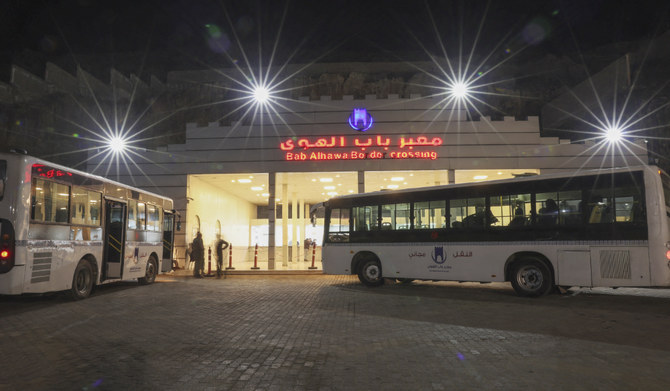
Bab Al-Hawa doors shut on Syrian cancer patients in need of urgent care

Syrian refugees living in Turkey take a bus through the northern Bab al-Hawa border crossing, on February 17, 2023, as they return to Syria in the aftermath of a deadly earthquake. (AFP)
Short Url
Updated 12 March 2023
Follow

Bab Al-Hawa doors shut on Syrian cancer patients in need of urgent care

  • Bashir Ismail, director of the medical office at Bab Al-Hawa crossing, told Arab News: “Before the earthquake we had about 10 daily ambulances carrying emergency cases that would receive treatment in Turkiye

BAB-AL-HAWA: Syria’s cancer patients are the latest victims of the fragile status of Bab Al-Hawa, an international crossing point that sits on the border of Turkiye and Syria.

Cancer patients in northwestern Syria were transferred through the border post to hospitals in Turkiye prior to the earthquake on Feb. 6, to receive the necessary care unavailable in the rebel-held zone.

That changed when the Turkiye-Syria quake rocked the region and prompted Turkish authorities to close the borders on those awaiting lifesaving treatment.

Bashir Ismail, director of the medical office at Bab Al-Hawa crossing, told Arab News: “Before the earthquake we had about 10 daily ambulances carrying emergency cases that would receive treatment in Turkiye.

“We had about 450 so-called ‘cold medical conditions’ per month, including cardiac surgery and cancer patients.

“These patients can no longer enter Turkiye to receive their treatments.”

Nawaf Bakran, 69, from the province of Idlib, is one of the many cancer patients paying the price for the border’s closure.

He told Arab News: “I came out alive from under the rubble. I suffer from cancer, and I have a monthly follow-up. I need a muscle injection for cancer, and I am also diabetic.”

Despite the doctor’s orders for Bakran to return to Turkiye for treatment, those at the border post have barred him from entering.

Bakran added: “They didn’t acknowledge the report of the cancer specialist, and we are now lost. We don’t know where to go.”

A pressing issue is missing documents, including ID papers and medical records, that have been lost underneath the rubble of toppled buildings.

Like Bakran, 58-year-old Mohamed Afsan is also an earthquake survivor currently battling cancer.

Afsan told Arab News: “We couldn't save any of our things. Now we want to retrieve our medical reports, we want to be put in contact with specialists and continue our treatment and the things we are required to do.

“We need radiation; our disease requires radiation. Radiation isn’t available here, and there’s no way we would go to the areas controlled by the regime.”

Afsan says people living in rebel-held Idlib would be putting themselves and their families’ lives at risk if they were to go to the areas controlled by the Syrian government.

Ayham Jamo is a hematologist and head of the oncology department at Idlib Central Hospital.

The Syrian American Medical Society is supporting his facility, but this has not made it any easier to relieve the overwhelming pressure brought on by the tragedy and its consequences.

He told Arab News of the plan he believes needs to be executed.

He said: “[This means] securing chemo doses and immunotherapies for all types of cancer. These therapies are expensive and aren’t available for free.

“We also call for a humanitarian corridor for radiotherapy, as it is an essential treatment that isn’t available in northwestern Syria."

The needs of cancer patients in northwest Syria are extensive, and Jamo believes that although solutions should start with securing the border crossing for patient transfers, urgent action is also needed within the country.

He told Arab News that this would mean establishing “an integrated cancer treatment center including chemotherapy, radiotherapy, immunotherapy, a linear particle accelerator, PET scan, and bone scintigraphy.”

Aziz Asmar, a graffiti artist from Binnish in Idlib, has turned to art to draw the world’s attention to the plight of his people.

He said: “Through this drawing, we call on the Turkish authorities and all the active associations and organizations to help facilitate their entry to Turkiye so they can keep receiving their treatment.”

Asmar says “trending” has to take place before action is taken.

That is why he has painted in different languages the words “help me trend,” in a bid to ensure that all medical cases receive equal attention.

It is not the first time that the fragility of the border — precipitated by the geopolitics of the 12-year conflict — has resulted in cancer patients in northwestern Syria suffering further heartache.

In early 2020, with the accelerating spread of COVID-19, Turkish authorities also decided to close the borders on them.


Tunisia’s famed blue-and-white village threatened after record rains

Updated 31 January 2026
Follow

Tunisia’s famed blue-and-white village threatened after record rains

  • The one-time home of French philosopher Michel Foucault and writer Andre Gide, the village is protected under Tunisian preservation law, pending a UNESCO decision on its bid for World Heritage status

SIDI BOU SAID, Tunisia: Perched on a hill overlooking Carthage, Tunisia’s famed blue-and-white village of Sidi Bou Said now faces the threat of landslides, after record rainfall tore through parts of its slopes.
Last week, Tunisia saw its heaviest downpour in more than 70 years. The storm killed at least five people, with others still missing.
Narrow streets of this village north of Tunis — famed for its pink bougainvillea and studded wooden doors — were cut off by fallen trees, rocks and thick clay. Even more worryingly for residents, parts of the hillside have broken loose.
“The situation is delicate” and “requires urgent intervention,” Mounir Riabi, the regional director of civil defense in Tunis, recently told AFP.
“Some homes are threatened by imminent danger,” he said.
Authorities have banned heavy vehicles from driving into the village and ordered some businesses and institutions to close, such as the Ennejma Ezzahra museum.

- Scared -

Fifty-year-old Maya, who did not give her full name, said she was forced to leave her century-old family villa after the storm.
“Everything happened very fast,” she recalled. “I was with my mother and, suddenly, extremely violent torrents poured down.”
“I saw a mass of mud rushing toward the house, then the electricity cut off. I was really scared.”
Her Moorish-style villa sustained significant damage.
One worker on site, Said Ben Farhat, said waterlogged earth sliding from the hillside destroyed part of a kitchen wall.
“Another rainstorm and it will be a catastrophe,” he said.
Shop owners said the ban on heavy vehicles was another blow to their businesses, as they usually rely on tourist buses to bring in traffic.
When President Kais Saied visited the village on Wednesday, vendors were heard shouting: “We want to work.”
One trader, Mohamed Fedi, told AFP afterwards there were “no more customers.”
“We have closed shop,” he said, adding that the shops provide a livelihood to some 200 families.

- Highly unstable -

Beyond its famous architecture, the village also bears historical and spiritual significance.
The village was named after a 12th-century Sufi saint, Abu Said Al-Baji, who had established a religious center there. His shrine still sits atop the hill.
The one-time home of French philosopher Michel Foucault and writer Andre Gide, the village is protected under Tunisian preservation law, pending a UNESCO decision on its bid for World Heritage status.
Experts say solutions to help preserve Sidi Bou Said could include restricting new development, building more retaining walls and improving drainage to prevent runoff from accumulating.
Chokri Yaich, a geologist speaking to Tunisian radio Mosaique FM, said climate change has made protecting the hill increasingly urgent, warning of more storms like last week’s.
The hill’s clay-rich soil loses up to two thirds of its cohesion when saturated with water, making it highly unstable, Yaich explained.
He also pointed to marine erosion and the growing weight of urbanization, saying that construction had increased by about 40 percent over the past three decades.
For now, authorities have yet to announce a protection plan, leaving home and shop owners anxious, as the weather remains unpredictable.
