

Conference in Qatar withdraws invitation of UK’s former health secretary

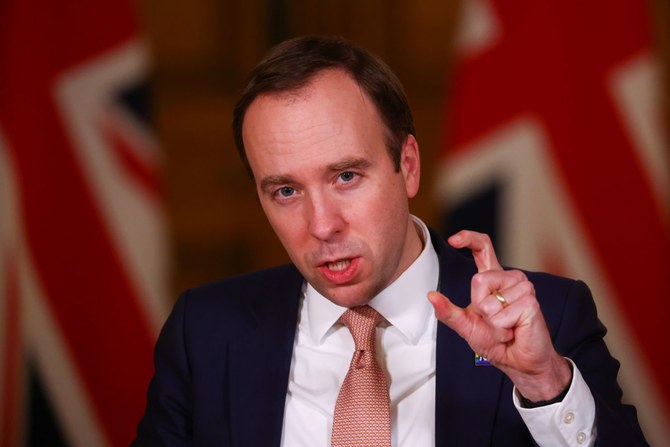
UK’s former Health Secretary Matt Hancock speaks during a news conference amid the COVID-19 outbreak on December 10, 2020. (File/Reuters)
Short Url
Updated 07 March 2023
Follow

Conference in Qatar withdraws invitation of UK’s former health secretary

  • Leaked WhatsApp messages revealed Matt Hancock joking about hotel quarantine
  • Ex-minister criticized the aviation industry as ‘totally offside,’ ‘completely unhelpful’

LONDON: The UK’s former Health Secretary Matt Hancock has had his invitation to a travel industry conference in Qatar revoked after his WhatsApp messages about COVID-19 restrictions were leaked.

The Institute of Travel and Tourism announced on Wednesday that Hancock would be a guest speaker at its annual conference, which will be held in Doha in June. 

A few days later, leaked WhatsApp messages revealed Hancock joking with Cabinet Secretary Simon Case about hotel quarantine, The Independent reported on Monday. 

The UK government imposed hotel quarantines in February 2021, a month after introducing a 19-week ban on international leisure travel.

“We are giving big families all the suites and putting pop stars in the box rooms,” Hancock wrote.

Case replied: “I just want to see some of the faces of people coming out of first class and into a Premier Inn shoe box.”

The former health secretary also accused the aviation industry of being “totally offside” and “completely unhelpful,” The Independent reported.

Regarding the decision to revoke Hancock’s invitation, Steven Freudmann, ITT chair, said: “The decision was triggered by the publication of his WhatsApp messages.

“Some of his private messages are really shocking and clearly we now know that he is no friend of the travel industry, as evidenced by his messages and avalanche of criticism on social media.

“We had been hoping that we could concentrate on lessons learnt from the handling of the pandemic, but in the end we simply decided that it would be unfair on our other 25 distinguished speakers if the entire focus was on Hancock.”


Journalists in Bangladesh demand protection amid rising attacks

Updated 5 sec ago
Follow

Journalists in Bangladesh demand protection amid rising attacks

  • Media industry in the South Asian country is being systematically targeted
  • Interim government blamed for failing to adequately respond to the incidents
DHAKA: Journalists, editors and owners of media outlets in Bangladesh on Saturday demanded that authorities protect them following recent attacks on two leading national dailies by mobs.
They said the media industry in the South Asian country is being systematically targeted in the interim government headed by Nobel Peace Prize laureate Muhammad Yunus. They said the administration failed to prevent attacks on the Daily Star, the country’s leading English-language daily, and the Prothom Alo, the largest Bengali-language newspaper, both based in Dhaka, the capital.
In December, angry mobs stormed the offices of the two newspapers and set fire to the buildings, trapping journalists and other staff inside, shortly after the death of a prominent Islamist activist.
The newspaper authorities blamed the authorities under the interim government for failing to adequately respond to the incidents despite repeated requests for help to disperse the mobs. Hours later, the trapped journalists who took shelter on the roof of the Daily Star newspaper were rescued. The buildings were looted. A leader of the Editors Council, an independent body of newspaper editors, was manhandled by the attackers when he arrived at the scene.
On the same day, liberal cultural centers were also attacked in Dhaka.
It was not clear why the protesters attacked the newspapers, whose editors are known to be closely connected with Yunus. Protests had been organized in recent months outside the offices of the dailies by Islamists who accused the newspapers of links with India.
On Saturday, the Editors Council and the Newspapers Owners Association of Bangladesh jointly organized a conference where editors, journalist union leaders and journalists from across the country demanded that the authorities uphold the free press amid rising tensions ahead of elections in February.
Nurul Kabir, President of the Editors Council, said attempts to silence media and democratic institutions reflect a dangerous pattern.
Kabir, also the editor of the English-language New Age daily, said unity among journalists should be upheld to fight such a trend.
“Those who want to suppress institutions that act as vehicles of democratic aspirations are doing so through laws, force and intimidation,” he said.
After the attacks on the two dailies in December, an expert of the United Nations said that mob attacks on leading media outlets and cultural centers in Bangladesh were deeply alarming and must be investigated promptly and effectively.
“The weaponization of public anger against journalists and artists is dangerous at any time, and especially now as the country prepares for elections. It could have a chilling effect on media freedom, minority voices and dissenting views with serious consequences for democracy,” Irene Khan said in a statement.
Yunus came to power after former Prime Minister Sheikh Hasina fled the country amid a mass uprising in August, 2024. Yunus had promised stability in the country, but global human rights groups including Human Rights Watch and Amnesty International have blamed the government for its failure to uphold human and other civil rights. The Yunus-led regime has also been blamed for the rise of the radicals and Islamists.
Dozens of journalists are facing murder charges linked to the uprising on the grounds that they encouraged the government of Hasina to use lethal weapons against the protesters. Several journalists who are known to have close links with Hasina have been arrested and jailed under Yunus.