

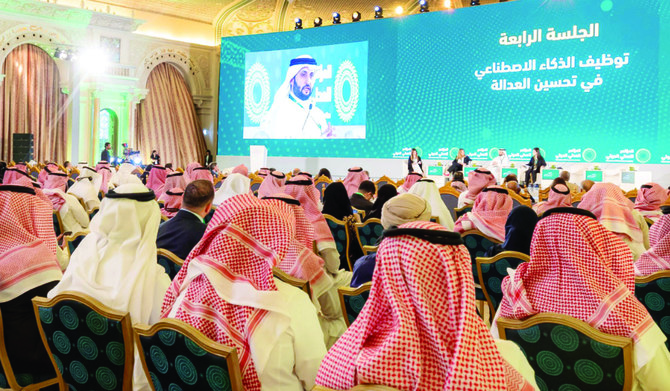


RIYADH: Speaking on Monday at the International Conference on Justice in Riyadh, Saudi Arabia’s deputy minister for planning and development highlighted the role of artificial intelligence in the world of justice.
Yasser Al-Sudais’ remarks came during the conference’s first session, titled “Using AI to enhance justice,” with international experts Francesca Mazzi and Deng Suning.
Al-Sudais discussed the experience of the Ministry of Justice in employing AI to improve justice.
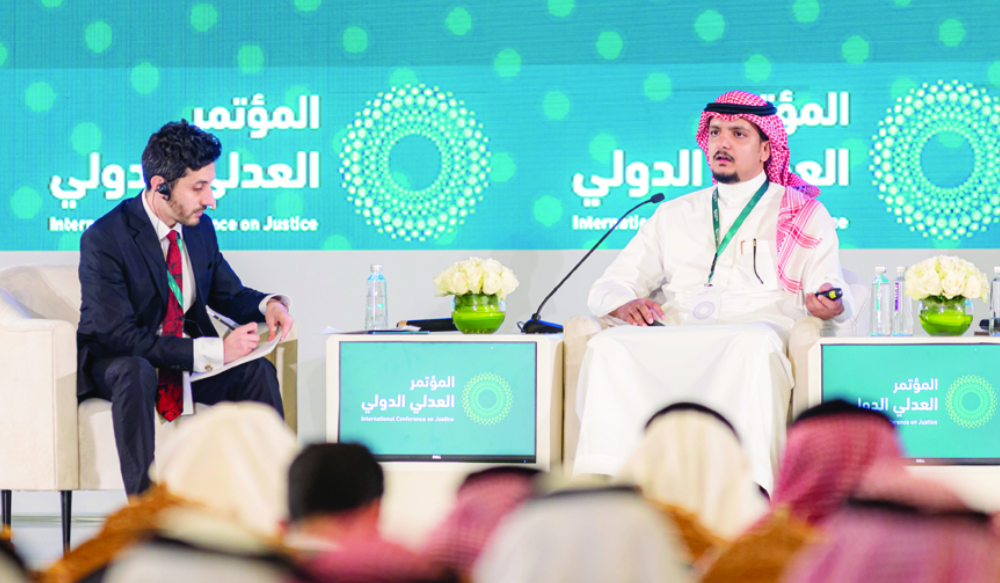
Yusuf Al-Ghamdi, director of Taradhi at the Ministry of Justice, spoke about the experience of the ministry in remote reconciliation in Saudi Arabia. (Photo/Abdulrahman AlMofarreh)
“We have a huge amount of cases that are carrying a heavy load for the courts. So, we want to solve this using AI. There are many ways you can design a system to use AI, by engaging a committee of human experts to take into consideration protecting your public ideologies, ideas and your social norms,” he said.
Mazzi, a researcher specializing in intersections between technology and the arts at the University of Oxford, spoke about AI ethics and protection from algorithmic bias.
HIGHLIGHT
Deng Suning, a researcher at the East China University of Political Science and Law, talked about China’s experience with the applications of AI in justice.
“In every field, including the justice field, AI can be used, but (it) also can create negative consequences. So, the more we have a main event relation that allows us to have control and to direct information that is human-centric, the more we have certainties,” said Mazzi.
Deng, a researcher at the East China University of Political Science and Law, talked about China’s experience with the applications of AI in justice.

Roy Radding made a presentation titled “Artificial Intelligence and Bias in the Field of Justice Causes and Possible Cures.” (Photo/Abdulrahman AlMofarreh)
The second session, titled “Data analytics for justice enhancement,” featured discussions with Rory J. Radding, Prof. Wang Zhu and other experts in the field.
Radding, a partner in Mobile Cowboy Buds Law Firm, spoke on the different forms of AI, including “generative AI, deep and machine learning, neural networks, prediction, and probabilistic reasoning.”
Radding also gave the presentation: “Artificial intelligence and bias in the field of justice: causes and possible cures.”
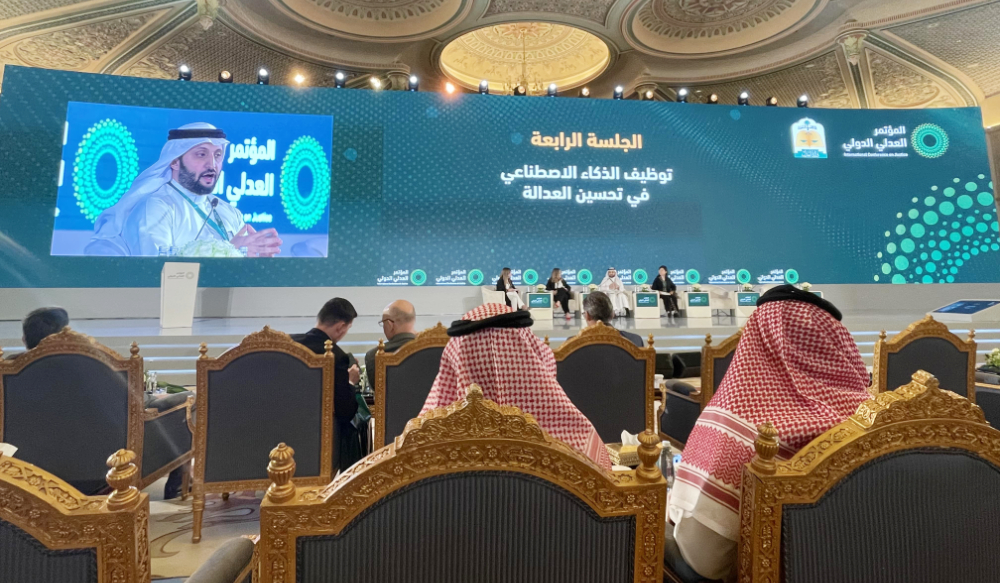
Al-Sudais said that, “We have a huge amounts of cases that are carrying a heavy load for the courts. So we want to solve this using the AI." (Photo/Abdulrahman AlMofarreh)
He provided an overview of the history of robotics, credited to the father of robotics Ismail Al-Jazari, and possible sectors where AI bias may be introduced.
“Bias means the reliability of the system, such as hardware bias, software bias, and data bias. AI may intensify human bias,” said Radding. “A judge’s decision is biased, and that’s the norm everywhere in the world. AI can’t assist the judge in this case.”
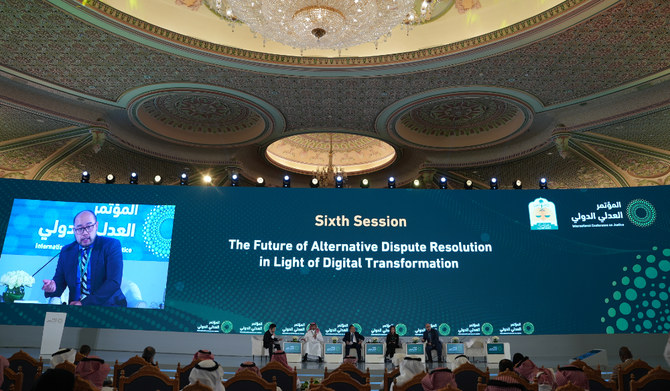
The third session at the conference, titled “The future of alternative dispute resolution in light of digital transformation,” featured Chuan Wee Meng, Gloria Lim, Dr. Zhang Yuntong and Yusuf Al-Ghamdi.

Researcher Francesca Mazzi spoke about AI ethics and protection from algorithmic bias. (Supplied)
Al-Ghamdi, director of the reconciliation initiative known as Taradhi at the Saudi Ministry of Justice, spoke about the experience of the ministry in remote reconciliation in Saudi Arabia.
“Taradhi is a platform that brings together disputants and mediators digitally, as the platform has been developed to be smooth, easy and flexible, with fast procedures and models,” he said.
Taradhi has contributed to reducing the costs incurred by both parties in a conflict, ensuring the swift resolution of disputes through easy and confidential processes while promoting a culture of amicable settlements.
“Today, more than 1 million disputes are resolved through Taradhi,” he added.
Lim, CEO of the Singapore International Arbitration Centre, spoke on how the center has benefited from digital transformation.
“What parties in conflict are looking for is a trusted system that provides them with certainty, predictability, and effective mechanisms to resolve disputes,” she said.


