

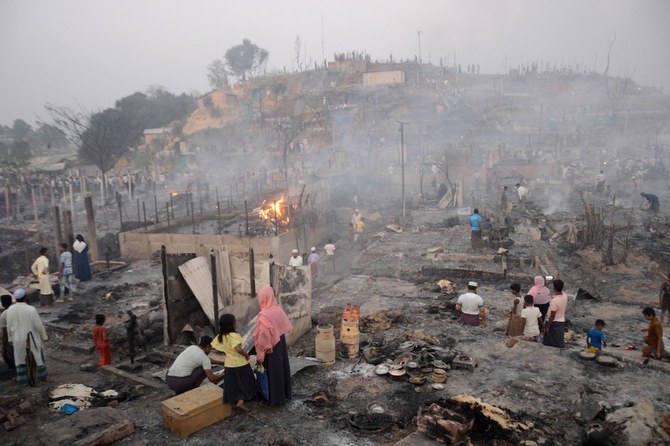

DHAKA: Bangladeshi authorities launched on Monday an investigation into a massive fire at Rohingya refugee camps that has left 12,000 people without shelter.
The fire broke out on Sunday afternoon in Cox’s Bazar, a southeastern coastal district and the world’s largest refugee settlement, which hosts about 1.2 million Rohingya Muslims who fled violence and persecution in neighboring Myanmar.
The blaze swept through the Kutupalong and Balukhali camps, reducing to ashes some 2,000 huts before it was brought under control in the evening.
“The fire broke out in three blocks of the Rohingya camps, affecting around 12,000 Rohingyas. All of them lost their shelter,” Refugee Relief and Repatriation Commissioner Mizanur Rahman said, adding that no casualties have been reported so far.
“Cox’s Bazar district administration has formed a seven-member committee today to find the exact reason for the fire. The committee is asked to file the report in three days.”
Rahman told Arab News that work to restore the shelters have already started, and the International Organization for Migration has distributed housing materials among the Rohingya, who will be rebuilding their homes themselves.
The UN Children’s Fund estimated that half of the refugees affected by the fire were children.
Sheldon Yett, UNICEF representative in Bangladesh, said in a statement on Monday that infrastructure critical to their education and healthcare has been destroyed, including 20 learning centers, at least one nutrition center, and several sanitation facilities.
The Rohingya camps in Cox’s Bazar are prone to fires.
Atish Chakma, deputy assistant director of the Fire Service and Civil Defense Department in Cox’s Bazar, told Arab News that the danger of fire in the area is high due to congestion, the flammable materials the shelters are built from, and a lack of water to immediately put out the flames.
“Rohingya camps are highly congested, and the makeshift homes were built side by side, keeping no distance in between. Besides, the plastic materials that were used for building these shelters are highly flammable. So, whenever a fire erupts in one house, it spreads rapidly,” he said.
“There is a huge scarcity of water inside the camps. For this reason, our firefighters face difficulties while dousing the fire.”
Between January 2021 and December 2022, at least 222 fire incidents were recorded in the settlements, according to Defense Ministry data.
In 2021, 15 refugees were killed and more than 50,000 were displaced after a huge blaze spread through the camps.


