

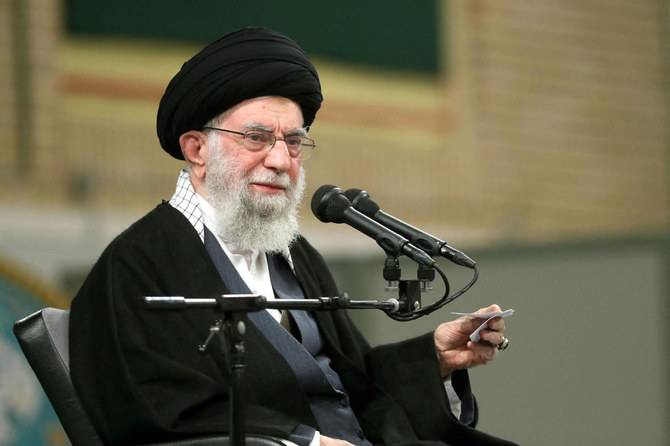

TEHRAN: Iran’s supreme leader said Monday that if a series of suspected poisonings at girls’ schools is proven to be deliberate the culprits should be sentenced to death for committing an “unforgivable crime.”
It was the first time Supreme Leader Ayatollah Ali Khamenei, who has the final say on all matters of state, has spoken publicly about the suspected poisonings, which began late last year and have sickened hundreds of children.
Iranian officials only acknowledged them in recent weeks and have provided no details on who may be behind the attacks or what chemicals — if any — have been used. Unlike neighboring Afghanistan, Iran has no history of religious extremists targeting women’s education.
“If the poisoning of students is proven, those behind this crime should be sentenced to capital punishment and there will be no amnesty for them,” Khamenei said, according to the state-run IRNA news agency.
Authorities have acknowledged suspected attacks at more than 50 schools across 21 of Iran’s 30 provinces since November.
Iran’s Interior Minister Ahmad Vahidi said over the weekend that “suspicious samples” had been gathered by investigators, without elaborating. He called on the public to remain calm and accused unnamed enemies of inciting fear to undermine the Islamic Republic.
Vahidi said at least 52 schools had been affected by suspected poisonings, while Iranian media reports have put the number of schools at over 60. At least one boy’s school reportedly has been affected.
Videos of upset parents and schoolgirls in hospital emergency rooms with IVs in their arms have flooded social media.
Iran has imposed stringent restrictions on independent media since the outbreak of nationwide protests in September, making it difficult to determine the nature and scope of the suspected poisonings.
On Monday, Iranian media reported that authorities arrested a Qom-based journalist, Ali Pourtabatabaei, who had been regularly reporting on the suspected poisonings. The hard-line Kayhan newspaper in an editorial had called for the arrests of newspaper publishers who printed articles on the crisis critical of Iran’s theocracy.
Meanwhile, international pressure continues to grow on Iran over the suspected poisonings. White House press secretary Karine Jean-Pierre called for a “credible, independent investigation” into the incidents.
“If these poisonings are related to participation in protests, then it is well within (the) mandate of the UN independent international fact-finding mission on Iran to investigate,” she said Monday.
The September protests were sparked by the death of a young woman who had been detained by morality police for allegedly violating the country’s strict dress code. Religious hard-liners in Iran have been known to attack women they perceive as dressing immodestly in public. But even at the height of Iran’s 1979 Islamic Revolution, women and girls continued attending schools and universities.
The children affected in the poisonings have reportedly complained of headaches, heart palpitations, feeling lethargic or otherwise unable to move. Some described smelling tangerines, chlorine or cleaning agents.
Reports suggest at least 400 schoolchildren have fallen ill since November. Vahidi, the interior minister, said in his statement that two girls remain in hospital because of underlying chronic conditions. There have been no reported fatalities.
As more attacks were reported Sunday, videos were posted on social media showing children complaining about pain in the legs, abdomen and dizziness. State media have mainly referred to these as “hysteric reactions.”
The World Health Organization documented a similar phenomenon in Afghanistan from 2009 to 2012, when hundreds of girls across the country complained of strange smells and poisoning. No evidence was found to support the suspicions, and the WHO said it appeared to be “mass psychogenic illnesses.”


