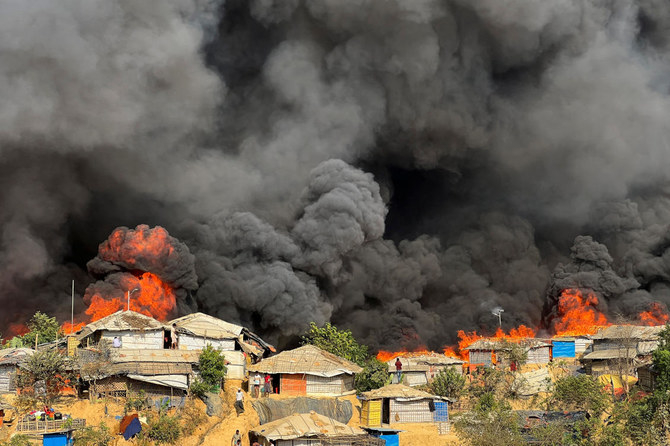
DHAKA: A big fire at a camp for Rohingya refugees in Bangladesh destroyed homes and sent thick black clouds of smoke through the area on Sunday before being brought under control.
The blaze erupted at Camp 11 in Cox’s Bazar, a southeastern border district where more than a million Rohingya refugees live. Most of the refugees fled a military-led crackdown in Myanmar in 2017, and the fire left some of them homeless again.
“We currently don’t have an estimate for damages but there are no reports of casualties,” Rafiqul Islam, additional police superintendent at Cox’s Bazar told Reuters.
He added that the blaze was under control and senior officials from the fire, police and refugee relief departments were at the site. Faruque Ahmed, a local police official, said the cause of the fire was not clear.
Neither police official gave an estimate for the number of homes destroyed.
“I couldn’t save anything. Everything burnt to ashes. Many are without homes. I don’t know what will happen to us,” said 40-year-old refugee Selim Ullah, a father of six children.
“When we were in Myanmar we faced lots of problems... our houses were burned down, he said. “Now it has happened again.”
The refugee camps in Cox’s Bazar are prone to such blazes. A massive fire in March 2021 killed at least 15 refugees and destroyed over 10,000 homes.

Fire destroys homes Cox’s Bazar refugee camp in Bangladesh
https://arab.news/ptdpj
Fire destroys homes Cox’s Bazar refugee camp in Bangladesh
- The refugee camps in Cox’s Bazar are prone to such blazes
- A massive fire in March 2021 killed at least 15 refugees and destroyed over 10,000 homes
Pakistan army chief tells Kabul to choose Islamabad or Taliban militants
- Pakistan blames Afghanistan for facilitating cross-border attacks in its territory, allegations Kabul denies
- Ties have been strained since October, when border clashes left dozens dead on both sides
ISLAMABAD: Pakistan’s Chief of Defense Forces Field Marshal Syed Asim Munir has told Afghanistan to choose between Islamabad and the outlawed Tehreek-e-Taliban Pakistan militants, state media reported on Sunday as ties between both neighbors remain strained.
Pakistan’s army and civilian government have both blamed the Afghan Taliban recently for facilitating cross-border attacks in Pakistan, a charge Kabul denies. Afghanistan said it does not allow its territory to be used for attacks against Pakistan and cannot be held responsible for Islamabad’s security challenges.
Both countries were involved in border clashes in October in which dozens of soldiers were killed and wounded on both sides. Officials from Afghanistan and Pakistan have held peace talks in Qatar, Turkiye and Saudi Arabia over the past few months but failed to reach an agreement.
“Chief of Army Staff and Chief of Defense Forces Field Marshal Syed Asim Munir has said Afghanistan will have to choose between Fitna Al-Khawarij and Pakistan,” state broadcaster Radio Pakistan reported.
Munir was addressing the National Ulema and Mashaikh Conference in Islamabad earlier this month, state media said.
“Fitna Al-Khawarij” is a term the Pakistan military frequently uses for the TTP.
Munir pointed out that 70 percent of the TTP’s formations that enter Pakistan from Afghanistan comprise Afghan citizens.
“He said innocent citizens, including children, are being targeted through terrorism with the backing of the Afghan Taliban,” Radio Pakistan reported.
While Pakistan and Afghanistan have agreed to a temporary ceasefire, tensions persist between the two countries as militant attacks persist in Pakistan.
Pakistan summoned Afghanistan’s deputy head of mission on Friday and demanded “decisive action” against TTP militants after four Pakistani soldiers were killed in an attack on a military camp in northwest Pakistan.
The foreign office said the Afghan government had been informed that Pakistan “reserves the right to defend its sovereignty and protect its citizens” and would take all necessary measures to respond to attacks originating from Afghan territory.
Afghanistan has warned Pakistan in the past against attacking its territory, saying it reserves the right to respond to such provocations.


