

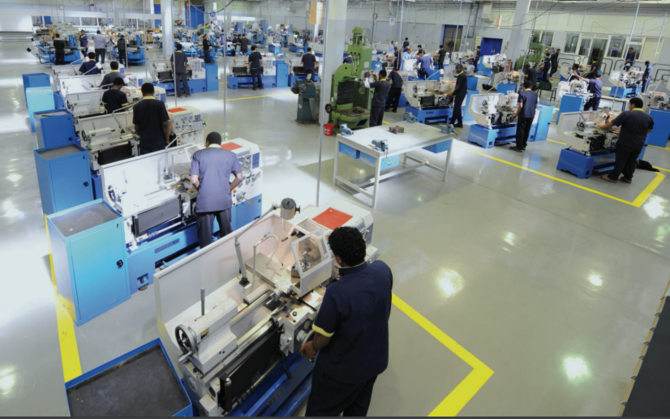
Saudi Arabia ranks first globally in technical and vocational education

TVTC succeeded in attracting 28 percent of high school graduates to enroll in technical and vocational training in 2021, 4 percent higher than the stipulated target of 24 percent.
Short Url
Updated 05 March 2023
Follow

Saudi Arabia ranks first globally in technical and vocational education

RIYADH: Saudi Arabia has been ranked first globally for the percentage of students enrolled in post-secondary non-tertiary education under technical and vocational training programs, Saudi Press Agency reported citing data from the Global Knowledge Index 2022.

As the Kingdom is making steady progress in the technical and vocational training sector, Ahmad bin Fahad Al-Fahaid, governor of Technical and Vocational Training Corp. conveyed his gratitude to King Salman and Crown Prince Mohammed bin Salman. 

Al-Fahaid noted that this achievement is the result of the support offered by the Kingdom’s visionary leadership, which is playing a crucial role in equipping its citizens to actively contribute to the development and renaissance of the country.

He further pointed out that TVTC is working to expand the number of colleges and educational institutions in the vocational training sector. 

According to Al-Fahaid, TVTC succeeded in attracting 28 percent of high school graduates to enroll in technical and vocational training in 2021, 4 percent higher than the stipulated target of 24 percent. 

Earlier in November, TVTC announced that it is currently training 6,189 people in preparation for jobs in the tourism and hotel industries.

TVTC’s aims align with Saudi Vision 2030, under which efforts are exerted to cut the unemployment rate in the Kingdom from 11.6 percent to 7 percent by 2030.

The Global Knowledge Index is issued annually by Mohammed bin Rashid Al Maktoum Knowledge Foundation in association with UN Development Program, and it aims to provide reliable data to help countries and decision-makers to understand the present scenario and challenges in various sectors, along with discovering future paths. 

The index contains seven composite sub-indices that focus on the performance of six vital knowledge sectors: pre-university education; technical and vocational education and training; higher education; information and communications technology; research, development, and innovation; and economy. 

It also has a special sub-index for enabling environment that diagnoses social, political, economic, health, and environmental contexts for those sectors.


Saudi Arabia’s foreign reserves rise to a 6-year high of $475bn

Updated 22 February 2026
Follow

Saudi Arabia’s foreign reserves rise to a 6-year high of $475bn

RIYADH: Saudi Arabia’s foreign reserves climbed 3 percent month on month in January to SR1.78 trillion, up SR58.7 billion ($15.6 billion) from December and marking a six-year high.

On an annual basis, the Saudi Central Bank’s net foreign assets rose by 10 percent, equivalent to SR155.8 billion, according to data from the Saudi Central Bank, Argaam reported.

The reserve assets, a crucial indicator of economic stability and external financial strength, comprise several key components.

According to the central bank, also known as SAMA, the Kingdom’s reserves include foreign securities, foreign currency, and bank deposits, as well as its reserve position at the International Monetary Fund, Special Drawing Rights, and monetary gold.

The rise in reserves underscores the strength and liquidity of the Kingdom’s financial position and aligns with Saudi Arabia’s goal of strengthening its financial safety net as it advances economic diversification under Vision 2030.

The value of foreign currency reserves, which represent approximately 95 percent of the total holdings, increased by about 10 percent during January 2026 compared to the same month in 2025, reaching SR1.68 trillion.

The value of the reserve at the IMF increased by 9 percent to reach SR13.1 billion.

Meanwhile, SDRs rose by 5 percent during the period to reach SR80.5 billion.

The Kingdom’s gold reserves remained stable at SR1.62 billion, the same level it has maintained since January 2008.

Saudi Arabia’s foreign reserve assets saw a monthly rise of 5 percent in November, climbing to SR1.74 trillion, according to the Kingdom’s central bank.

Overall, the continued advancement in reserve assets highlights the strength of Saudi Arabia’s fiscal and monetary buffers. These resources support the national currency, help maintain financial system stability, and enhance the country’s ability to navigate global economic volatility.

The sustained accumulation of foreign reserves is a critical pillar of the Kingdom’s economic stability. It directly reinforces investor confidence in the riyal’s peg to the US dollar, a foundational monetary policy, by providing SAMA with ample resources to defend the currency if needed.

Furthermore, this financial buffer enhances the nation’s sovereign credit profile, lowers national borrowing costs, and provides essential fiscal space to navigate global economic volatility while continuing to fund its ambitious Vision 2030 transformation agenda.