

Eni agrees deal with UAE’s ADNOC as Italy rebuilds relationship

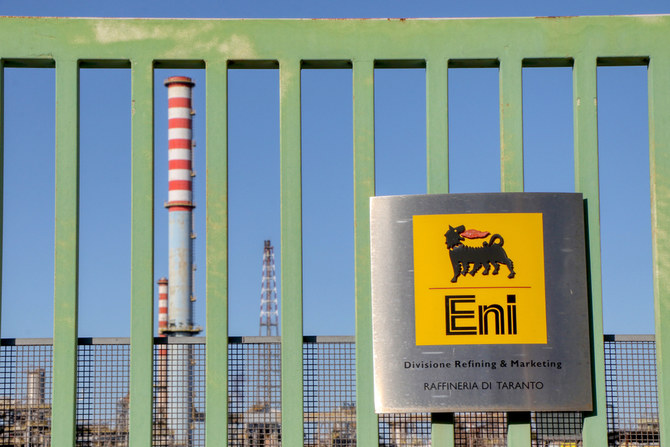
State-controlled Eni said that together with ADNOC it would explore opportunities in renewable energy, blue and green hydrogen and carbon dioxide capture and storage. (Shuttestock)
Short Url
Updated 06 March 2023
Follow

Eni agrees deal with UAE’s ADNOC as Italy rebuilds relationship

  • Italy in 2021 halted the sale of thousands of missiles to Saudi Arabia and the UAE
  • The UAE in turn asked Italy to vacate a military base in the Gulf

MILAN: Italian oil and gas group Eni said it would cooperate with Abu Dhabi National Oil Co on energy transition projects, as Rome’s new government works to rebuild ties with the UAE.

After a meeting with UAE President Sheikh Mohamed bin Zayed Al-Nahyan, Italian Prime Minister Giorgia Meloni said that now that reciprocal trust was being re-established areas for future cooperation could range from energy to defense.

“Discussions ... went very, very well and we’re going back to a strategic partnership. Italy historically had very strong relations with UAE which in recent years experienced serious difficulties,” she told reporters in Abu Dhabi.

Italy in 2021 halted the sale of thousands of missiles to Saudi Arabia and the UAE, citing Rome’s commitment to restoring peace in Yemen. The UAE in turn asked Italy to vacate a military base in the Gulf.

State-controlled Eni said that together with ADNOC it would explore opportunities in renewable energy, blue and green hydrogen and carbon dioxide capture and storage.

The two companies will also work on reducing greenhouse gas and methane gas emissions, as well as routine gas flaring.

Italy on Saturday signed a declaration of intent with UAE climate envoy and designated president of the COP28 climate summit Sultan Ahmed Al-Jaber, who last month pledged to lay out an inclusive and innovative roadmap to tackle global warming.

“We found our partners extremely open and attentive to the priorities on our agenda,” Meloni said.

Meloni said the UAE was particularly interested in Italy’s energy policy in Africa, which was discussed on Saturday alongside topics such as the stabilization of Libya and the financial situation in Tunisia, which have an impact on migration flows.

“I think there is a strong will on both sides to rebuild not just good but excellent relations, a friendship, which I think is very important for our national interest.”


Saudi Arabia launches skills framework to support mining, industrial growth 

Updated 6 sec ago
Follow

Saudi Arabia launches skills framework to support mining, industrial growth 

JEDDAH: Saudi Arabia has launched a new skills framework for the mining and industrial sectors to standardize job roles and support workforce development. 

The initiative was unveiled by Minister of Industry and Mineral Resources Bandar Alkhorayef on the sidelines of the Global Labor Market Conference 2026, according to Al-Eqtisadiah. 

The framework is intended to help employers, job seekers and training providers better navigate labor demand in mining and industry, as Saudi Arabia accelerates investment in manufacturing, minerals processing and related value chains under Vision 2030. 

“This is, in fact, a tool which ensures clear definitions of occupations and their required skills. It will cover more than 500 job roles, detailing the necessary skills, responsibilities, and titles,” Alkhorayef said during a discussion panel at the event. 

The Ministry of Industry and Mineral Resources said the initiative — known as the Industry & Mining Occupations & Skills Framework — will serve as a national reference for occupations and skills in mining and industry. 

The framework is designed to achieve a set of strategic objectives that support human capital development in the industrial and mining sectors. It aims to strengthen workforce planning, training programs, and career pathways, while supporting informed decision-making. 

Covering more than 500 industrial occupations, over 300 professional specialties, 600 skills, and 900 professional certifications, the framework sets standardized job titles, descriptions, and skill requirements to support recruitment, performance, and competitiveness. 

For each occupation, a profile is developed, outlining the code, job titles, and descriptions, as well as other information such as key tasks, educational qualifications, and required skills.

These profiles give employees clarity on roles, career pathways, and accredited credentials, while helping job seekers match their qualifications with suitable roles and focus on targeted skill development. 

The framework, published by the ministry, runs to nearly 3,200 pages and was developed through collaboration with the General Authority for Statistics, alongside government bodies, private sector organizations and academic institutions. 

The launch comes as Saudi Arabia’s mining push gains momentum after new surveys of the Arabian Shield showed the Kingdom’s mineral resources are larger than previously estimated. 

Official estimates have jumped by about 90 percent to roughly SR9.37 trillion ($2.5 trillion), up from around SR5 trillion in 2016, strengthening the case for further mining investment and skills development.