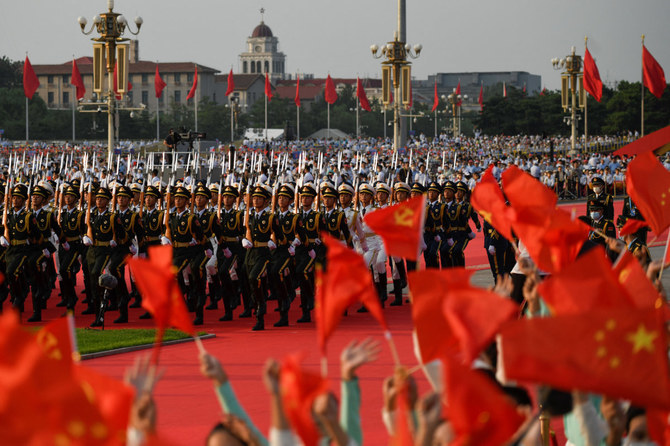
BEIJING: China will boost defense spending 7.2 percent this year, slightly outpacing last year’s increase and faster than the government’s modest economic growth forecast, as Premier Li Keqiang called for the armed forces to boost combat preparedness.
The 1.55 trillion yuan ($224 billion) in military spending in the national budget released on Sunday is closely watched by China’s neighbors and in Washington as a barometer of how aggressively the country will beef up its military.
This year’s hike marks the eighth consecutive single-digit increase. As in previous years, no breakdown of the spending was given, only the overall amount and the rate of increase.
The spending increase outpaces targeted economic growth of around 5 percent, which is slightly below last year’s target as the world’s second-largest economy faces domestic headwinds.
Beijing is nervous about challenges on fronts ranging from Chinese-claimed Taiwan to US naval and air missions in the disputed South China Sea near Chinese-occupied islands.
China staged war games near Taiwan last August to express anger at the visit to Taipei of then-US House Speaker Nancy Pelosi.
In his work report to the annual session of parliament, Li said military operations, capacity building and combat preparedness should be “well-coordinated in fulfilling major tasks.”
“Our armed forces, with a focus on the goals for the centenary of the People’s Liberation Army in 2027, should work to carry out military operations, boost combat preparedness and enhance military capabilities,” he said in the state-of-the-nation address to the largely rubber-stamp legislature.
China, with the world’s largest military in terms of personnel, is busy adding a slew of new hardware, including aircraft carriers and stealth fighters.
Its development and Beijing’s strategic intentions have sparked concern regionally and in Washington, especially as tensions have spiked in recent years over Taiwan.
Beijing says its military spending for defensive purposes is a comparatively low percentage of its GDP and that critics want to demonize it as a threat to world peace.
“The armed forces should intensify military training and preparedness across the board, develop new military strategic guidance, devote greater energy to training under combat conditions and make well-coordinated efforts to strengthen military work in all directions and domains,” Li said.


![]()
![]()
![]()

China plans 7.2% defense spending rise this year, faster than GDP target


Short Url
https://arab.news/6jdcz
China plans 7.2% defense spending rise this year, faster than GDP target
- Budget is closely watched as a barometer of how aggressively China will beef up its military
- Premier Li says armed forces should boost combat preparedness


Latest updates


Recommended


© 2026 SAUDI RESEARCH & PUBLISHING COMPANY, All Rights Reserved And subject to Terms of Use Agreement.