New Philippine bill seeks introduction of Arabic into school curriculum

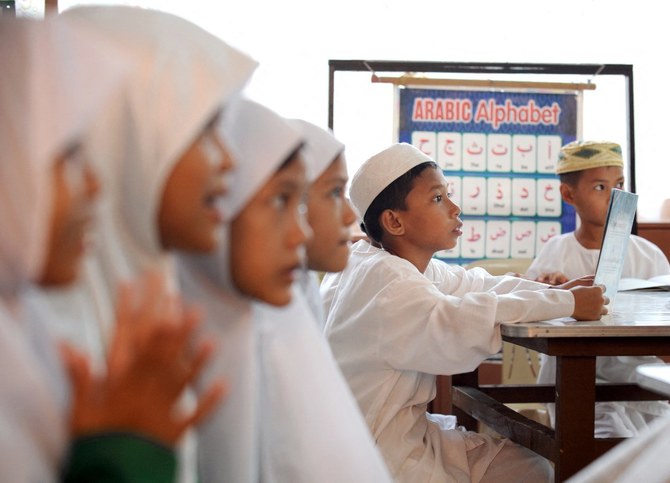
Muslim students listen to their teacher at a government elementary school in Manila on Oct. 9, 2008. (AFP/File)
Short Url
Updated 04 March 2023
Follow

New Philippine bill seeks introduction of Arabic into school curriculum

  • Legislation aims to expand access for Muslims to education in accordance with their beliefs
  • Muslims constitute 5 percent of the nearly 110 million population of the Philippines

MANILA: A new bill filed in the Philippine Congress seeks to introduce the teaching of Arabic into the school curriculum to increase awareness of Muslim culture and traditions in the Southeast Asian country where a sizeable minority professes Islam.

Muslims constitute roughly 5 percent of the nearly 110 million, predominantly Catholic population of the Philippines. Muslim communities live mostly on the island of Mindanao and the Sulu archipelago in the country’s south, as well as in the central-western province of Palawan.

The bill was filed in Congress on Feb. 9 by lawmaker Mujiv Hataman from Basilan in the Bangsamoro Autonomous Region — an autonomous, largely Muslim area of the southwestern portion of the island of Mindanao.

The proposed legislation No. HB 7130, aims to expand access for Muslims to “education according to their cultural, traditional, social, and religious beliefs.”

FASTFACT

Legislation aims to expand access for Muslims to education in accordance with their beliefs.

The Philippine government currently has a program, titled Arabic Language and Islamic Values Education, to teach the Arabic language and fundamentals of Islam at regular schools, but it has not been fully implemented.

“The ALIVE program provides a curriculum for public and private elementary schools that caters to Muslim students. HB 7130 seeks to institutionalize this curriculum because, presently, it suffers from many challenges that include, but are not limited to, non-implementation, lack of funding, lack of training of qualified teachers, and more,” Hataman told Arab News on Friday.

“If passed into law, it will allow them to learn about the subjects at the primary education (level), no matter what school they are in. It also aims to enrich the Philippine education system with cultural and religious knowledge of the Islamic faith and foster national unity in diversity among Muslim and non-Muslim students.”

According to Hataman’s bill, the implementation of the program — which shall be optional and at the behest of students’ parents — would develop the learners’ functional literacy in Arabic, while teaching Islamic values would help them understand the religion’s values and foster interfaith dialogue, multiculturalism and respect for differences in belief.

It is not the first time that such legislation is proposed in the Philippines.

In 2022, Sen. Win Gatchalian filed a similar bill in the Senate to “ensure the contribution of Muslim Filipinos to national goals and aspirations aimed at making them partners in nation-building.”

According to Gatchalian, the chairman of the Senate Committee on Basic Education, the measure would help foster inclusive education to address learners’ diversity of needs and ensure their full participation.

While Gatchalian’s bill is currently pending in the Senate, Hataman’s is now with Congress, awaiting its first hearing.

It may take months until congressmen, and later senators, deliberate it, but the lawmaker is dedicated to pursuing the cause to ensure that Muslim students are able to fully realize their potential.

“It is imperative that we mandate the teaching of Arabic language and Islamic values to Muslim students,” he said.

“We need to recognize that our diverse cultural and religious backgrounds require a more responsive educational approach.”


FGM reports add to scrutiny of Somali community in Minnesota

UN data shows that nearly 98 percent of Somalia’s female population aged between 15 and 49 have undergone FGM. (Getty Images)
Updated 6 sec ago
Follow

FGM reports add to scrutiny of Somali community in Minnesota

CHICAGO: The US state of Minnesota has reportedly seen a rise in instances of female genital mutilation, or FGM, especially among the growing Somali community.

More than 260,000 Somalis live in the US, with nearly 100,000 of them settled in Minnesota. About 50,000 Somalis live in Minnesota’s 5th Congressional District, represented by Somali American Rep. Ilhan Omar.

UN data shows that nearly 98 percent of Somalia’s female population aged between 15 and 49 have undergone the procedure.

The controversy over FGM in Minnesota has only added to the dark cloud of alleged fraud that is hanging over the state’s Somali community. US President Donald Trump made this subject a major part of his State of the Union speech on Tuesday, calling the fraudsters “Somali pirates.”

State and federal investigators have said Somalis in Minnesota have been implicated in the theft of billions of dollars in state and federal funds intended to support childcare, food programs for families and seniors, and healthcare and mental health programs. Officials contend that this has resulted in the loss of up to $9 billion in funding over many years. In his State of the Union speech, however, Trump said the fraud has cost American taxpayers as much as $19 billion.

Muslim leaders are speaking out against the practice of FGM. Imam Kifah Mustapha of the Orland Prayer Center, one of the largest mosques in Illinois, said FGM is not representative of Muslim religious practices and is not required by Islam.

“There is nothing in Islam that says it should be done as an obligation. There’s no such thing,” Mustapha told Arab News.

“It is not something that Islam urges parents or families to do for their children at all. It is not practiced at all in most Muslim countries. It is not something Islam urges people to do or obligates people to do. We know that most Muslim countries now even prohibit it, they don’t allow it anymore.”

Congress first banned FGM on girls under the age of 18 in 1996. However, a 2018 federal court ruling struck down that law as unconstitutional. President Trump toughened the law and signed the Stop FGM Act into law in 2021, imposing a penalty of up to 10 years’ imprisonment for anyone convicted.

Forty-one US states, including Minnesota, have enacted their own laws banning FGM. The nine states that have failed to adopt bans are Alabama, Alaska, Connecticut, Hawaii, Maine, Mississippi, Montana, Nebraska and New Mexico, all states with small Muslim populations.

Minnesota was one of the first states to pass an FGM law in 1994. State Rep. Mary Franson has been fighting ever since to strengthen its enforcement. She recently told the media that cultural secrecy makes FGM “exceptionally difficult to detect” in tight-knit communities.

Somali-born activist Ayaan Hirsi Ali, an author who survived FGM and has spoken out against it, has publicly described the lasting physical and psychological damage that she experienced. Hirsi Ali has called for a strong legal response.

Hirsi Ali was on Sunday quoted as saying: “Female genital mutilation is violence against the most vulnerable — children. It causes infection, incontinence, unbearable pain during childbirth and deep physical and emotional scars that never heal. Religious or cultural practices that deliberately and cruelly harm children must be confronted. No tradition can ever justify torture.”

In 2018, the UN Population Fund released a report showing that nearly 70 million girls will undergo FGM between 2015 and 2030.