

Using smart technology to cultivate fresh greens

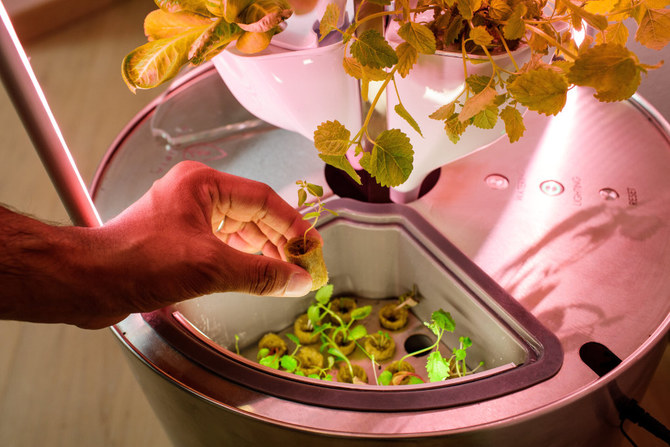
The Natufia Smart Garden gives households total control over the greens they want to consume without depending on the climate or the seasons. (Supplied)
Short Url
Updated 04 March 2023
Follow

Using smart technology to cultivate fresh greens

  • Food tech firm adopts penetrative pricing to drive food security in Saudi Arabia

RIYADH: Saudi Arabia is in overdrive to achieve its ambitious goals of diversifying its economy and further uplifting the quality of life without compromising its commitment to sustainable living.

Its measures have created a rich environment conducive to innovation and investment and witnessed mushrooming startups developing novel ideas supported by different institutions in the public and private sectors.

One of those entities is the King Abdullah University of Science and Technology which has emerged as a beacon for innovative ideas and a home to the most diverse startups in the region.

Its venture, Natufia Labs, is contributing toward ensuring food security in the Kingdom. 
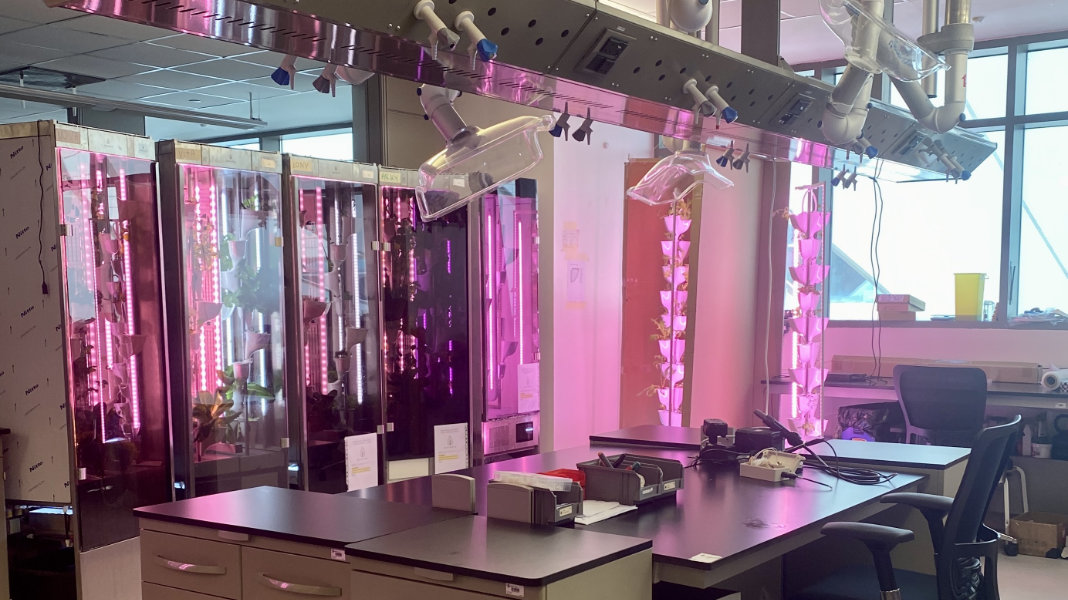
In 2014, the company pioneered a hydroponic kitchen farm that automates plant growth through a self-contained case that provides optimal water, lighting, and nutrients to cultivate fresh greens throughout the year.

Called Natufia Smart Garden, the technology gives households total control over the greens they want to consume without depending on the climate or the seasons.

With the smart kitchen garden, though, you place the seed pods within the nursery of the cabinet to germinate. After about 10 days, the pod turns into a plant. It is then moved to the growth chamber, and 30 days later, you have fresh green produce devoid of pesticides or preservatives.

The technology can sow over 40 varieties of seed pods and can grow almost 32 plants simultaneously, including basil, chilies, kale, lettuce, cherry tomatoes, and chamomile, to name a few. But the technology came with a price.

At $13,000, the product was a luxury and a preserve of the uber-rich. Weighing 270 kg, it was a hardware-intensive technology that commanded huge manufacturing costs coupled with the logistics challenges of sourcing parts from different parts of the world. 

“Our first clients were chefs in France and private clients in California. These were people who loved food and cooking, and for them, Natufia was an extension of their gardens. They told us it was something they wanted for years,” Gregory Lu told Arab News, who set up the company in 2014 in Estonia after spending the better part of his life selling dream homes across Europe.

What also went in the company’s favor was its environmental commitment because here was a product that curbed packaging, pollution, food miles, and toxins.

So, what turned this one-time realtor into an environmentalist? In 2012, after advising high net worth individuals on lucrative real estate opportunities, the law graduate found his true calling as he purchased an olive plantation in Sicily.

“I was able to reconnect with nature and produce olive oil in the most natural way, without fertilizer, pesticide, and excess watering,” said Lu. This enthusiastic embrace of natural living inspired Lu to dream of a farm for every household.

In 2018, Natufia Labs joined the Techstars Dubai Accelerator Opening Class and closed a $1.2-million seed round led by Butterfly Ventures, Techstars, and the Dubai-based Ginco Investments.

I was able to reconnect with nature and produce olive oil in the most natural way, without fertilizer, pesticide, and excess watering.

Gregory Lu, Natufia Labs founder and CEO

However, when the COVID-19 pandemic engulfed the world, it highlighted the fragility of the global supply chains and their impact on food security. It made it harder for farmers and food producers to get their produce to market.

For instance, according to the General Authority for Statistics, food and beverage in Saudi Arabia recorded the highest annual increase of 14.4 percent in July 2020, primarily due to a 19 percent increase in vegetable prices and 18.2 percent in meat prices.

With limited mobility and increased demand for home deliveries, transportation costs also shot up, burdening the food basket further. The July 2020 GASTAT report further revealed that transportation costs in Saudi Arabia increased by 7.3 percent, mainly from a 13.9 percent increase in vehicle prices.

The lightning had struck, furthering Lu’s resolve to reach the masses.

In 2021, Lu finally received a helping hand from the unlikeliest place nearly 4,000 km away from his base camp: KAUST.

It not only awarded $2 million to Natufia Labs through its venture capital investment arm, the KAUST Innovation Fund, but also offered a residency at the KAUST Research and Technology Park. Lu soon perfected the art of production and lowered the price. Later, Lu realized the only way he could push the envelope was by designing a product that was smaller in size and more compact in shape than the Natufia Smart Garden.

In the fall of 2022, it launched Natufia One, a smaller and semi-automated version of Natufia Smart Garden, which was entirely developed at KAUST. Weighing 65 kg, Natufia One ventured into the market.

Lu now plans to raise new investments to increase production capacity and triple the firm’s distribution network before the end of this year. He also hopes to launch a slew of new products in 2024.

The plans are encouraging, considering the Kingdom is on a war footing to localize the country’s food industry by 2030.


AI will never replace human creativity, says SRMG CEO 

Updated 6 sec ago
Follow

AI will never replace human creativity, says SRMG CEO 

  • Speaking to Maya Hojeij, senior business anchor at Asharq with Bloomberg, Jomana R. Alrashid expressed pride in SRMG platforms that had absorbed and adopted AI

RIYADH: Jomana R. Alrashid, CEO of Saudi Research and Media Group, highlighted how AI cannot replace human creativity during a session at The Family Office’s “Investing Is a Sea” summit at Shura Island on Friday. 

“You can never replace human creativity. Journalism at the end of the day, and content creation, is all about storytelling, and that’s a creative role that AI does not have the power to do just yet,” Alrashid told the investment summit. 

“We will never eliminate that human role which comes in to actually tell that story, do the actual investigative reporting around it, make sure to be able to also tell you what’s news or what’s factual from what’s wrong ... what’s a misinformation from bias, and that’s the bigger role that the editorial player does in the newsroom.”

Speaking on the topic of AI, moderated by Maya Hojeij, senior business anchor at Asharq with Bloomberg, the CEO expressed her pride in SRMG platforms that had absorbed and adopted AI in a way that was “transformative.”

“We are now translating all of our content leveraging AI. We are also now being able to create documentaries leveraging AI. We now have AI-facilitated fact-checking, AI facilities clipping, transcribing. This is what we believe is the future.”

Alrashid was asked what the journalist of the future would look like. “He’s a journalist and an engineer. He’s someone who needs to understand data. And I think this is another topic that is extremely important, understanding the data that you’re working with,” she said.

“This is something that AI has facilitated as well. I must say that over the past 20 years in the region, especially when it comes to media companies, we did not understand the importance of data.”

The CEO highlighted that previously, media would rely on polling, surveys or viewership numbers, but now more detailed information about what viewers wanted was available. 

During the fireside session, Alrashid was asked how the international community viewed the Middle Eastern media. Alrashid said that over the past decades it had played a critical role in informing wider audiences about issues that were extremely complex — politically, culturally and economically — and continued to play that role. 

“Right now it has a bigger role to play, given the role again of social media, citizen journalists, content creators. But I also do believe that it has been facilitated by the power that AI has. Now immediately, you can ensure that that kind of content that is being created by credible, tier-A journalists, world-class journalists, can travel beyond its borders, can travel instantly to target different geographies, different people, different countries, in different languages, in different formats.”

She said that there was a big opportunity for Arab media not to be limited to simply Arab consumption, but to finally transcend borders and be available in different languages and to cater to their audiences. 

The CEO expressed optimism about the future, emphasizing the importance of having a clear vision, a strong strategy, and full team alignment. 

Traditional advertising models, once centered on television and print, were rapidly changing, with social media platforms now dominating advertising revenue.

“It’s drastically changing. Ultimately in the past, we used to compete with one another over viewership. But now we’re also competing with the likes of social media platforms; 80 percent of the advertising revenue in the Middle East goes to the social media platforms, but that means that there’s 80 percent interest opportunities.” 

She said that the challenge was to create the right content on these platforms that engaged the target audiences and enabled commercial partnerships. “I don’t think this is a secret, but brands do not like to advertise with news channels. Ultimately, it’s always related with either conflict or war, which is a deterrent to advertisers. 

“And that’s why we’ve entered new verticals such as sports. And that’s why we also double down on our lifestyle vertical. Ultimately, we have the largest market share when it comes to lifestyle ... And we’ve launched new platforms such as Billboard Arabia that gives us an entry into music.” 

Alrashid said this was why the group was in a strong position to counter the decline in advertising revenues across different platforms, and by introducing new products.

“Another very important IP that we’ve created is events attached to the brands that have been operating in the region for 30-plus years. Any IP or any title right now that doesn’t have an event attached to it is missing out on a very big commercial opportunity that allows us to sit in a room, exchange ideas, talk to one another, get to know one another behind the screen.” 

The CEO said that disruption was now constant and often self-driving, adding that the future of the industry was often in storytelling and the ability to innovate by creating persuasive content that connected directly with the audience. 

“But the next disruption is going to continue to come from AI. And how quickly this tool and this very powerful technology evolves. And whether we are in a position to cope with it, adapt to it, and absorb it fully or not.”