


RIYADH: Saudi Arabia is in overdrive to achieve its ambitious goals of diversifying its economy and further uplifting the quality of life without compromising its commitment to sustainable living.
Its measures have created a rich environment conducive to innovation and investment and witnessed mushrooming startups developing novel ideas supported by different institutions in the public and private sectors.
One of those entities is the King Abdullah University of Science and Technology which has emerged as a beacon for innovative ideas and a home to the most diverse startups in the region.
Its venture, Natufia Labs, is contributing toward ensuring food security in the Kingdom.
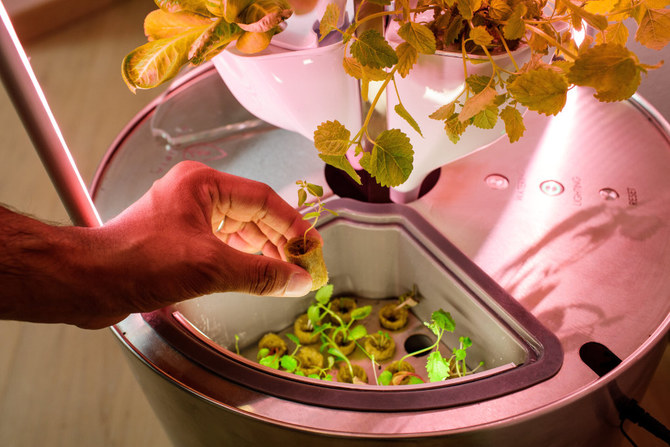
In 2014, the company pioneered a hydroponic kitchen farm that automates plant growth through a self-contained case that provides optimal water, lighting, and nutrients to cultivate fresh greens throughout the year.
Called Natufia Smart Garden, the technology gives households total control over the greens they want to consume without depending on the climate or the seasons.
With the smart kitchen garden, though, you place the seed pods within the nursery of the cabinet to germinate. After about 10 days, the pod turns into a plant. It is then moved to the growth chamber, and 30 days later, you have fresh green produce devoid of pesticides or preservatives.
The technology can sow over 40 varieties of seed pods and can grow almost 32 plants simultaneously, including basil, chilies, kale, lettuce, cherry tomatoes, and chamomile, to name a few. But the technology came with a price.
At $13,000, the product was a luxury and a preserve of the uber-rich. Weighing 270 kg, it was a hardware-intensive technology that commanded huge manufacturing costs coupled with the logistics challenges of sourcing parts from different parts of the world.

“Our first clients were chefs in France and private clients in California. These were people who loved food and cooking, and for them, Natufia was an extension of their gardens. They told us it was something they wanted for years,” Gregory Lu told Arab News, who set up the company in 2014 in Estonia after spending the better part of his life selling dream homes across Europe.
What also went in the company’s favor was its environmental commitment because here was a product that curbed packaging, pollution, food miles, and toxins.
So, what turned this one-time realtor into an environmentalist? In 2012, after advising high net worth individuals on lucrative real estate opportunities, the law graduate found his true calling as he purchased an olive plantation in Sicily.
“I was able to reconnect with nature and produce olive oil in the most natural way, without fertilizer, pesticide, and excess watering,” said Lu. This enthusiastic embrace of natural living inspired Lu to dream of a farm for every household.
In 2018, Natufia Labs joined the Techstars Dubai Accelerator Opening Class and closed a $1.2-million seed round led by Butterfly Ventures, Techstars, and the Dubai-based Ginco Investments.

I was able to reconnect with nature and produce olive oil in the most natural way, without fertilizer, pesticide, and excess watering.
Gregory Lu, Natufia Labs founder and CEO
However, when the COVID-19 pandemic engulfed the world, it highlighted the fragility of the global supply chains and their impact on food security. It made it harder for farmers and food producers to get their produce to market.
For instance, according to the General Authority for Statistics, food and beverage in Saudi Arabia recorded the highest annual increase of 14.4 percent in July 2020, primarily due to a 19 percent increase in vegetable prices and 18.2 percent in meat prices.
With limited mobility and increased demand for home deliveries, transportation costs also shot up, burdening the food basket further. The July 2020 GASTAT report further revealed that transportation costs in Saudi Arabia increased by 7.3 percent, mainly from a 13.9 percent increase in vehicle prices.
The lightning had struck, furthering Lu’s resolve to reach the masses.
In 2021, Lu finally received a helping hand from the unlikeliest place nearly 4,000 km away from his base camp: KAUST.
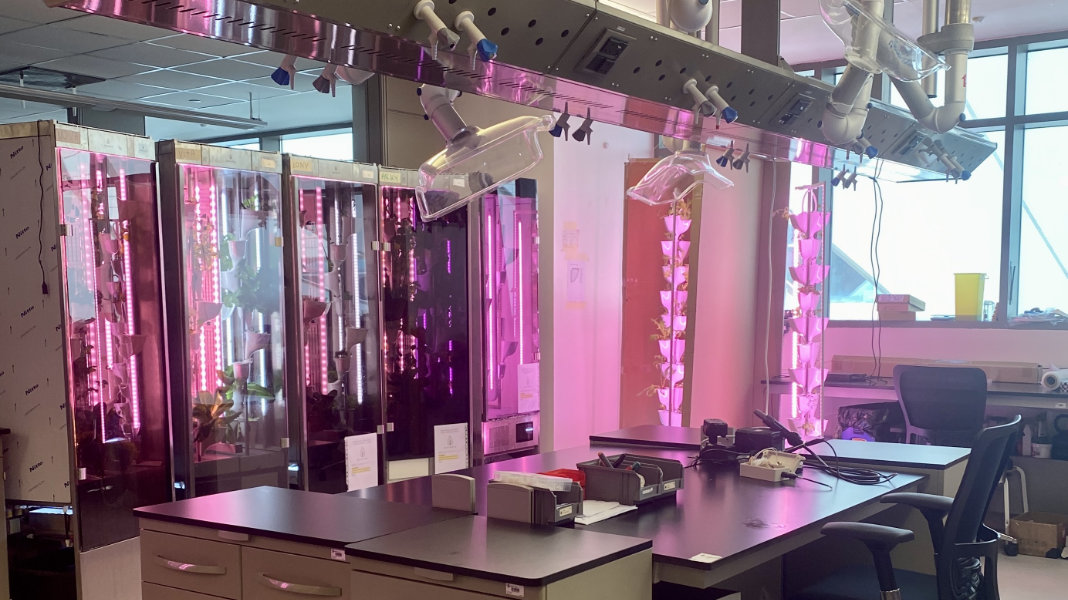
It not only awarded $2 million to Natufia Labs through its venture capital investment arm, the KAUST Innovation Fund, but also offered a residency at the KAUST Research and Technology Park. Lu soon perfected the art of production and lowered the price. Later, Lu realized the only way he could push the envelope was by designing a product that was smaller in size and more compact in shape than the Natufia Smart Garden.
In the fall of 2022, it launched Natufia One, a smaller and semi-automated version of Natufia Smart Garden, which was entirely developed at KAUST. Weighing 65 kg, Natufia One ventured into the market.
Lu now plans to raise new investments to increase production capacity and triple the firm’s distribution network before the end of this year. He also hopes to launch a slew of new products in 2024.
The plans are encouraging, considering the Kingdom is on a war footing to localize the country’s food industry by 2030.


