

UN chief slams rich countries’ treatment of poor states

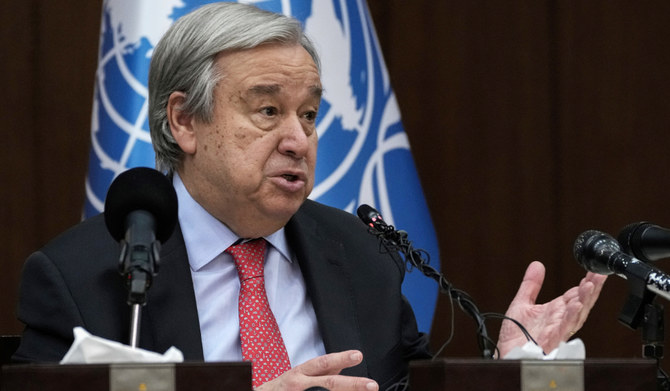
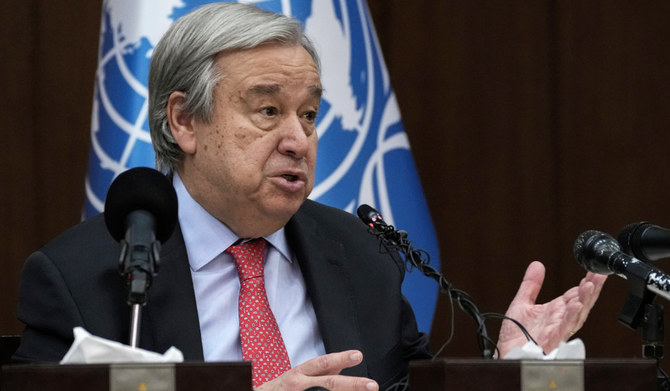
United Nations Secretary-General Antonio Guterres speaks to reporters during a news conference, in Baghdad, Iraq, Wednesday, March 1, 2023. (AP)
Short Url
Updated 04 March 2023
Follow

UN chief slams rich countries’ treatment of poor states

  • Wealthy nations should provide $500bn a year to help others ‘trapped in vicious cycles’

DOHA: UN Secretary-General Antonio Guterres on Saturday slammed the world’s rich countries and energy giants for throttling poor nations with “predatory” interest rates and crippling fuel prices.

Speaking in the Qatari capital, Doha, Guterres told leaders of more than 40 of the most deprived states that wealthy nations should provide $500 billion a year to help others “trapped in vicious cycles” that block efforts to boost economies and vital services.
The summit of Least Developed Countries is normally held every 10 years but has twice been delayed since 2021 because of the coronavirus pandemic.
Afghanistan and Myanmar, two of the poorest countries, are not present at the Doha meeting of 46 LDC states because their governments are not recognized by UN members.

HIGHLIGHT

Afghanistan and Myanmar, two of the poorest countries, are not present at the Doha meeting of 46 LDC states because their governments are not recognized by UN members.

No leader from any of the world’s major economies attended.
At a leaders’ summit ahead of the start of the general LDC conference on Sunday, Guterres hit out straight away at the way poor nations are treated by the more powerful.
“Economic development is challenging when countries are starved for resources, drowning in debt, and still struggling with the historic injustice of an unequal COVID-19 response,” he said.
The LDCs have complained that they did not get a fair share of the COVID vaccines that went mainly to Europe and North America.
“Combatting climate catastrophe that you did nothing to cause is challenging when the cost of capital is sky-high” and the financial help received “is a drop in the bucket,” said Guterres.
“Fossil fuel giants are raking in huge profits, while millions in your countries cannot put food on the table.”
Guterres said the poorest nations were being left behind in the “digital revolution” and the Ukraine war had fueled their food and fuel prices.
“Our global financial system was designed by wealthy countries, largely to their benefit,” he said.
“Deprived of liquidity, many of you are locked out of capital markets by predatory interest rates,” the UN leader said.
A host of presidents and ministers hit out at financing conditions for LDCs, whose debt has more than quadrupled in a decade to an estimated $50 billion in 2021.
East Timor’s President Jose Ramos-Horta called interest rates “rapacious” and “insensitive.”
Malawi’s President Lazarus Chakwera, the summit chairman, highlighted “broken promises” and said that aid was not “an act of charity” but a “moral responsibility.”
Wealthy nations had failed to keep a promise to give 0.15-0.20 percent of their Gross National Income to LDCs, the UN chief said.
With poorer states trapped in a “perfect storm for perpetuating poverty and injustice,” Guterres said LDCs required a “minimum” $500 billion a year to overcome their problems, build up job creating industries and repay debts.
He added that the UN would also “keep pushing” richer countries to hand over hundreds of billions of dollars promised separately to help poorer states battle climate change.
Under proposals a so-called Doha Programme of Action, a food stockholding system, will be set up to help countries facing hunger crises through drought and high prices.
It also calls for new efforts to help LDCs attract foreign funding and lower interest rates to ease the impact of their debts.
Bhutan will this year become one of seven countries — along with Bangladesh, Laos, Nepal, Angola, Sao Tome and Principe and the Solomon Islands to “graduate” out of LDC status by 2026.
But they will gradually lose trade and aid privileges. Guterres said they risk becoming “victims of the cruelest sleight-of-hand trick — support systems vanishing before their eyes” and would need help after they move up the wealth scale.




The Iran war has upended flights across the Middle East. Here’s what travelers should know

Updated 4 sec ago
Follow

The Iran war has upended flights across the Middle East. Here’s what travelers should know

NEW YORK: The US and Israel’s joint war in Iran has already upended travel across the Middle East, stranding tens of thousands of people. And the future is anything but certain.
Experts stress that flights scheduled in the coming days and weeks could continue to see disruptions — causing ripple effects globally, especially as the war widens with retaliatory strikes in the Gulf states. Beyond the Middle East, airports in the Gulf serve as critical hubs connecting travelers going to Europe, Africa and Asia.
Amid airspace closures across the region, many carriers have been forced to either cancel flights or shift to longer routes. That’s straining operating costs and ticket prices, both of which could become more expensive if airlines have to pay more for fuel the longer the war drags on. In the near future, experts recommend postponing unnecessary travel if possible, checking refund or insurance policies and, most importantly, monitoring safety adviseries.
“This is not a normal delay story. This is a conflict zone airspace story,” said Hassan Shahidi, president and CEO of the Flight Safety Foundation — stressing that halted traffic and guidance from carriers, airports and governments may shift each day, if not by the hour. “Travelers should absolutely expect uncertainty.”
Here’s what travelers should know about upcoming trips.
Monitor adviseries and other safety information
Since the US and Israel launched attacks over the weekend, retaliatory strikes and other developments have unfolded rapidly. Iran says hundreds of people have been killed in the country. For travelers across the region, experts stress the importance of following safety guidance and updates from government officials.
A handful of governments have also issued travel adviseries and emergency evacuation orders. The US State Department on Monday urged all US citizens to immediately leave Iran and Israel, as well as Qatar, Bahrain, Egypt, Iraq, Jordan, Kuwait, Lebanon, Oman, the Palestinian territories, Saudi Arabia, Syria, the United Arab Emirates and Yemen using any available commercial transportation — and Secretary of State Marco Rubio pleaded for the media to publicize ways to help Americans evacuate. Meanwhile, countries like China, Italy, France and Germany moved to organize evacuation efforts for their citizens.
Experts like Shahidi say travelers should monitor these travel adviseries from governments and embassies to make sure they have the latest information. And because so many people are still stranded amid swaths of cancelations and airspace closures, he added that it’s wise to reconsider or rebook upcoming trips, if possible.
“If travel is optional, consider postponing it,” Shahidi said. “But if it’s necessary, then make sure that you get refundable or changeable fares.”
Travelers should also monitor updates from airports and airlines. Long-haul carriers Etihad Airways and Emirates, based in Abu Dhabi and Dubai, along with Doha-based Qatar Airways all temporarily suspended certain routes — citing airspace closures and safety requirements.
Read the fine print of refunds and insurance
Many airlines are taking refund requests or offering free rebooking — but such options are often limited to specific dates or routes, so it’s important for travelers to check carriers’ individual websites for more information. For future trips, buying refundable tickets now may provide more flexibility.
Beyond what individual airlines can offer, some may also be seeking travel insurance. But it’s important to read the fine print, particularly the exclusions listed under specific policies.
“Acts of war and civil unrest are typically excluded because they’re unpredictable,” said Suzanne Morrow, CEO of travel insurance agency InsureMyTrip. Consumers could still buy coverage for delays, she added, but travel insurance is “designed to make you whole,” and if an airline does everything to rebook you or offers a refund, you may not have an added claim.
Christina Tunnah, of World Nomads Travel Insurance, reiterates that the majority of her firm’s policies excludes coverage for losses resulting from acts of war, although someone might be able to get compensation in certain scenarios — such as if they purchase a “cancel for any reason” plan. Still, the traveler would have to cancel within a certain time frame.
Tunnah adds that once an event is known, it’s unlikely to be covered. So if a consumer has not already purchased traveler insurance, many insurers may have added restrictions to impacted destinations.
Brace for longer flights and higher ticket prices
Beyond cancelations, many carriers are now taking longer routes to avoid closed airspace. Shahidi noted that includes not only closures stemming from this current war but also previous conflicts worldwide.
Navigating these different conflict zones has become increasingly difficult for airlines, because longer routes can be more expensive. It’s industry standard for carriers to pay “overflight fees” when flying through other countries’ airspace — which there could be more of now. And, of course, longer flights need more fuel.
“Those costs will be passed on to the passengers,” explained Bryan Terry, managing director at Alton Aviation Consultancy. If the conflict continues, he said, travelers should “anticipate that some carriers will likely impose fuel surcharges” or increase existing fees.
Passengers have already reported seeing sky-high ticket prices. Experts say those immediate hikes more likely reflect supply and demand as thousands of flights were canceled in recent days. But the costs of those longer routes — paired with oil prices that have already spiked since the US and Israel launched their attacks — could trickle down to consumers further ahead.
The price of crude oil is a key component for jet fuel, which accounted for about 30 percent of airlines’ operating costs as of 2024, according to research from the International Air Transport Association.
Many routes within the next week are completely sold out or have exorbitant prices for last remaining seats. The market currently shows those costs, while still elevated, are lower for trips booked further out, Terry notes — but, again, if the war drags on or worsens, “those conditions could change at a moment’s notice.”