LOS ANGELES: The man convicted of shooting dead Robert Kennedy in 1968 was denied parole in California on Wednesday, thwarting his latest effort to leave prison.
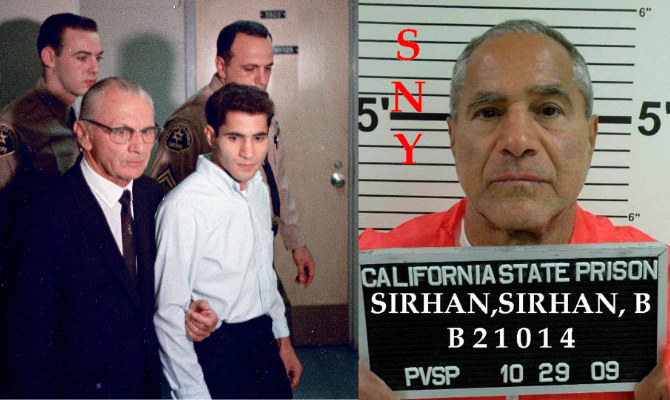
Sirhan Sirhan, now 78, has been behind bars for more than five decades — despite doubts that he fired the shots that likely changed the course of US politics.
Kennedy, the younger brother of slain president John F. Kennedy, was campaigning for the Democratic presidential nomination himself when he was gunned down in a Los Angeles hotel.
Sirhan’s latest request for parole — he became eligible in 1972 — was denied by a California board on Wednesday.
A different board had greenlit his release in August 2021, but California Governor Gavin Newsom reversed that decision in January of the following year.
Newsom, who is also a Democrat, said at the time that Sirhan “poses an unreasonable threat to public safety.”
He said the decision was based on several factors “including Mr. Sirhan’s refusal to accept responsibility for his crime.”
Sirhan was convicted and sentenced to death in 1969 after pleading guilty, but his sentence was commuted to life imprisonment several years later.
Doubts around Sirhan’s culpability have swirled since his trial, when it was revealed that Kennedy was shot at point-blank range from behind, but witnesses said Sirhan was standing in front of him.
Later, evidence emerged that as many as 13 shots were fired, yet Sirhan’s gun could only hold eight bullets.
Suspicion over the verdict led Kennedy’s son, Robert F. Kennedy Jr, to visit Sirhan in prison.
“I went there because I was curious and disturbed by what I had seen in the evidence,” he told the Washington Post in 2018.
“I was disturbed that the wrong person might have been convicted of killing my father.”
He and his youngest brother, Douglas, supported Sirhan’s 2021 attempt at release.
A Palestinian immigrant, Sirhan said at the time of the assassination that his actions were motivated by Kennedy’s support for military sales to Israel.
During a 2016 parole hearing, he said he had drunk too much the night of the shooting, and that his prior confession was the result of bad legal advice from his lawyer.

Robert Kennedy’s assassin denied parole again
https://arab.news/b2y5q
Robert Kennedy’s assassin denied parole again
- Sirhan B. Sirhan was convicted in 1969 after pleading guilty of assassinating Robert Kennedy in 1968, but doubts have swirled as evidence emerged that as many as 13 shots were fired, yet Sirhan’s gun could hold only 8 bullets
Geoeconomic confrontation tops global risks in 2026: WEF report
- Also armed conflict, extreme climate, public polarization, AI
- None ‘a foregone conclusion,’ says WEF’s MD Saadia Zahidi
DUBAI: Geoeconomic confrontation has emerged as the top global risk this year, followed by state-based armed conflict, according to a new World Economic Forum report.
The Global Risks Report 2026, released on Wednesday, found that both risks climbed eight places year-on-year, underscoring a sharp deterioration in the global outlook amid increased international competition.
The top five risks are geoeconomic confrontation (18 percent of respondents), state-based armed conflict (14 percent), extreme weather events (8 percent), societal polarization (7 percent) and misinformation and disinformation (7 percent).
The WEF’s Managing Director Saadia Zahidi said the report “offers an early warning system as the age of competition compounds global risks — from geoeconomic confrontation to unchecked technology to rising debt — and changes our collective capacity to address them.
“But none of these risks are a foregone conclusion.”

The report assesses risks across three timeframes: immediate (2026); short-to-medium term (next two years); and long term (next 10 years).
Economic risks show the largest overall increase in the two-year outlook, with both economic downturn and inflation jumping eight positions.
Misinformation and disinformation rank fifth this year but rise to second place in the two-year outlook and fourth over the 10-year horizon.
The report suggests this reflects growing anxiety around the rapid adoption of artificial intelligence, with adverse outcomes linked to AI surging from 30th place in the two-year timeframe to fifth in the 10-year outlook.
Uncertainty dominates the global risk outlook, according to the report.
Surveyed leaders and experts view both the short- and long-term outlook negatively, with 50 percent expecting a turbulent or stormy global environment over the next two years, rising to 57 percent over the next decade.
A further 40 percent and 32 percent, respectively, describe the outlook as unsettled across the two- and 10-year timeframes, while just 1 percent anticipate a calm global outlook in either period.
Environmental risks ease slightly in the short-term rankings. Extreme weather fell from second to fourth place and pollution from sixth to ninth. Meanwhile, critical changes to Earth systems and biodiversity loss dropped seven and five positions, respectively.
However, over the next decade, environmental threats re-emerge as the most severe, with extreme weather, biodiversity loss, and critical changes to Earth systems topping the global risk rankings.

Looking ahead over the next decade, around 75 percent of respondents anticipate a turbulent or stormy environmental outlook, making it the most pessimistic assessment across all risk categories.
Zahidi said that “the challenges highlighted in the report underscore both the scale of the potential perils we face and our shared responsibility to shape what comes next.”
Despite the gloomy outlook, Zahidi signaled a positive shift in global cooperation.
“It is also clear that new forms of global cooperation are already unfolding even amid competition, and the global economy is demonstrating resilience in the face of uncertainty.”
Now in its 21st year, the Global Risks Report highlights a core message: global risks cannot be managed without cooperation.
As competition intensifies, rebuilding trust and new forms of collaboration will be critical, with the report stressing that today’s decisions will shape future outcomes.
The report was released ahead of WEF’s annual meeting, which will be held in Davos from Jan. 19 to 23.