WHO chief visits rebel-held Syria for first time after quake

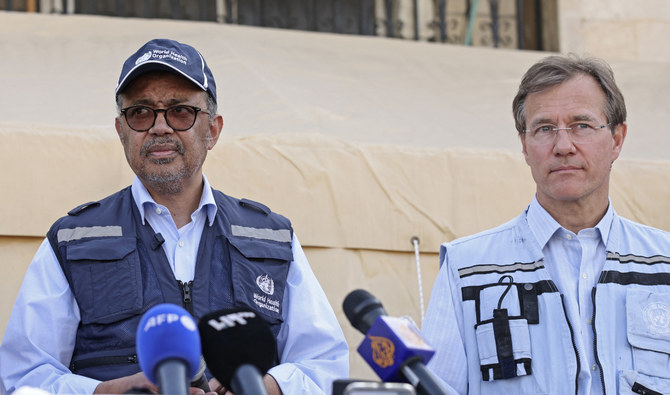
WHO chief Tedros Adhanom Ghebreyesus (L) holds a press conference alongside UN deputy regional humanitarian coordinator David Carden in Bab Al-Hawa on March 1, 2023. (AFP)
Short Url
Updated 02 March 2023
Follow

WHO chief visits rebel-held Syria for first time after quake

  • He visited several hospitals and a shelter for those displaced

BAB AL-HAWA, Syria: World Health Organization chief Tedros Adhanom Ghebreyesus on Wednesday visited areas of rebel-held northwestern Syria that were devastated by last month’s earthquake, an AFP correspondent reported.

Tedros, the highest-ranking United Nations official to visit Syria’s rebel-held zones since the February 6 quake, had traveled to government-controlled areas of Aleppo and Damascus the week of the disaster.

He entered Syria on Wednesday from neighboring Turkiye via the Bab Al-Hawa crossing and visited several hospitals and a shelter for those displaced, the correspondent said.

In the aftermath of the quake, activists and emergency teams in the rebel-held northwest decried the UN’s slow response, contrasting it with the planeloads of humanitarian aid that have been delivered to government-controlled airports.

A total of 258 planes laden with aid have reached regime-controlled areas, 129 of them from the United Arab Emirates.

UN relief chief Martin Griffiths admitted on February 12 that the body had “so far failed the people in northwest Syria.”

Since then, the UN launched a $397 million appeal to help quake victims in Syria.

The United Nations says a total of 420 trucks loaded with UN aid have crossed into the rebel-held pocket since the tragedy.

More than 4 million people live in areas outside government control in Syria’s north and northwest, 90 percent of whom depend on aid to survive.

The first UN aid convoy crossed into the area on February 9 — three days after the quake struck — and carried tents and other relief for 5,000 that had been expected before the earthquake.

The UN largely delivers relief to Syria’s northwest via neighboring Turkiye through the Bab Al-Hawa crossing — the only way for aid to enter without Damascus’s permission.

The crossing is located in the Idlib region, which UN officials rarely visit and is controlled by the jihadist group Hayat Tahrir Al-Sham.

The WHO chief said on February 12 that Assad had expressed openness to more border crossings for aid to be brought to quake victims in the rebel-held northwest.

On February 13, the United Nations said Damascus had allowed it to also use two other crossings in areas outside its control — Bab Al-Salama and Al-Rai — for three months.

An AFP correspondent said a new aid convoy entered via Bab Al-Salama on Wednesday.

The first UN delegation to visit rebel-held northwestern Syria after the earthquake crossed over from Turkiye on February 14.

It comprised deputy regional humanitarian coordinator David Carden and Sanjana Quazi, who heads the UN Office for the Coordination of Humanitarian Affairs in Turkiye and was largely an assessment mission.

The 7.8-magnitude quake that struck war-torn Syria and Turkiye killed more than 50,000 people across the two countries.

The Syrian government has said 1,414 people were killed in areas under its control, while Turkish-backed officials in Syria have put the death toll in rebel-held areas at 4,537.


Israel says it has launched ‘broad wave’ of strikes on Iran, as Tehran widens its response across the region

Updated 24 min 47 sec ago
Follow

Israel says it has launched ‘broad wave’ of strikes on Iran, as Tehran widens its response across the region

  • ​US military says 17 Iranian navy ships destroyed, struck nearly ‌2,000 targets ‌in ​Iran thus far
  • US and Israeli attacks have killed 787 people in Iran:  Iranian Red Crescent

JERUSALEM/DUBAI/TEHRAN: Israel early Wednesday launched new attacks on Iran as the US military said it has hit nearly 2,000 targets inside the Islamic republic, which tried to impose a cost by expanding a missile and drone barrage across the region.
With global energy prices on the rise, President Donald Trump said the US Navy was ready to escort oil tankers through the Strait of Hormuz, the vital chokepoint into the Gulf that Iran has threatened to seal off.
Israel’s military said it launched a “broad wave of strikes” after midnight across Iran, which in the hours before had launched three separate missile barrages at Israel, causing mild injuries to a woman in Tel Aviv.
The US military has hit nearly 2,000 targets since attacking Iran alongside Israel on Saturday, targeting ballistic missiles and “all the things that can shoot at us,” said Admiral Brad Cooper, commander of US Central Command.
“These forces bring a massive amount of firepower, representing the largest buildup by the US in the Middle East in a generation,” he said in a video message, describing the first day’s barrage as bigger than the so-called “shock and awe” against Saddam Hussein’s Iraq in 2003.
The US and Israeli attacks have killed 787 people in Iran, according to the Iranian Red Crescent, a toll that could not be independently confirmed by AFP.
Iran vowed to inflict a heavy price in retaliation. Drones struck adjacent the US consulate in Dubai, starting a fire but inflicting no casualties, and against the US military base at Al-Udeid in Qatar.
The attacks came a day after strikes on the US embassies in Riyadh and Kuwait City and on a US air base in Bahrain.
“We are saying to the enemy that if it decides to hit our main centers, we will hit all economic centers in the region,” Islamic Revolutionary Guard General Ebrahim Jabbari said.


Trump says no more talks

The United States and Israel launched the attack on Saturday and quickly killed Iran’s supreme leader, Ayatollah Ali Khamenei, two days after US envoys had been speaking to Iran in Geneva on a nuclear accord.
Trump insisted that Iran wanted to resume talks but it was “too late.”
He also walked back a statement the day before from Secretary of State Marco Rubio, who said the US attack’s timing was precipitated by Israel’s plans.
“If anything, I might have forced Israel’s hand,” Trump said as he met German Chancellor Friedrich Merz at the White House.
Trump boasted that “just about everything’s been knocked out” in Iran, including its navy, air force and air detection, and said the attacks had killed even leaders who could have taken over.
“Most of the people we had in mind are dead,” Trump said. “Now we have another group. They may be dead also, based on reports.”
According to Iranian media, US and Israeli strikes targeted a building on Tuesday in the holy city of Qom belonging to the committee that is to elect a new supreme leader. The Tasnim news agency reported that strikes had already targeted the body’s main headquarters in Tehran the day before.
Trump and Israeli Prime Minister Benjamin Netanyahu have urged Iranians to rise up but Trump said regime change was not the goal.
The assault came weeks after Iranian authorities clamped down on mass protests, killing thousands.

Iran hits US embassies

The US State Department said Tuesday it’s preparing military and charter flights for Americans who want to leave the Middle East. Several other countries also arranged evacuation flights for their citizens.

An attack from two drones on the US Embassy in Riyadh caused a “limited fire,” according to the Saudi Arabian Defense Ministry, and the embassy urged Americans to avoid the compound.
An Iranian drone struck a parking lot outside the US consulate in Dubai, sparking a small fire, Secretary of State Marco Rubio said in Washington. He said all personnel were accounted for.
The United Arab Emirates said it has intercepted the vast majority of more than 1,000 Iranian missile and drone attacks against it.
US embassies in Saudi Arabia, Kuwait and Lebanon said they were closed to the public.
The US State Department ordered the evacuation of non-emergency personnel and family in Kuwait, Bahrain, Iraq, Qatar, Jordan and the United Arab Emirates. And US citizens were urged to leave more than a dozen Middle Eastern countries, though many were stranded because of airspace closures.

The US military has confirmed six deaths of American service members.
Four of the American soldiers killed were identified as Capt. Cody A. Khork, 35, of Winter Haven, Florida; Sgt. 1st Class Noah L. Tietjens, 42, of Bellevue, Nebraska; Sgt. 1st Class Nicole M. Amor, 39, of White Bear Lake, Minnesota; and Sgt, Declan J. Coady, 20, of West Des Moines, lowa, who received a posthumous promotion in rank. They were assigned to the Iowa-based 103rd Sustainment Command.

Lebanon violence expands 

The regional war also took a growing toll on Lebanon, where Hezbollah, the armed Shiite Muslim movement that long had Tehran as a benefactor, launched drones and rockets at Israel in retaliation for Khamenei’s slaying.
Hezbollah said it targeted the Israeli naval base in the northern city of Haifa and Israel said it struck Beirut’s heavily Shiite southern suburbs. Loud explosions were heard early Wednesday.
Israeli strikes have killed at least 52 people in Lebanon, according to the government, while the United Nations said that more than 30,000 people were displaced.
In a throwback to earlier wars, Israel said it was moving troops across the border to create a buffer zone inside Lebanon.
In Tehran, photos showed damage to Mehrabad airport, which handles mainly domestic flights.
The Israeli military also announced a strike on an underground facility on the eastern outskirts of Tehran where it alleged scientists were covertly working on a nuclear program.
The United States ordered non-emergency personnel to leave embassies in much of the region. The Washington Post reported that the Iranian drone in Riyadh hit the station of the CIA.
The United States encouraged all Americans to leave the region if they can find commercial flights, even though air travel has been severely disrupted.
The State Department said that some 9,000 Americans have found a way home.
Qatar said it had downed missiles targeting Hamad International Airport in Doha. Oman reported several drones attacking the port of Duqm, and in the UAE falling debris from an intercepted drone caused a fire at an oil storage and trading zone, authorities said.

Ghost town

In Tehran, residents who have not fled remained shut away in their homes for fear of the US-Israeli bombardment.
The Iranian capital is normally home to around 10 million people, but in recent days “there are so few people that you’d think no one ever lived here,” said Samireh, a 33-year-old nurse.
Authorities had previously urged people to leave the city, and police officers, armed security forces and armored vehicles have been stationed at main junctions, carrying out random checks on vehicles.
In the more upmarket north of Tehran, the meowing of cats and chirping of birds replaced the usual din of traffic jams.
Iranian authorities said a strike on a school in the city of Minab on the first day of the war killed more than 150 people.