

Pakistan’s top court to announce verdict today in provincial elections delay case

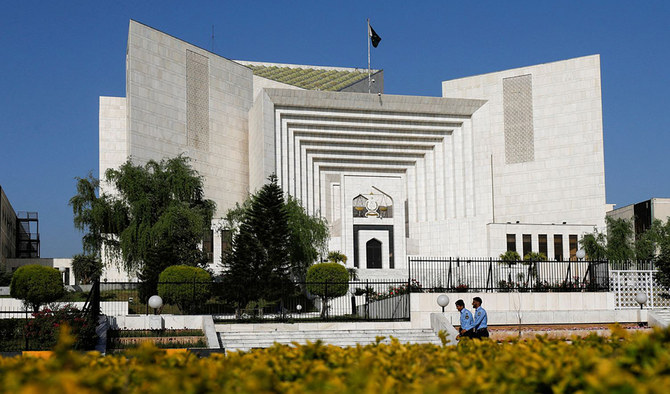
Police officers walk past the Supreme Court of Pakistan building, in Islamabad, Pakistan on April 6, 2022. (REUTERS/File)
Short Url
Updated 28 February 2023
Follow

Pakistan’s top court to announce verdict today in provincial elections delay case

  • The chief justice says constitution requires conduct of polls within 90 days of dissolution assemblies
  • The electoral oversight body maintains a date for polls should come from respective provincial governors

ISLAMABAD: After a daylong hearing, Pakistan’s top court on Tuesday reserved its judgment in a case pertaining to delay in elections of Punjab and Khyber Pakhtunkhwa provincial assemblies, which would be announced at 11pm on Wednesday.  

The Supreme Court of Pakistan last week took a suo motu notice of the delay in provincial elections and decided to ascertain as to who was responsible to announce a date for polls, more than a month after the dissolution of the provincial legislatures.  

“The judgment would be announced tomorrow by 11am,” the Supreme Court announced after wrapping up the hearing.  

Seeking to force the government into holding an early national election, former prime minister Imran Khan dissolved the provincial government in Khyber Pakhtunkhwa in January, days after his allies did the same in the most populous Punjab province. The two regions account for more than half of the country’s 220 million population. 

Khan’s Pakistan Tehreek-e-Insaf (PTI) party is gambling on the government of PM Shehbaz Sharif being unable to afford to hold the provincial elections separately from a nationwide election, which is otherwise due by October.  

Under the Pakistani law, fresh polls for the two provincial assemblies should be held within 90 days, but in recent weeks, senior PTI members have variously said the government is trying to delay elections in the two provinces.  

Last week, President Arif Alvi, a close Khan aide, announced that elections in both provinces would be held on April 9. He accused the governors of both provinces of delaying the elections, adding that it was his constitutional duty to announce polls in such an instance. The government, however, said Alvi did not have the authority to make such a call. 

“If the elections are not held in time, uncertainty will prevail in the country,” Chief Justice Umar Ata Bandial remarked on Tuesday, repeatedly emphasising “it is spirit of the constitution to hold elections within 90 days.”  

During the hearing, the Election Commission of Pakistan’s (ECP) lawyer Sajeel Sheryar Swati said dates for the provincial elections should be announced by the respective governors, adding the commission had written separate letters to Punjab and KP governors in this regard.  

“The election commission should have completed all preparations for the polls and reached out to the governors again [for the election date],” the chief justice said.  

The president’s authority to announce the election date also came under discussion during the hearing as he had unilaterally fixed April 9 as the date for polls in both provinces. 

Attorney-General Shehzad Ata Elahi objected to the president’s authority of giving the election date, saying that he can fix a date only if the National Assembly was dissolved or general elections were to be held after the expiry of the assembly’s term.  

Elahi said the election commission had the authority to decide the election date and conduct polls, adding if schedule given in the 2017 Elections Act was followed, then provincial elections could not be held before April 25.  

“As per the Elections Act, at least 28 days are required for the election campaign, but the election commission could reduce this time to hold the elections within 90 days,” the attorney-general said.  

President Alvi’s lawyer Salman Akram Raja defended his authority to fix the election date as per the constitution. “The president doesn’t need an advice [from the government] to announce the election date,” Raja maintained.  

Farooq H. Naek, who represents another ruling coalition partner, the Pakistan Peoples Party (PPP), termed the president’s announcement of the election date "unconstitutional," saying he fixed the date without the prime minister’s advice.  

Earlier in the day, the court gave the PTI and the coalition government until 4pm to sit together and develop a consensus over the election date, but it could not be reached.  

“Everyone here agrees that under Article 224, elections are to be conducted within 90 days,” the chief justice said.  

“The court is trying to ascertain as to who should give the election date. It has to be determined who will give the election date in the future.” 


Tens of thousands flee northwest Pakistan over fears of military operation

Updated 28 January 2026
Follow

Tens of thousands flee northwest Pakistan over fears of military operation

  • More than 70,000 people, mostly women and children, have fled remote Tirah region bordering Afghanistan 
  • Government says no military operation underway or planned in Tirah, a town in Khyber Pakhtunkhwa province

BARA, Pakistan: More than 70,000 people, mostly women and children, have fled a remote region in northwestern Pakistan bordering Afghanistan over uncertainty of a military operation against the Pakistani Taliban, residents and officials said Tuesday.

Pakistan’s Defense Minister Khawaja Mohammad Asif has denied the claim by residents and provincial authorities. He said no military operation was underway or planned in Tirah, a town in Khyber Pakhtunkhwa province.

Speaking at a news conference in Islamabad, he said harsh weather, rather than military action, was driving the migration. His comments came weeks after residents started fleeing Tirah over fears of a possible army operation.

The exodus began a month after mosque loudspeakers urged residents to leave Tirah by Jan. 23 to avoid potential fighting. Last August, Pakistan launched a military operation against Pakistani Taliban in the Bajau r district in the northwest, displacing hundreds of thousands of people.

Shafi Jan, a spokesman for the provincial government in Khyber Pakhtunkhwa, posted on X that he held the federal government responsible for the ordeal of the displaced people, saying authorities in Islamabad were retracting their earlier position about the military operation.

Khyber Pakhtunkhwa Chief Minister Suhail Afridi, whose party is led by imprisoned former Prime Minister Imran Khan, has criticized the military and said his government will not allow troops to launch a full-scale operation in Tirah.

The military says it will continue intelligence-based operations against Pakistani Taliban, who are known as Tehrik-e-Taliban Pakistan, or TTP. Though a separate group, it has been emboldened since the Afghan

Taliban returned to power in 2021. Authorities say many TTP leaders and fighters have found sanctuary in Afghanistan and that hundreds of them have crossed into Tirah, often using residents as human shields when militant hideouts are raided.

Caught in the middle are the residents of Tirah, who continued arriving in Bara.

So far, local authorities have registered roughly 10,000 families — about 70,000 people — from Tirah, which has a population of around 150,000, said Talha Rafiq Alam, a local government administrator overseeing the relief effort. He said the registration deadline, originally set for Jan. 23, has been extended to Feb. 5.

He said the displaced would be able to return once the law-and-order situation improves.

Among those arriving in Bara and nearby towns was 35-year-old Zar Badshah, who said he left with his wife and four children after the authorities ordered an evacuation. He said mortar shells had exploded in villages in recent weeks, killing a woman and wounding four children in his village. “Community elders told us to leave. They instructed us to evacuate to safer places,” he said.

At a government school in Bara, hundreds of displaced lined up outside registration centers, waiting to be enrolled to receive government assistance. Many complained the process was slow.

Narendra Singh, 27, said members of the minority Sikh community also fled Tirah after food shortages worsened, exacerbated by heavy snowfall and uncertain security.

“There was a severe shortage of food items in Tirah, and that forced us to leave,” he said.

Tirah gained national attention in September, after an explosion at a compound allegedly used to store bomb-making materials killed at least 24 people. Authorities said most of the dead were militants linked to the TTP, though local leaders disputed that account, saying civilians, including women and children, were among the dead.