Philippine leader urges military to focus on South China Sea

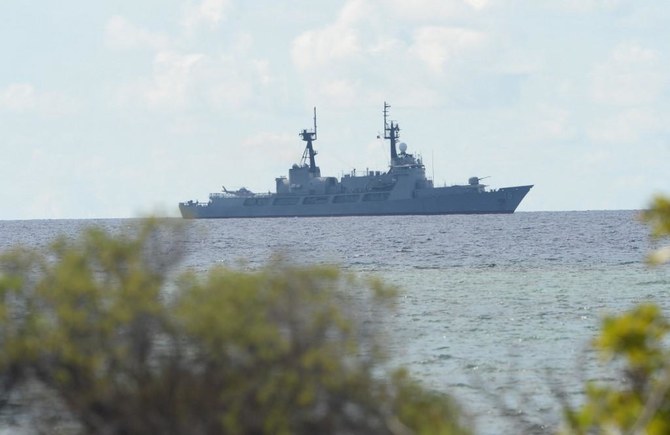
The Philippine navy’s frigate BRP Gregorio del Pilar is anchored near Thitu island in South China Sea on April 21, 2017. (AFP file photo)
Short Url
Updated 28 February 2023
Follow

Philippine leader urges military to focus on South China Sea

  • China, the Philippines, Vietnam, Malaysia, Taiwan and Brunei have been locked in an increasingly tense territorial standoff in the South China Sea
  • The disputes have intensified after China turned seven disputed reefs into missile-protected island bases to bolster its claims

MANILA: The Philippine president said the main mission of his country’s military has changed to ensure the protection of its territory as disputes with China and US-China rivalry intensify.
President Ferdinand Marcos Jr. stressed the urgency of shifting the military’s focus to external defense in a speech before troops Monday afternoon. He spoke two weeks after summoning China’s ambassador to protest the use of a military-grade laser by the Chinese coast guard that briefly blinded some of the crew of a Philippine patrol vessel in the South China Sea.
The Philippines condemned the Feb. 6. incident in one of the more than 200 diplomatic protests it has filed against Beijing’s increasingly aggressive actions in the disputed waterway since last year.
China has accused the Philippines of intruding into its territory and said its coast guard used a harmless laser to track the Philippine vessel. China claims the South China Sea virtually in its entirety.
“I’m saying that your mission in the AFP has changed,” Marcos told the troops, referring to the Armed Forces of the Philippines. “For many, many years, we were able to maintain that peace and maintain that understanding with all of our neighbors. Now things have begun to change and we must adjust accordingly.”
He said that the country’s boundaries were being put into question, “and there are many things that are happening so the air force has a very big mission to fully secure the Philippines.” He also cited “the intensification of the competition between the superpowers.”
Marcos did not offer specifics nor mentioned China in his speech in central Cebu province, but underscored that Philippine foreign policy remains committed to peace.
Despite being a relatively small country, “we still have to fight for the rights of every Filipino because the Philippines is a sovereign nation and the Philippines has a functioning government,” he said.
After decades of combating Muslim and communist insurgencies, the military has begun to focus on defending the country’s sea borders. It has launched efforts to modernize in a program that has faced delays and financial constraints.
Many of the weapons and equipment have been aimed to improve its air and sea patrols to guard the archipelago’s vast coastline and build a minimal deterrence.
Under a 2014 defense pact with the United States, Marcos recently approved a wider US military presence in the Philippines by allowing rotating batches of American forces to stay in four more Philippine military camps. That’s a sharp turnaround from his predecessor Rodrigo Duterte, who feared that American military footprint could offend Beijing.
China, the Philippines, Vietnam, Malaysia, Taiwan and Brunei have been locked in an increasingly tense territorial standoff in the South China Sea, where US Navy ships and fighter jets have carried out patrols to promote freedom of movement, challenge Beijing’s expansive claims and reassure allies like the Philippines.
The disputes have intensified after China turned seven disputed reefs into missile-protected island bases to bolster its claims. The disputed waters have been regarded as a possible Asian flashpoint and a delicate front in the US-China rivalry in the region.


Journalists in Bangladesh demand protection amid rising attacks

Updated 5 sec ago
Follow

Journalists in Bangladesh demand protection amid rising attacks

  • Media industry in the South Asian country is being systematically targeted
  • Interim government blamed for failing to adequately respond to the incidents
DHAKA: Journalists, editors and owners of media outlets in Bangladesh on Saturday demanded that authorities protect them following recent attacks on two leading national dailies by mobs.
They said the media industry in the South Asian country is being systematically targeted in the interim government headed by Nobel Peace Prize laureate Muhammad Yunus. They said the administration failed to prevent attacks on the Daily Star, the country’s leading English-language daily, and the Prothom Alo, the largest Bengali-language newspaper, both based in Dhaka, the capital.
In December, angry mobs stormed the offices of the two newspapers and set fire to the buildings, trapping journalists and other staff inside, shortly after the death of a prominent Islamist activist.
The newspaper authorities blamed the authorities under the interim government for failing to adequately respond to the incidents despite repeated requests for help to disperse the mobs. Hours later, the trapped journalists who took shelter on the roof of the Daily Star newspaper were rescued. The buildings were looted. A leader of the Editors Council, an independent body of newspaper editors, was manhandled by the attackers when he arrived at the scene.
On the same day, liberal cultural centers were also attacked in Dhaka.
It was not clear why the protesters attacked the newspapers, whose editors are known to be closely connected with Yunus. Protests had been organized in recent months outside the offices of the dailies by Islamists who accused the newspapers of links with India.
On Saturday, the Editors Council and the Newspapers Owners Association of Bangladesh jointly organized a conference where editors, journalist union leaders and journalists from across the country demanded that the authorities uphold the free press amid rising tensions ahead of elections in February.
Nurul Kabir, President of the Editors Council, said attempts to silence media and democratic institutions reflect a dangerous pattern.
Kabir, also the editor of the English-language New Age daily, said unity among journalists should be upheld to fight such a trend.
“Those who want to suppress institutions that act as vehicles of democratic aspirations are doing so through laws, force and intimidation,” he said.
After the attacks on the two dailies in December, an expert of the United Nations said that mob attacks on leading media outlets and cultural centers in Bangladesh were deeply alarming and must be investigated promptly and effectively.
“The weaponization of public anger against journalists and artists is dangerous at any time, and especially now as the country prepares for elections. It could have a chilling effect on media freedom, minority voices and dissenting views with serious consequences for democracy,” Irene Khan said in a statement.
Yunus came to power after former Prime Minister Sheikh Hasina fled the country amid a mass uprising in August, 2024. Yunus had promised stability in the country, but global human rights groups including Human Rights Watch and Amnesty International have blamed the government for its failure to uphold human and other civil rights. The Yunus-led regime has also been blamed for the rise of the radicals and Islamists.
Dozens of journalists are facing murder charges linked to the uprising on the grounds that they encouraged the government of Hasina to use lethal weapons against the protesters. Several journalists who are known to have close links with Hasina have been arrested and jailed under Yunus.