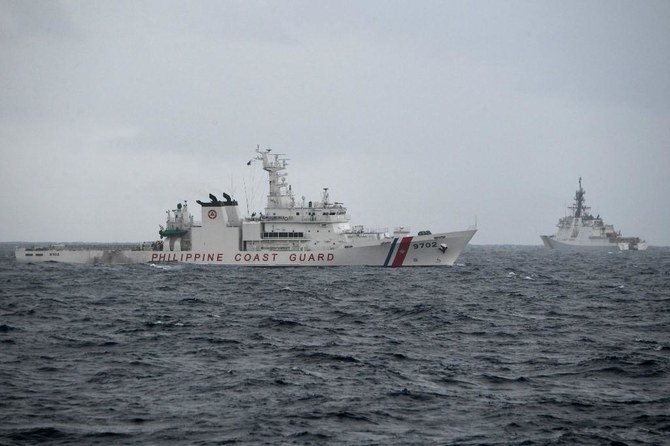
MANILA: The Philippines and the United States are discussing conducting joint coast guard patrols, including in the South China Sea, a Manila official said on Monday.
With overlapping sovereign claims in the strategic waterway, the Philippines has ramped up rhetoric against what it describes as China’s “aggressive activities” in the South China Sea, which has also become a flashpoint for Chinese and US tensions around naval operation.
Jay Tarriela, the Philippine Coast Guard’s (PCG) spokesperson on South China See issues, told CNN Philippines that talks with the United States have advanced beyond the infancy stage and the likelihood of carrying out joint patrols is high.
Tarriela did not provide details on the scale or timing of the proposed patrols, which come after the Pentagon said this month the United States and the Philippines had “agreed to restart joint maritime patrols in the South China Sea.”
“There is already a clear path of possibility since the Defense Department of the United States has also supported the joint patrol with the Philippine navy and the US navy so there is a certainty for this particular joint patrols to happen between the coast guard of both countries,” Tarriela said.
“There is also a possibility that it will be conducted in the South China Sea in support of the freedom of navigation of the United States government,” he said.
Rommel Jude Ong, former vice commander of the Philippine Navy, told Reuters on Monday, the idea of a coast guard deployment in the South China Sea instead of the navy will “mitigate any miscalculation and prevent China from finding an excuse to escalate tension” in the waterway.
Earlier this month, the PCG accused China’s coast guard of aiming a “military-grade laser” against its vessel supporting a resupply mission for troops on an atoll, temporarily blinding its crew, prompting expressions of concern from other countries including Japan, Australia and the United States. China has refuted the PCG’s account, which it said did not reflect the truth.
The Chinese Embassy in Manila did not immediately respond to a request for comment on the joint patrols.
Philippine President Ferdinand Marcos Jr last week summoned China’s ambassador to relay his concern over the frequency and intensity of China’s actions in the South China Sea.


![]()

Philippines, US discuss joint coast guard patrols in South China Sea
Short Url
https://arab.news/v7bkk
Philippines, US discuss joint coast guard patrols in South China Sea
- Details were not provided on the scale or timing of the proposed patrols
- Chinese coast guard earlier accused of aiming a ‘military-grade laser’ against a Philippine coast guard vessel


Latest updates


© 2026 SAUDI RESEARCH & PUBLISHING COMPANY, All Rights Reserved And subject to Terms of Use Agreement.