US drone strike kills 2 suspected Al-Qaeda militants in Yemen’s Marib

The US has killed hundreds of Al-Qaeda militants through drone strikes in Yemen. (Getty Images)
Short Url
Updated 27 February 2023
Follow

US drone strike kills 2 suspected Al-Qaeda militants in Yemen’s Marib

  • A missile blasted through a house owned by three unnamed persons, killing two and injuring another
  • Follows January assassination of bomb-maker Hussein Hadboul

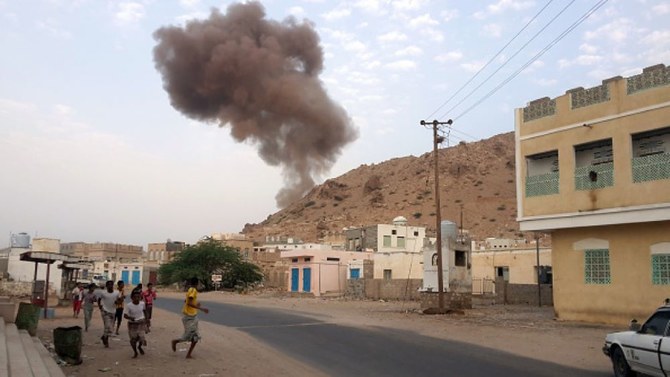
AL-MUKALLA: Two suspected Al-Qaeda militants were killed after an alleged US drone struck their home in Yemen’s central province of Marib, the latest in a series of similar strikes on Al-Qaeda in Yemen.

A large explosion shook the Al-Hosen region in Marib’s Wadi Abeda district, according to residents and a local journalist, when a missile blasted through a house owned by three unnamed persons, killing two and injuring another.

A journalist in Marib told Arab News that the strike in Al-Hosen killed two people, but he could not confirm if the deceased were members of Al-Qaeda.

On Jan. 30, a US drone attack in the Wadi Abeda district of Marib killed three Al-Qaeda members, including bomb-maker Hussein Hadboul and his brother. Yemeni security officials described Hadboul, also known as Hassan Al-Hadrami, as the most senior Al-Qaeda operative killed by a drone strike in recent months.

Hadboul was responsible for constructing bombs and other explosive devices that targeted security and military institutions around Yemen. Throughout the last six months, Al-Qaeda’s roadside bombs and IEDs have killed more than 70 soldiers and injured more than 170 as Yemeni government troops have advanced toward the militants’ rural and mountainous strongholds in the southern provinces of Shabwa and Abyan.

For more than two decades, the US has carried out secret drone operations in Yemen, killing hundreds of Al-Qaeda militants, including senior leaders, as well as civilians in Hadramout, Abyan, Al-Bayda, Marib and other Yemeni provinces.

Drone strikes have decreased dramatically over the last five years, with most of them concentrated in the central Yemeni province of Marib, after the Yemeni army’s successful expulsion of Al-Qaeda from strongholds in the south.

Meanwhile, in the southern city of Aden, a massive fire on Monday destroyed a carpet retail center in Crater district, claiming three lives and leaving one person missing.

Residents said that a fire ripped through the carpet business in the morning, destroying much of the building. The cause of the fire is unknown.


Gaza fuel running short after Israel closes borders amid Iran war

Gaza is wholly ‌dependent on fuel ‌brought in by trucks from Israel ​and ‌Egypt.
Updated 02 March 2026
Follow

Gaza fuel running short after Israel closes borders amid Iran war

  • Israel’s military closed all Gaza border crossings on Saturday after announcing air strikes on Iran carried out jointly with the US
  • Israeli authorities say the crossings cannot be operated safely during war

CAIRO/JERUSALEM: Gaza is rapidly running out of its limited fuel supply and stocks of food staples may become tight, officials say, after Israel blocked the ​entry of fuel and goods into the war-shattered territory, citing fighting with Iran.
Israel’s military closed all Gaza border crossings on Saturday after announcing air strikes on Iran carried out jointly with the United States. Israeli authorities say the crossings cannot be operated safely during war and have not said how long they would be shut.
Few days’ worth of supplies
Gaza is wholly ‌dependent on fuel ‌brought in by trucks from Israel ​and ‌Egypt ⁠and a ​lack ⁠of fresh supplies would put hospital operations at risk and threaten water and sanitation services, local officials say. Most Palestinians in Gaza are internally displaced after Israel’s two-year war with Hamas militants.
“I expect we have maybe a couple of days’ running time,” said United Nations official Karuna Herrmann, who directs fuel distribution in Gaza.
Amjad ⁠Al-Shawa, a Palestinian aid leader in Gaza, ‌who works with the UN and NGOs, ‌estimated fuel supplies could last three or ​four days, while stocks ‌of vegetables, flour, and other essentials could also soon run out ‌if the crossings remain shut.
Reuters was unable to independently verify those estimates.
Israel’s COGAT military agency, which controls access to Gaza, said that enough food had been delivered to the territory since the start of ‌an October truce to provide for the population.
“(The) existing stock is expected to suffice for ⁠an extended period,” ⁠COGAT said, without elaborating. It declined to comment on potential fuel shortages.
The truce was part of broader US-backed plan to end the war that involves reopening the Rafah border crossing with Egypt, increasing the flow of aid into the enclave, and rebuilding it.
Hamada Abu Laila, a displaced Palestinian in Gaza, said the closures were stoking fear of a return of famine, which gripped parts of the enclave last year after Israel blocked aid deliveries for 11 weeks.
“Why is it our fault, in ​Gaza, with regional wars ​between Israel, Iran, and America? It is not our fault,” Abu Laila said.