

SpaceX set to launch next International Space Station crew for NASA

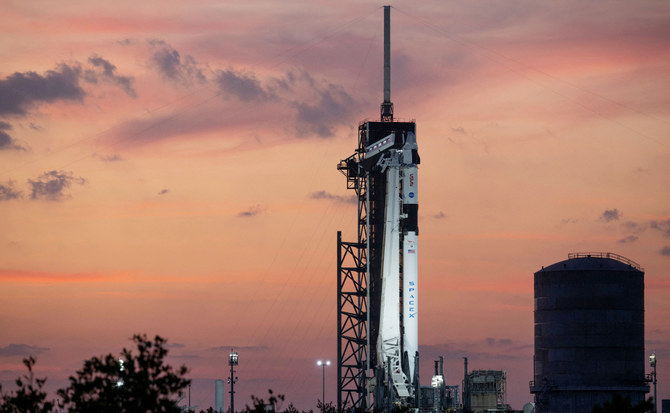
In this handout provided by the US National Aeronautics and Space Administration (NASA), A SpaceX Falcon 9 rocket with the company's Dragon spacecraft on top is seen at sunset on the launch pad at Launch Complex 39A as preparations continue for the Crew-6 mission, February 25, 2023, at NASA’s Kennedy Space Center in Florida. (AFP)
Short Url
Updated 27 February 2023
Follow

SpaceX set to launch next International Space Station crew for NASA

  • NASA said the mission’s launch readiness review was completed on Saturday, and that the flight was given a “go” to proceed to liftoff as planned

CAPE CANAVERAL, Florida: Elon Musk’s rocket company SpaceX was set to launch early on Monday the International Space Station’s next long-duration team into orbit, with an astronaut from the United Arab Emirates and a Russian cosmonaut joining two NASA crewmates for the flight.
The SpaceX launch vehicle, consisting of a Falcon 9 rocket topped with an autonomously operated Crew Dragon capsule called Endeavour, was set for liftoff at 1:45 a.m. EST (0645 GMT) from NASA’s Kennedy Space Center in Cape Canaveral, Florida.
The four-member crew should reach the International Space Station (ISS) about 25 hours later, on Tuesday morning, to begin a six-month mission in microgravity aboard the orbiting laboratory some 250 miles (420 km) above Earth.
Designated Crew 6, the mission marks the sixth long-term ISS team that NASA has flown aboard SpaceX since the private rocket venture founded by Musk — billionaire CEO of electric car maker Tesla and social media platform Twitter — began sending American astronauts to orbit in May 2020.
NASA said the mission’s launch readiness review was completed on Saturday, and that the flight was given a “go” to proceed to liftoff as planned.
“All systems and weather are looking good for launch,” Musk wrote on Twitter on Sunday.
The latest ISS crew is led by mission commander Stephen Bowen, 59, a onetime US Navy submarine officer who has logged more than 40 days in orbit as a veteran of three space shuttle flights and seven spacewalks.
Fellow NASA astronaut Warren “Woody” Hoburg, 37, an engineer and commercial aviator designated as the Crew 6 pilot, will be making his first spaceflight.
The Crew 6 mission also is notable for its inclusion of UAE astronaut Sultan Alneyadi, 41, only the second person from his country to fly to space and the first to launch from US soil as part of a long-duration space station team. UAE’s first-ever astronaut launched to orbit in 2019 aboard a Russian spacecraft.
Rounding out the four-man Crew 6 is Russian cosmonaut Andrey Fedyaev, 41, who like Alneyadi is an engineer and spaceflight rookie designated as a mission specialist for the team.
Fedyaev is the latest cosmonaut to fly aboard an American spacecraft under a ride-sharing deal signed in July by NASA and the Russian space agency Roscosmos, despite heightened tensions between Washington and Moscow over Russia’s invasion of Ukraine.
The Crew 6 team will be welcomed aboard the space station by seven current ISS occupants — three US NASA crew members, including commander Nicole Aunapu Mann, the first Native American woman to fly to space, along with three Russians and a Japanese astronaut.
The ISS, about the length of a football field and the largest artificial object in space, has been continuously operated by a US-Russian-led consortium that includes Canada, Japan and 11 European countries.
The outpost was conceived in part as a venture to improve relations between Washington and Moscow following the Soviet Union’s collapse and the end of Cold War rivalries that gave rise to the original US-Soviet space race in the 1950s and 1960s.
NASA-Roscosmos cooperation has been tested as never before since Russia invaded Ukraine a year ago, leading the United States to impose sweeping sanctions against Moscow while steadily increasing military aid to the Ukrainian government.
The Crew 6 mission also follows two recent mishaps in which Russian spacecraft docked to the orbiting laboratory sprang coolant leaks apparently caused micrometeoroids, tiny grains of space rock, streaking through space and striking the craft at high velocity.
One of the affected Russian vehicles was a Soyuz crew capsule that had carried two cosmonauts and an astronaut to the space station in September for a six-month mission now set to end in March. An empty replacement Soyuz to bring them home blasted off on Friday and arrived at the space station on Saturday.


World welcomes 2026 with fireworks after year of Trump and turmoil

Updated 01 January 2026
Follow

World welcomes 2026 with fireworks after year of Trump and turmoil

  • Australia holds defiant celebrations after its worst mass shooting in nearly 30 years
  • Hong Kong holds a subdued event after a deadly fire in tower blocks

PARIS, France: People around the globe toasted the end of 2025 on Wednesday, bidding farewell to one of the hottest years on record, packed with Trump tariffs, a Gaza truce and vain hopes for peace in Ukraine.
Russian President Vladimir Putin used his traditional New Year address to tell his compatriots their military “heroes” would deliver victory in Europe’s deadliest conflict since World War II, while his Ukrainian counterpart Volodymyr Zelensky said his country was “10 percent” away from a deal to end the fighting.
Earlier, New Year celebrations took on a somber tone in Sydney as revellers held a minute of silence for victims of the Bondi Beach shooting before nine tons of fireworks lit up the harbor city at the stroke of midnight.
Seeing in the New Year in Moscow, Natalia Spirina, a pensioner from the central city of Ulyanovsk, said that in 2026 she hoped for “our military operation to end as soon as possible, for the guys to come home and for peace and stability to finally be established in Russia.”
Over the border in Vyshgorod, Ukrainian beauty salon manager Daria Lushchyk said the war had made her work “hell” — but that her clients were still coming regardless.
“Nothing can stop our Ukrainian girls from coming in and getting themselves glam,” Lushchyk said.
Back in Sydney, heavily armed police patrolled among hundreds of thousands of people lining the shore barely two weeks after a father and son allegedly opened fire on a Jewish festival at Bondi Beach, killing 15 people in Australia’s deadliest mass shooting for almost 30 years.
Parties paused for a minute of silence an hour before midnight, with the famed Sydney Harbor Bridge bathed in white light to symbolize peace.
Pacific nations including Kiribati and New Zealand were the first to see in 2026, with Seoul and Tokyo following Sydney in celebrations that will stretch to glitzy New York via Scotland’s Hogmanay festival.
More than two million people are expected to pack Rio de Janeiro’s Copacabana Beach for what authorities have called the world’s biggest New Year’s Eve party.
In Hong Kong, a major New Year fireworks display planned for Victoria Harbor was canceled in homage to 161 people killed in a fire in November that engulfed several apartment blocks.

Truce and tariffs 

This year has brought a mix of stress and excitement for many, war for others still — and offbeat trends, with Labubu dolls becoming a worldwide craze.
Thieves plundered the Louvre in a daring heist, and K-pop heartthrobs BTS made their long-awaited return.
The world lost pioneering zoologist Jane Goodall, the Vatican chose a new, American, pope and the assassination of right-wing activist Charlie Kirk laid bare America’s deep political divisions.
Donald Trump returned as US president in January, launching a tariff blitz that sent global markets into meltdown.
Trump used his Truth Social platform to lash out at his sliding approval ratings ahead of midterm elections to be held in November.
“Isn’t it nice to have a STRONG BORDER, No Inflation, a powerful Military, and great Economy??? Happy New Year!” he wrote.
After two years of war that left much of the Gaza Strip in ruins, US pressure helped land a fragile ceasefire between Israel and Hamas in October — though both sides have accused each other of flagrant violations.
“We bid farewell to 2025 with deep sorrow and grief,” said Gaza City resident Shireen Al-Kayali. “We lost a lot of people and our possessions. We lived a difficult and harsh life, displaced from one city to another, under bombardment and in terror.”
In contrast, there was optimism despite abiding internal challenges in Syria, where residents of the capital Damascus celebrated a full year since the fall of Bashar Assad.
“There is no fear, the people are happy, all of Syria is one and united, and God willing ... it will be a good year for the people and the wise leadership,” marketing manager Sahar Al-Said, 33, told AFP against a backdrop of ringing bells near Damascus’s Bab Touma neighborhood.
“I hope, God willing, that we will love each other. Loving each other is enough,” said Bashar Al-Qaderi, 28.

Sports, space and AI

In Dubai, thousands of revellers queued for up to nine hours for a spectacular fireworks and laser display at the Burj Khalifa, the world’s tallest building.
After a build-up featuring jet skis and floating pianos on an adjacent lake, a 10-minute burst of pyrotechnics and LED effects lit up the needle-shaped, 828-meter tall (2,717-feet) tower.
The coming 12 months promise to be full of sports, space and questions over artificial intelligence.
NASA’s Artemis II mission, backed by tech titan Elon Musk, will launch a crewed spacecraft to circle the moon during a 10-day flight, more than 50 years since the last Apollo lunar mission.
After years of unbridled enthusiasm, AI is facing scrutiny and nervous investors are questioning whether the boom might now resemble a market bubble.
Athletes will gather in Italy in February for the Milano Cortina Winter Olympics.
And for a few weeks in June and July, 48 nations will compete in the biggest football World Cup in history in the United States, Mexico and Canada.