

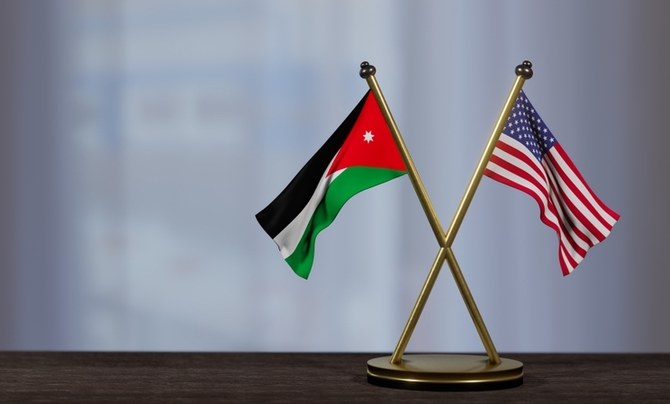
Jordan, US trade balance records $881m surplus in 2022   

The value of Jordan's imports from the US also increased in 2022 by 7.3 percent, to about 1.060 billion dinars, compared to 988 million dinars in 2021. (Shutterstock) 
Short Url
Updated 26 February 2023
Follow

Jordan, US trade balance records $881m surplus in 2022   

RIYADH: The trade balance between Jordan and the US has recorded a surplus of about 625 million Jordanian dinars ($881 million) in 2022, according to a statement.   

The volume of trade exchange between the two countries last year amounted to about 2.75 billion dinars, according to foreign trade data issued by the Department of Statistics in Jordan. Moreover, the value of exports from Jordan to the US has surged over the past year, to about 1.685 billion dinars.   

This figure reflects a 6.2 percent increase when compared to about 1.586 billion dinars back in 2021.  

Similarly, the value of Jordan's imports from the US also increased in 2022 by 7.3 percent, to about 1.060 billion dinars, compared to 988 million dinars in 2021.  

The free trade agreement between Jordan and the US entered into full force in January 2010, and provides for exemption from customs duties for Jordanian exports in an attempt to raise trade exchange between the two countries.  

Last month, King Abdullah of Jordan and the country’s foreign minister, Ayman Safadi greeted a delegation from Business Executives for National Security, the Jordan News Agency reported.    

BENS is an American nonprofit, nonpartisan network of business and industry executives that was founded in 1982, to help address security challenges in the US through business practices.   

During the meeting at Al-Husseiniya Palace in Amman, King Abdullah praised the strong, strategic relationship between Jordan and the US, expressing his desire to further strengthen it in all sectors.   

He highlighted the importance of expanding cooperation to address global challenges, particularly those related to food security, energy, and climate change. The participants also discussed recent regional and international developments.    

The BENS delegation also met Yousef Huneiti, chairperson of the Joint Chiefs of Staff of the Jordanian Armed Forces, with whom they discussed opportunities for cooperation. 


Non-hydrocarbon sector drives Qatar’s 2.9% growth in Q3 

Updated 37 sec ago
Follow

Non-hydrocarbon sector drives Qatar’s 2.9% growth in Q3 

RIYADH: Qatar’s real gross domestic product increased by 2.9 percent year on year in the third quarter of 2025, supported primarily by strong performance in the non-hydrocarbon sector, which recorded growth of 4.4 percent. 

Data released by the National Planning Council show that estimated GDP at constant prices reached 186.1 billion Qatari riyals ($51 billion) in the third quarter of 2025, up from 180.9 billion riyals during the same period last year, according to figures cited by the Qatar News Agency. 

This outcome is consistent with recent analysis by the International Monetary Fund, which noted that economies across the Gulf Cooperation Council are expected to sustain growth momentum despite heightened global uncertainty. The IMF attributed this resilience to robust non-oil activity, firm domestic demand, and the continued rollout of structural reforms across the region. 

The results also align with the IMF’s forecast that overall GCC output will accelerate to an average of 3.3 percent in 2025, compared with 1.7 percent in 2024, as member states gradually unwind oil production cuts agreed under the OPEC+ framework. 

According to QNA, non-hydrocarbon activities accounted for 65.5 percent of real GDP, with value added rising to 121.9 billion riyals in the third quarter of 2025, compared with 116.8 billion riyals in the corresponding period of 2024. This represents an annual increase of 4.4 percent and remains in line with the goals of the Third National Development Strategy and Qatar National Vision 2030. 

Within the non-hydrocarbon economy, construction, wholesale and retail trade, repair of motor vehicles and motorcycles, as well as accommodation and food service activities, emerged as the fastest-growing sectors on an annual basis, expanding by 9.1 percent, 8.9 percent, and 6.4 percent, respectively. 

The statement added that this growth reflects stronger domestic demand, increased visitor activity, and the continued execution of infrastructure and public sector projects, with positive spillover effects across services and trade-related industries. 

NPC Secretary-General Abdulaziz bin Nasser bin Mubarak Al-Khalifa said the results underscore “the strength of the Qatari economy and the continuation of the economic diversification path,” noting that real growth driven by non-hydrocarbon activities confirms the effectiveness of economic and development policies. He added that these policies are enhancing the contribution of productive and service sectors in line with the Third National Development Strategy and reinforcing the national economy’s capacity to achieve sustainable and balanced growth over the medium and long term. 

During the third quarter, 15 out of 17 economic activities recorded positive real growth, highlighting the breadth and resilience of Qatar’s economic base. 

The National Statistics Centre, which operates under the NPC, continues to enhance GDP measurement methodologies, with recent revisions applied to third quarter estimates. 

As part of broader efforts to align national accounts with international best practices, a comprehensive review of Qatar’s national accounts is currently underway and is expected to be completed by the first quarter of 2026.