

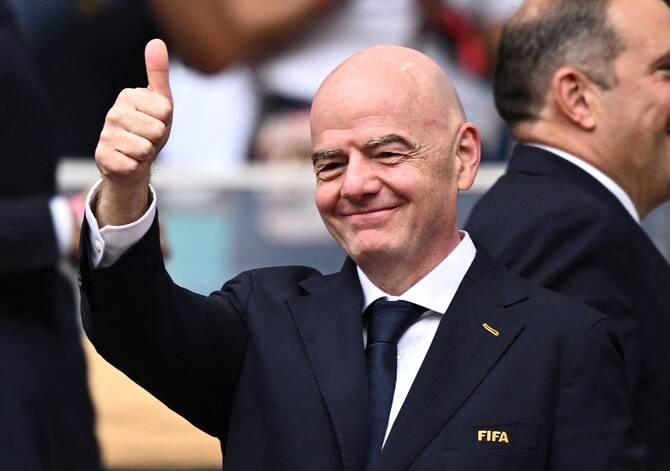

FIFA President Gianni Infantino’s suggestion that the World Cup could eventually expand to 64 teams has reignited one of football’s biggest debates.
Critics argue that another expansion would dilute the competition, weaken the qualifying process and create major logistical challenges for host nations. Supporters believe it would make the World Cup more representative of the global game and give more countries the opportunity to compete on football’s biggest stage.
Whatever FIFA ultimately decides, the first 48-team World Cup has given Infantino something he did not have before: evidence.
When FIFA approved the expansion from 32 to 48 teams in 2017, many questioned whether the tournament would lose some of its prestige. Would there be too many mismatches? Would qualification become less meaningful? Would the overall quality suffer?
Instead, the tournament has produced compelling evidence that opening the door to more nations can enrich the competition without sacrificing its drama or competitive edge.
Few matches illustrated that better than Egypt’s dramatic Round of 16 defeat to Argentina.
The Pharaohs came within minutes of eliminating the defending champions before Argentina fought back to claim a thrilling 3-2 victory in one of the tournament’s defining matches.
The drama continued after the final whistle, with Egyptian supporters questioning a disallowed Mostafa Ziko goal and a late penalty appeal involving Mohamed Salah. The controversy only added to one of the tournament’s most memorable knockout ties.
Whatever side fans take on those decisions, one thing is beyond dispute: Egypt produced one of the defining matches of the World Cup.
If Egypt delivered one of the tournament’s greatest spectacles, Cabo Verde became the clearest example of what FIFA hoped expansion would achieve.
Making their World Cup debut, the island nation of just over half a million people captured the imagination of football fans around the world. After progressing from the group stage, the Blue Sharks pushed Argentina all the way in a thrilling 3-2 defeat before leaving the tournament with enormous pride.
For a country appearing on football’s biggest stage for the first time, simply competing toe-to-toe with the defending champions represented a historic achievement.
Cabo Verde may ultimately become one of the defining success stories of the expanded format. Their success formed part of a much broader African story.
Infantino himself has pointed to Africa’s performances as evidence that the 48-team format has delivered, noting that nine of the continent’s 10 representatives progressed to the knockout stages, compared with only five African participants at the previous World Cup.
The statistic strengthens his central argument that expansion has not simply created more places, but more meaningful opportunities.
Egypt’s memorable run, Cabo Verde’s remarkable debut and Morocco’s second consecutive deep World Cup campaign formed part of a wider African success story that few predicted before the tournament began.
Morocco once again showed that its historic run to the semifinals in Qatar was no one-off, reinforcing its emergence as one of world football’s new powers ahead of co-hosting the 2030 World Cup.
Rather than simply making up the numbers, African nations challenged traditional powers, produced some of the tournament’s most compelling stories and demonstrated the continent’s growing strength on the world stage.
The success of this World Cup has not been limited to Africa.
Norway’s victory over Brazil signaled the return of one of Europe’s sleeping giants, while Switzerland equaled their best-ever World Cup finish by reaching the quarterfinals for the first time since 1954. Even in defeat, Switzerland pushed Argentina into extra time before eventually losing 3-1 with 10 men.
Not every memorable story exists because of expansion. Together, however, they have produced a World Cup that feels broader, richer and more representative of the global game than many expected.
That does not automatically make a 64-team World Cup the right solution.
Not everyone agrees with Infantino’s position. UEFA President Aleksander Ceferin has dismissed the idea as a “bad proposal,” while Concacaf President Victor Montagliani has warned that further expansion could harm the wider football ecosystem.
A 64-team World Cup would increase the number of matches from 104 to 128, placing greater demands on players, adding further pressure to an already congested football calendar and creating significant logistical challenges for future hosts.
For the 2030 World Cup, which will be staged primarily across Spain, Portugal and Morocco, with opening matches in Argentina, Uruguay and Paraguay, a larger tournament would place even greater pressure on venues, travel arrangements and scheduling.
For football fans, the prospect of more World Cup matches is undeniably appealing. But that excitement must be weighed against the realities of player welfare, an increasingly crowded football calendar and the demands placed on future hosts.
Whether 64 teams is the right next step remains open to debate.
What this World Cup has shown, however, is that expanding to 48 teams has enriched the tournament rather than diminished it, giving Infantino a far stronger case for further expansion than he had before the 2026 World Cup.


